Prolonged Separation and Lack of Cohabitation Constitute Desertion: SC
 Copy Link
 Share
Share Save
Save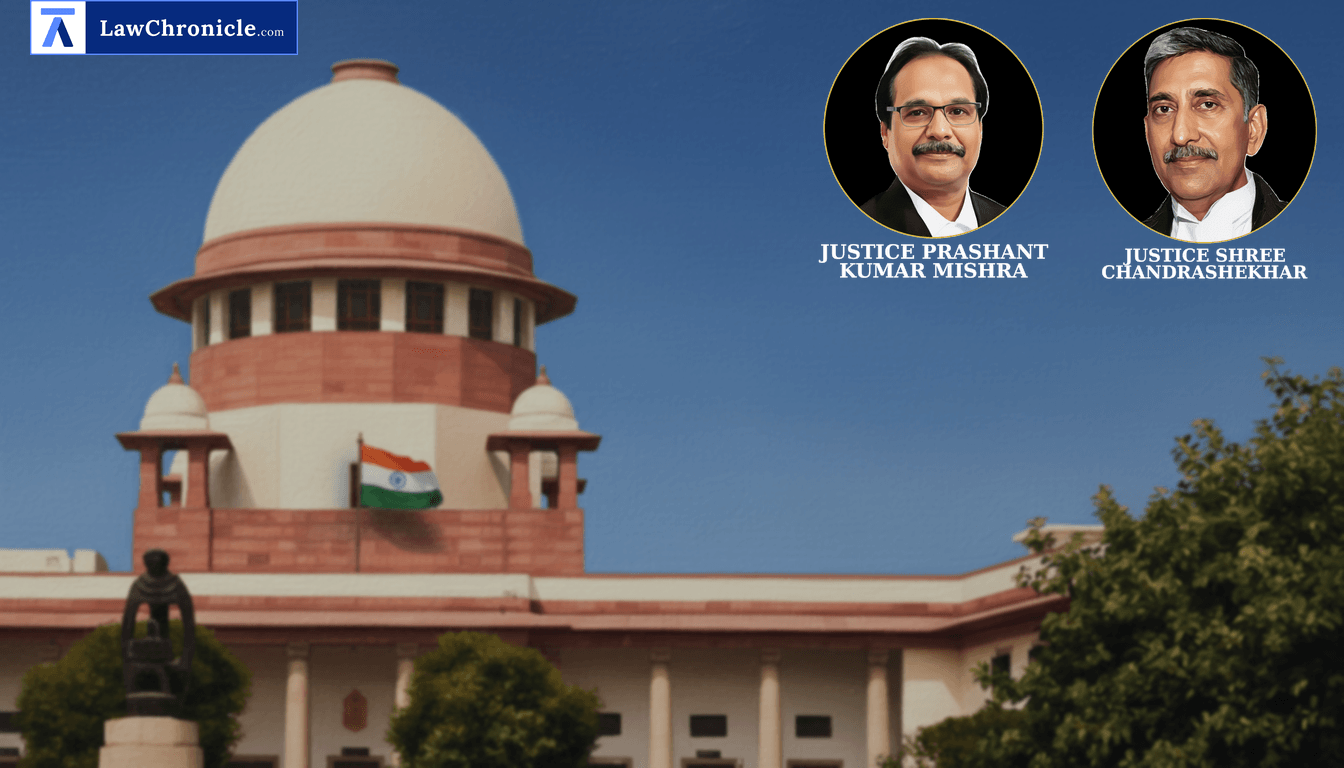
Where long-standing matrimonial separation is coupled with a refusal to resume cohabitation without reasonable cause, a spouse cannot evade a decree of divorce by merely offering oral assertions of willingness to discharge marital obligations. Dismantling passive defenses against divorce petitions, the Supreme Court ruled that actual conduct overriding verbal willingness establishes animus deserendi to dissolve broken matrimonial ties.
An appellate bench comprising Justice Prashant Kumar Mishra and Justice Shree Chandrashekhar delivered the judgment while hearing a civil appeal challenging the High Court's dismissal of a divorce petition filed by a husband on the grounds of cruelty and desertion under Section 13 of the Hindu Marriage Act, 1955.
Key Takeaways
- Conduct Overrides Mere Assertions: Oral claims by a spouse expressing readiness to fulfil marital duties carry no weight when their actual conduct demonstrates continuous refusal to cohabit.
- Significance of Prolonged Separation: Extended periods of physical separation serve as vital evidence in determining whether a marriage has completely collapsed beyond repair.
- Proof of Animus Deserendi: Refusing to return to the matrimonial home without a valid reason satisfies the intention to permanently end cohabitation.
The Supreme Court set aside the High Court's findings on desertion and granted a decree of divorce dissolving the wedlock. The Court issued the following directions:
"i. The Appeal is, accordingly, partly allowed by setting aside that part of the impugned judgment by which the High Court interfered with the observation of the Trial Court on the ground of desertion and held that the element of desertion was not proved qua the respondent-wife. The finding of the Trial Court and the High Court on the ground of cruelty is not disturbed.
ii. Accordingly, the marriage between the appellant-Bijendra and the respondent-Rekha solemnized on 23.06.2003 is hereby dissolved by a decree of divorce under Section 13(1)(ib) of the HMA.
iii. The appellant-husband shall pay a sum of Rs.7,00,000/- (Rupees Seven Lakhs only) towards permanent alimony to the respondent-wife by depositing the same before the Trial Court within a period of three months from today, failing which the respondent-wife can initiate execution for recovery of the said amount. If the amount is not paid within three months as directed above, it shall carry interest at the rate of 9% per annum.
iv. No order as to costs.
v. Registry to draw the decree accordingly."
The Court, in its reasoning, observed: "In the present case before us, the fact remains that the parties are living separately and even though the respondent has asserted in her deposition that she was ready to discharge her marital obligations, however, mere assertion cannot be sufficient when the conduct reflects otherwise. Considering that it was proven before the Trial Court that the parties had not cohabited with each other since December 2005, in our view, the High Court was wrong in inferring that there was no intention on the part of the respondent to desert the appellant."
Ratio
To establish desertion under Section 13(1)(ib) of the Hindu Marriage Act, 1955, there must be a combination of physical separation (factum desertionis) and an intention to permanently end cohabitation (animus deserendi). When physical separation is established and one spouse refuses to resume cohabitation without reasonable cause, an intention to desert is legally inferred, regardless of contrary oral assertions made during court proceedings.
Background
The parties were married on June 23, 2003. Shortly after the marriage, disputes arose, and the husband alleged that the wife insulted him, refused to cohabit, and eventually left for her parental home on November 30, 2005. When the husband attempted to bring her back on December 15, 2005, she refused to return. The parties remained continuously separated since then.
In 2007, the husband filed a divorce petition under Section 13 of the Hindu Marriage Act, 1955 alleging cruelty and desertion. The Trial Court held that while cruelty was not adequately established, the wife had deserted the husband since December 15, 2005. However, the Trial Court declined to grant divorce on the sole ground of separate living. The husband then approached the High Court under Section 28 of the Hindu Marriage Act, 1955. The High Court dismissed the appeal, holding that mere separation did not amount to desertion and that the husband failed to prove animus deserendi, relying on the precedent in Lachman Utamchand Kirpalani v. Meena alias Mota ( "(1964) 4 SCR 331": 1963 CaseBase(SC) 107).
During the appeal before the Supreme Court, mediation efforts failed. The Apex Court examined precedents including Naveen Kohli v. Neelu Kohli ( "(2006) 4 SCC 558": 2006 CaseBase(SC) 239), Savitri Pandey v. Prem Chandra Pandey ( "(2002) 2 SCC 73": 2002 CaseBase(SC) 597), and Shilpa Sailesh v. Varun Sreenivasan ( "(2023) 14 SCC 231": 2023 CaseBase(SC) 872) regarding broken matrimonial bonds and elements of desertion. The Supreme Court observed that the High Court erred in ignoring the wife's active refusal to return despite the husband's efforts. While upholding the findings on cruelty, the Apex Court allowed the appeal on the ground of desertion under Section 13(1)(ib) of the Hindu Marriage Act, 1955 and ordered permanent alimony of Rs. 7,00,000 to be paid by the husband within three months.
Case Details:
Case No.: CIVIL APPEAL NO. 10249 OF 2014
Neutral Citation: 2026 INSC 939
Case Title: BIJENDRA v. REKHA
Source: 2026 CaseBase(SC) 905
 Breaking News