Proof of Demand Must Precede Voluntary Acceptance of Illegal Gratification: SC
 Copy Link
 Share
 Save
Striking a heavy blow to mechanical corruption prosecutions, the Supreme Court has ruled that mere recovery of marked currency notes without primary proof of demand cannot sustain a conviction under anti-corruption law. Reaffirming that statutory presumption cannot substitute missing foundational facts, the Apex Court acquitted a former Tehsildar after finding the underlying official work was already completed before the alleged trap.
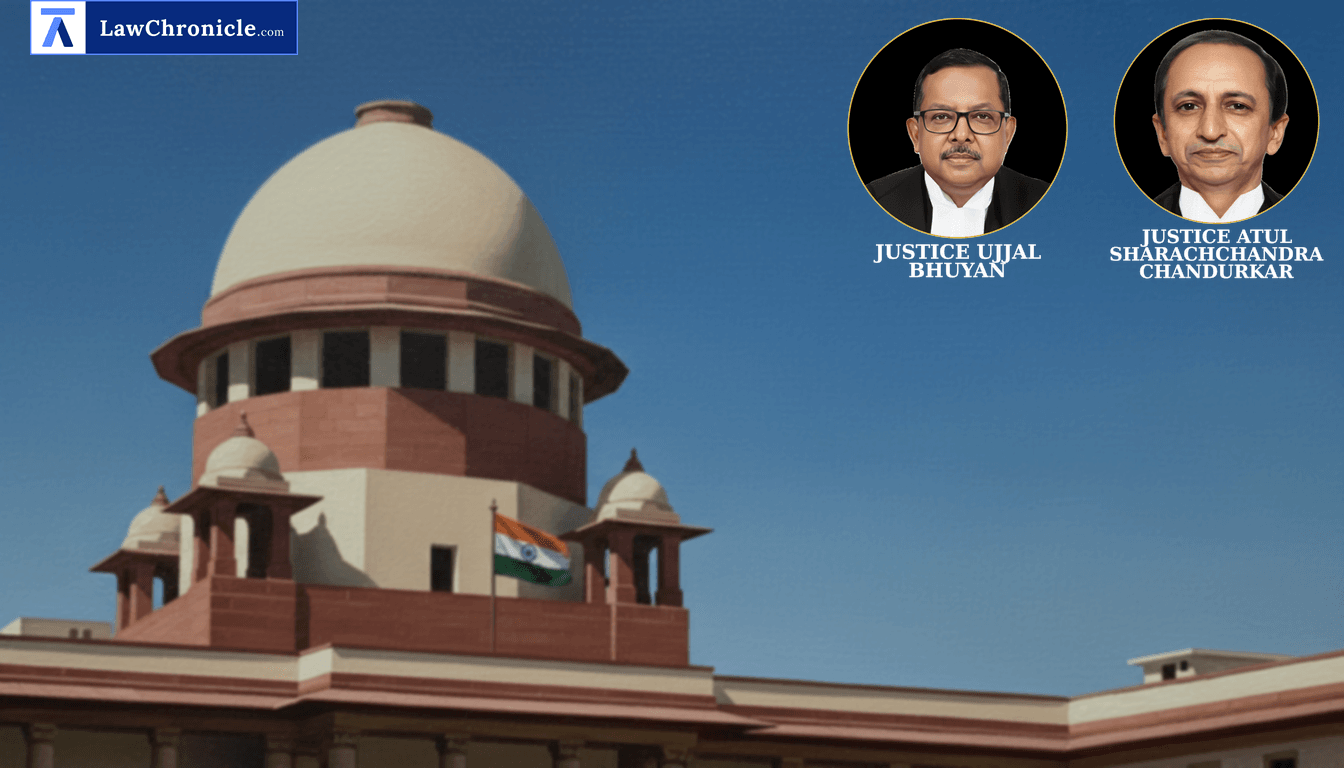
A Division Bench comprising Justice Ujjal Bhuyan and Justice Atul S. Chandurkar set aside the conviction of a former public servant under the Prevention Of Corruption Act, 1988, emphasizing that proof of prior demand for illegal gratification remains an indispensable prerequisite to trigger statutory presumptions.
Key Takeaways
- Proof of Demand Is Gravamen: Recovery of tainted currency notes alone, absent proof of demand, is legally insufficient to establish guilt under Section 7 and Section 13(1)(d) of the Prevention Of Corruption Act, 1988.
- Hearsay Trap Evidence Inadmissible: Statements of trap officers relaying what deceased shadow witnesses saw or heard constitute inadmissible hearsay evidence.
- Presumption Requires Foundational Proof: Statutory presumption under Section 20 of the Prevention Of Corruption Act, 1988 cannot be invoked unless the prosecution independently proves both demand and voluntary acceptance beyond reasonable doubt.
- Standard of Rebuttal for Accused: The defense is only required to rebut statutory presumptions on the touchstone of preponderance of probabilities, not beyond reasonable doubt.
Court Observations and Rationale
The Supreme Court observed that both the trial court and the High Court erred in relying on Section 20 of the Prevention Of Corruption Act, 1988 to presume guilt without establishing the foundational requirements of demand and voluntary acceptance. The Bench highlighted that with both the complainant and the shadow witness having passed away prior to trial, the testimony of the trap officer regarding the conversation was purely hearsay. It observed that "The presumption under Section 20 can be invoked only when the two basic facts required to be proved under Section 7, are proved. The said two basic facts are ‘demand’ and ‘acceptance’ of gratification... Merely recovery of tainted currency notes, absent proof of demand, cannot sustain a conviction under Sections 7 and 13(1)(d) of the PC Act."
Tracing the established legal framework, the Supreme Court analyzed Neeraj Dutta Vs. State (Government of NCT of Delhi) and Neeraj Dutta Vs. State (Government of NCT of Delhi), highlighting that while the absence of a deceased complainant does not automatically abate a trial, the prosecution must still establish demand through corroborative or circumstantial evidence. Referring to State of Uttar Pradesh Vs. A.K. Gaba, Jaswinder Singh Vs. State of Punjab ( "2026 SCC OnLine SC 1952": 2026 CaseBase(SC) 2095), and P. Satyanarayana Murthy Vs. State of A.P., the Bench reiterated that failure to prove demand for illegal gratification is fatal to the prosecution's case.
The Bench further reviewed precedents cited by the respondent State, including Aman Bhatia Vs. State, noting that statutory presumptions remain strictly rebuttable and contingent upon initial proof of conscious acceptance.
Ratio
Proof of demand of illegal gratification is a sine qua non for establishing offences under Section 7 and Section 13(1)(d) of the Prevention Of Corruption Act, 1988. In the absence of primary or reliable circumstantial proof establishing demand and voluntary acceptance, no statutory presumption under Section 20 of the Prevention Of Corruption Act, 1988 can be drawn against an accused public servant based solely on the recovery of tainted money.
Background
The dispute originated from a labour court award directing a firm to pay pending wages to the complainant. The execution file was forwarded to the office of the appellant, who was then serving as Tehsildar, Kotwali. The complainant alleged that the appellant demanded a bribe of Rs. 3,000 to process the file and subsequently demanded an additional Rs. 1,000 on January 6, 2003, prompting a trap by the Anti-Corruption Bureau.
During the trap, two phenolphthalein-treated Rs. 500 currency notes were recovered from the coat pocket of the appellant, and hand-wash tests turned pink. However, during the trial under the Code Of Criminal Procedure, 1973, both the complainant and the shadow witness died before recording their evidence. The Special Judge convicted the appellant under Sections 7 and 13(1)(d) read with Section 13(2) of the Prevention Of Corruption Act, 1988, sentencing him to two years of rigorous imprisonment, which the High Court of Delhi later affirmed while reducing the imprisonment to one year.
On appeal, the Supreme Court examined official records which revealed that the recovery cheques had already been dispatched by the appellant's office to the Labour Department on December 28, 2002, and received there on January 1, 2003, days before the alleged trap on January 6, 2003. Finding no pending official work and holding the trap officer's testimony to be hearsay regarding the demand, the Supreme Court held that the appellant successfully raised a plausible defense on preponderance of probabilities. Consequently, the Supreme Court set aside the conviction and acquitted the appellant.
Case Details:
Case No.: Criminal Appeal No. 571 of 2015
Neutral Citation: 2026 INSC 1230
Case Title: Har Parsad Gaur v. State (NCT of Delhi)
Appearances:
For the Petitioner(s): Mr. Parthiv K Goswami, Senior Counsel
For the Respondent(s): Dr. Nachiketa Joshi, Senior Counsel
Source: 2026 CaseBase(SC) 10296
 Breaking News