Punjab and Haryana HC Awards Over ₹31 Lakh in Uninsured Motor Accident Claim
 Copy Link
 Share
 Save
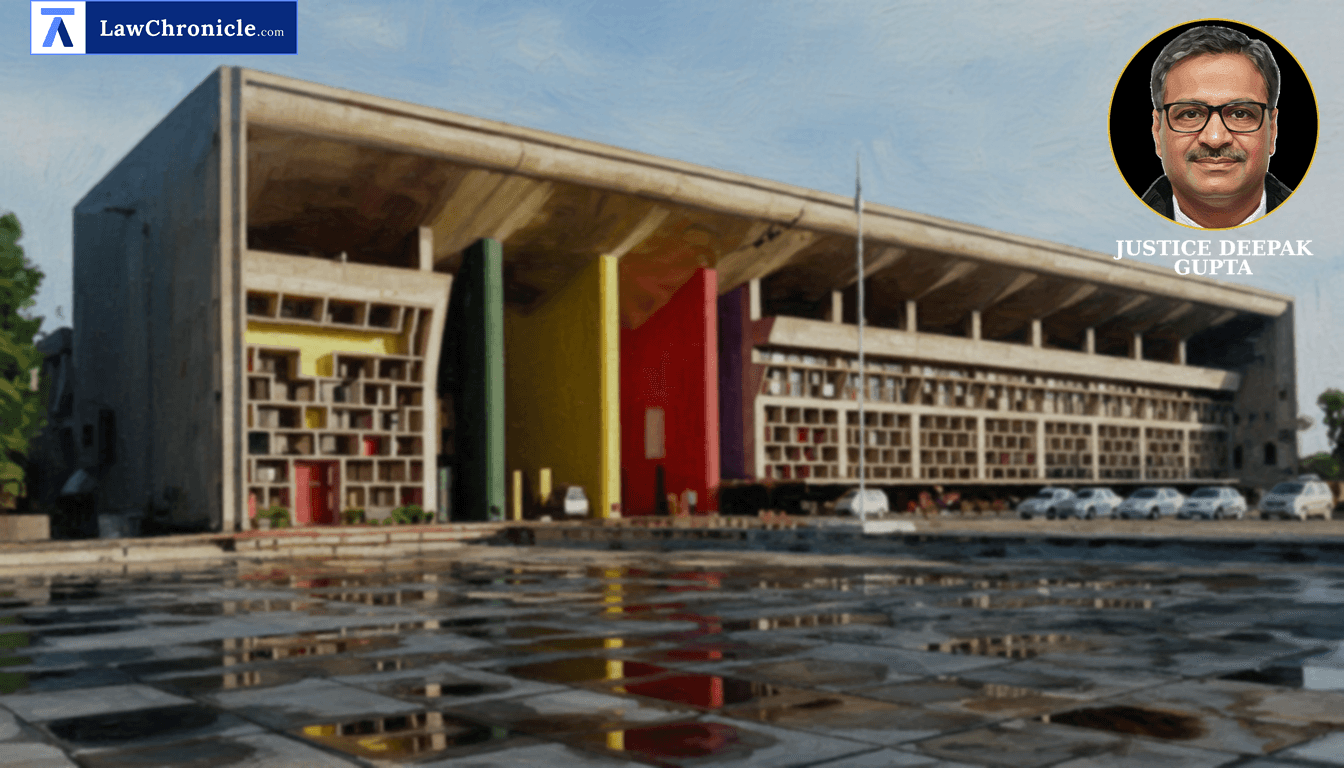
The Punjab and Haryana High Court has overturned a fifteen-year-old Tribunal decision, ruling that the 'preponderance of probabilities' must guide motor accident claims rather than the stringent standard of 'beyond reasonable doubt' applicable in criminal trials.
Justice Deepak Gupta, while hearing an appeal preferred by the widow and minor children of a deceased Lecturer, set aside the findings of the Motor Accidents Claims Tribunal (MACT), Karnal. The Bench found that the Tribunal had adopted an "unduly technical approach" in dismissing the claim petition merely because the involvement of the offending motorcycle was disputed.
Key Takeaways
Standard of Proof Deciphered
Claims under the [Motor Vehicles Act, 1988 are to be decided on the touchstone of preponderance of probabilities, significantly lower than the criminal standard of proof.
Liability of Uninsured Vehicles
In cases involving uninsured vehicles, the driver and owner remain jointly and severally liable to personally satisfy the award, emphasizing the risk of operating vehicles without valid insurance.
Credibility of Eyewitnesses
Direct testimony of a witness cannot be discarded solely due to their acquaintance with the deceased or minor inconsistencies, provided their presence at the spot is probable.
Future Prospects for Permanent Employees
Determining compensation for permanent government employees must include a mandatory addition for future prospects based on their age at the time of the accident.
Court's Rationale on Proof and Evidence
The Punjab and Haryana High Court observed that the beneficial nature of the law requires a holistic assessment of evidence. Relying on Bimla Devi and others v. Himachal Road Transport Corporation and others ( "(2009) 13 SCC 530": 2009 CaseBase(SC) 631) and Sunita and others v. Rajasthan State Road Transport Corporation and another ( "(2020) 13 SCC 486": 2019 CaseBase(SC) 2094), the Bench emphasized that Tribunals must determine whether the claimants' version is "more probable" rather than seeking mathematical certainty.
The Punjab and Haryana High Court analysed that “The Tribunal appears to have attached decisive importance to discrepancies concerning the reporting of the accident and the identification of the motorcycle, without adequately considering the cumulative effect of PW-2's eyewitness account, the admitted presence of respondent No.1 on motorcycle No. HR-05-P-8919, and the weaknesses in the defence evidence. The evidence was required to be assessed as a whole, rather than by isolating individual discrepancies.” Regarding the identification of the vehicle, the Bench noted that while Section 279 and Section 304-A of the Indian Penal Code, 1860 proceedings do not establish civil liability, the admission by the driver regarding his presence at the scene materially narrowed the controversy.
Assessment of Quantum and Compensation
Identifying the deceased as a permanent Government Lecturer, the Punjab and Haryana High Court applied the principles from Sarla Verma v. Delhi Transport Corporation ( "(2009) 6 SCC 121": 2009 CaseBase(SC) 380) and National Insurance Company Limited v. Pranay Sethi ( "(2017) 16 SCC 680": 2017 CaseBase(SC) 551). The Bench calculated the loss of dependency after adding 30% for future prospects and deducting necessary income tax as per 2006-07 slabs. The Court further awarded sums for spousal and parental consortium, following the expanded definitions in Magma General Insurance Company Limited v. Nanu Ram alias Chuhru Ram ( "(2018) 18 SCC 130": 2018 CaseBase(SC) 597) and United India Insurance Company Limited v. Satinder Kaur alias Satwinder Kaur and others ( "(2021) 11 SCC 780": 2020 CaseBase(SC) 1774).
The Punjab and Haryana High Court eventually allowed claim under Section 166 of the Motor Vehicles Act, holding the claimants entitled to compensation of ₹31,39,108.5, together with interest at the rate of 7.5% per annum from the date of filing of the claim petition till realisation. The driver and owner of motorcycle were held jointly and severally liable to satisfy the award.
Ratio
In motor accident claim proceedings, the Tribunal is required to adopt a holistic approach and determine liability on the touchstone of preponderance of probabilities rather than proof beyond reasonable doubt. Minor discrepancies in witness statements or reporting cannot defeat a genuine claim if the cumulative evidence establishes the involvement of the offending vehicle as more probable than the alternative version.
Background
The case originated from a 2006 accident where Bishambar, a Lecturer in Electrical Engineering, was struck by a motorcycle. He succumbed to his injuries three days later. The widow and children filed a petition under the Motor Vehicles Act, 1988, but the MACT Karnal dismissed it in 2011, citing failure to establish the identity of the offending vehicle. The claimants appealed to the High Court, leading additional evidence including medical records and employment certificates.
The Punjab and Haryana High Court scrutinized the testimony of PW-2, an eyewitness who was 20 yards behind the deceased, and compared it with the contradictory defence of the respondent, who admitted being on the motorcycle at the time but denied the collision. The Bench found the eyewitness account more probable and set aside the dismissal, awarding the family full compensation with interest.
Case Details:
Case No.: FAO-4416-2011
Case Title: Sudesh Kumari and others v. Lakhvinder Singh and others
Appearances:
For the Petitioner(s): Mr. Devyansh, Advocate for Mr. Nischal Chetanya Manchanda, Advocate
For the Respondent(s): Ex-parte
Source: 2026 CaseBase(PNH) 30025
 Breaking News