


Purchaser Cannot Be Prosecuted For Forgery Or Cheating If Vendor Used Faked Will: Supreme Court
 Copy Link
 Share
 Save
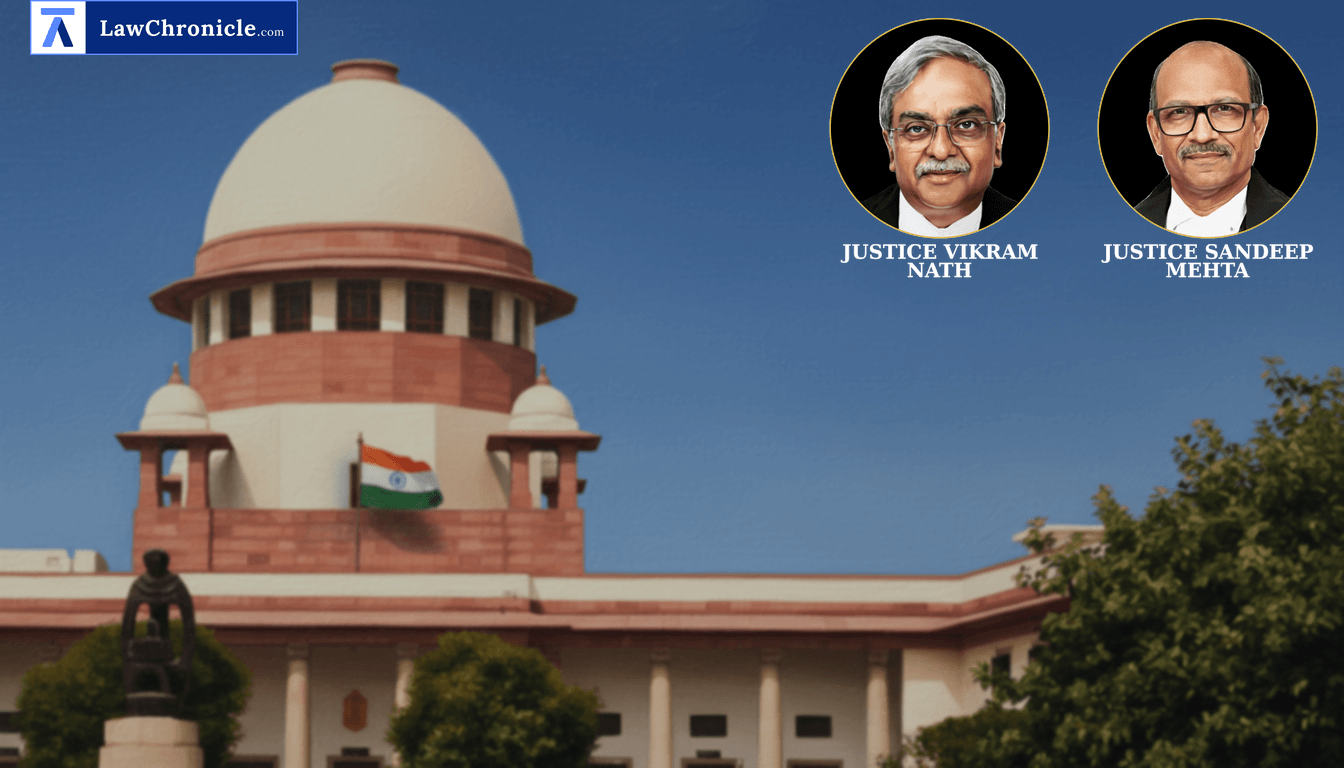
The Supreme Court has clarified that a bona fide purchaser of a property cannot be held liable for criminal conspiracy or cheating merely because the vendor allegedly used a forged Will to establish title, especially when the purchaser was not involved in the fabrication of the document. The bench of Justice Vikram Nath and Justice Sandeep Mehta quashed the criminal proceedings against an appellant who had purchased land through a registered sale deed, noting that the continuation of such a prosecution would amount to a gross abuse of the judicial process.
While hearing an appeal against a Madras High Court order that refused to quash proceedings under Section 482 of the Code of Criminal Procedure, 1973, the Court examined whether a subsequent purchaser could be charged for the alleged forgery of a Will executed years prior to the sale. The Court emphasized that if a Will is indeed forged, the purchasers are often the aggrieved parties themselves as their title becomes clouded.
The Quashing of Criminal Proceedings
Summarizing the main holding, the Court observed that there was no tangible material to connect the appellant to the alleged conspiracy of creating a forged Will in 1988. The Court noted that the appellant was a minor at the time of the Will's execution and a student abroad during the property purchase in 1998. The Court has the following directions:
"The impugned order dated 11th August, 2022 is set aside. As a consequence, all proceedings qua the appellant only pending in C.C. No.419 of 2018 in the Court of learned Judicial Magistrate No.II, Karur, are hereby quashed. However, it is made clear that the proceedings shall continue against the other accused."
Rationale on Third-Party Complaints and Forgery
The Court, in its reasoning, observed: "When a sale deed is executed conveying a property claiming ownership thereto, it may be possible for the purchaser under such sale deed to allege that the vendor has cheated him by making a false representation of ownership and fraudulently induced him to part with the sale consideration. But in this case the complaint is not by the purchaser. On the other hand, the purchaser is made a co-accused... a third party who is not the purchaser under the deed may not be able to make such complaint."
The Court further highlighted the evidentiary weakness of the prosecution's case, noting that the Forensic Science Laboratory (FSL) report was based on a photocopy of the Will rather than the original document, which raised serious doubts about its persuasive worth.
Background:
The dispute originated from a complaint filed by Respondent No. 2, alleging that his brother (A-1) had joined hands with several others to fabricate a Will dated September 12, 1988, purportedly executed by their deceased father. It was alleged that A-1 used this forged Will to sell ancestral property to the appellant and others (A-2 to A-6) via registered sale deeds in 1998. Consequently, an FIR was registered for offences under Sections 465, 468, 420, and 120-B of the Indian Penal Code, 1860.
The appellant moved the High Court seeking to quash the proceedings in C.C. No. 419 of 2018, arguing he was a bona fide purchaser who exercised due diligence. However, the High Court dismissed the petition, citing that the case involved disputed questions of fact. Reversing this, the Supreme Court relied on the principles laid down in Mohammed Ibrahim and Others v. State of Bihar and Another, holding that execution of a sale deed by a person claiming ownership is not 'making a false document' in a way that deceives a third party. The appeal was allowed, and proceedings against the appellant were quashed.
Case Details:
Case No.: Criminal Appeal No. of 2026 (Arising out of SLP (Crl.) No. 12177 of 2022)
NeutralCitation: 2026 INSC 418
Case Title: S. ANAND v. STATE OF TAMIL NADU REPRESENTED BY ITS INSPECTOR OF POLICE AND ANR.
Appearances:
For the Petitioner(s): Shri Arvind Varma, Senior Counsel
For the Respondent(s): Shri V. Krishnamurthy, Sr. AAG; Mr. A. Lakshminarayanan, Advocate
Source: 2026 CaseBase(SC) 548
Similar Articles



 Breaking News


