Quantum of Inherited Property Does Not Constitute a Substantial Question of Law: Gauhati HC
 Copy Link
 Share
Share Save
Save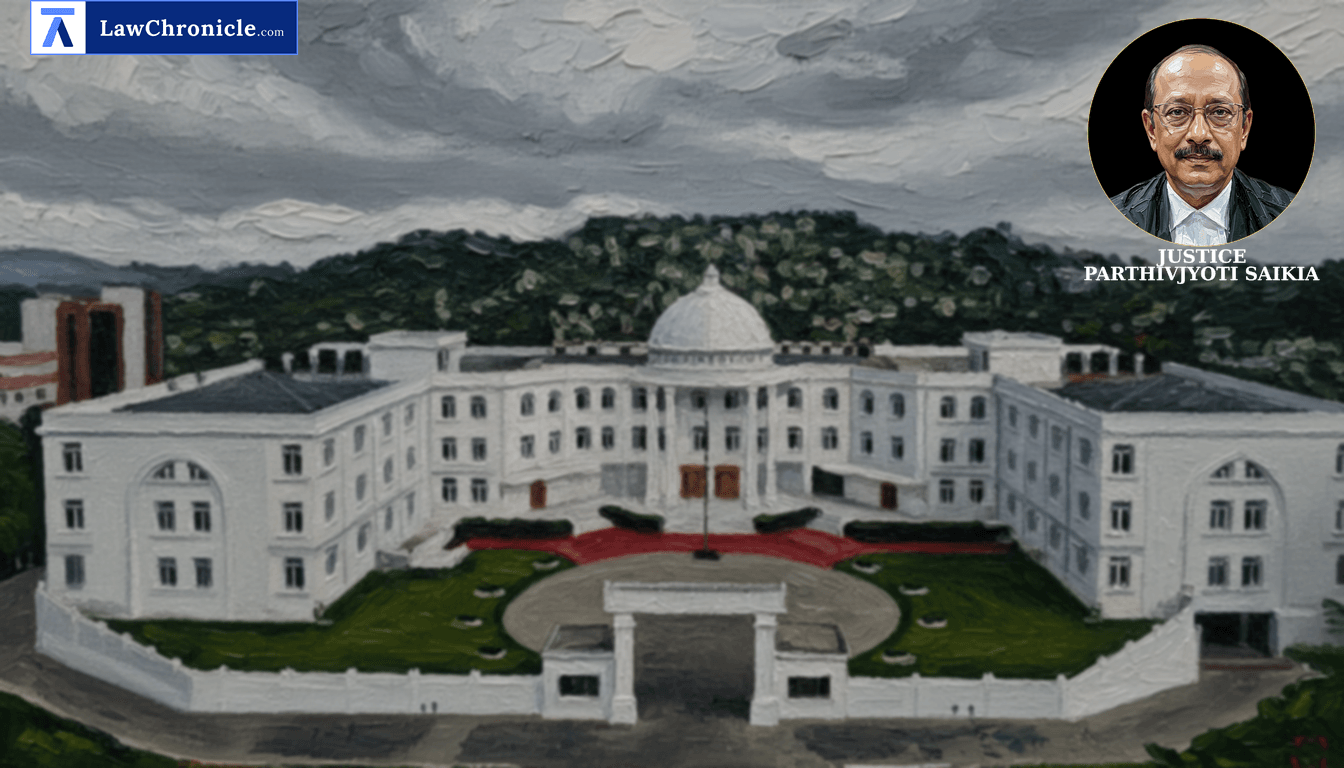
The Gauhati High Court has slammed the door on second appeals based on humanitarian grounds regarding the size of inherited land, ruling that the physical sufficiency of a share for construction does not elevate a factual grievance to a substantial question of law. This decision reinforces the stringent jurisdictional boundaries of Section 100 of the Civil Procedure Code, effectively insulating concurrent findings of fact from merit-based reappreciation in the absence of a debatable legal principle.
In a decisive ruling, Justice Parthivjyoti Saikia dismissed a regular second appeal challenging the concurrent findings of the lower courts in a partition suit. The Court addressed whether the small size of a devolved share or the school of Hindu law could constitute grounds for High Court intervention in a second appeal.
Key Takeaways
Strict Adherence to Section 100 CPC
Factual disputes, including the physical utility of partitioned land, do not qualify as substantial questions of law required for a second appeal.
Finality of Concurrent Findings
Concurrent findings of fact by the Trial Court and First Appellate Court cannot be reappreciated by the High Court unless they are proven perverse or lack legal foundation.
Humanitarian Grounds Rejected
Legal entitlements under succession law are not subject to 'humanitarian' adjustments regarding the viability of land for house construction.
Court Rejects Factual Grievances as Substantial Legal Questions
The court observed that the issues raised by the appellants, particularly regarding the size of the land left for them after accounting for an electricity transformer, were purely factual in nature. The appellants had argued that since their share was less than 2 lechas, it was insufficient for building a house, and sought to invoke Section 2 of the Partition Act, 1893 to purchase the other shares. However, the Court found no legal basis to interfere.
The Court has the following directions:
"The instant appeal has no merit at all and stands dismissed accordingly. Send back the TCR."
In its reasoning, the Court relied on the precedent set in Govindaraju v. Mariamman ( "(2005) 2 SCC 500": 2005 CaseBase(SC) 756) to define the limits of its jurisdiction. The Court, in its reasoning, observed: "I have sufficient reasons to hold that the questions of law formulated as substantial questions of law in this appeal cannot, in any way, be termed to be questions of law much less a substantial question of law. The questions formulated, in fact, are questions of facts and in a second appeal, this Court is not entitled to reappreciate the evidence. There are no substantial questions of law in this appeal."
Ratio
A question of law must be debatable, not previously settled by binding precedent, and have a material bearing on the rights of the parties to be considered a 'substantial question of law' under Section 100 of the Civil Procedure Code. The High Court cannot reappreciate evidence or entertain factual disputes disguised as legal questions in a second appeal.
Background
The dispute originated from the estate of late Gopal Dey Choudhury, who owned 10 lechas of land. Following his death and the subsequent death of his son Jayanta Dey Choudhury, the legal heirs of a deceased daughter and three other daughters claimed their shares. The appellants, being the heirs of the son, contended that a transformer occupied 2 lechas, leaving only 8 lechas to be divided among 5 parts. They argued that their resulting share would be too small for construction.
The Trial Court in T.S. No.354/2019 and the First Appellate Court in Title Appeal No.05/2020 concurrently held that the daughters were entitled to equal shares. The appellants challenged these findings in a Second Appeal, questioning the applicability of Section 6 of the Hindu Succession (Amendment) Act, 2005 to parties guided by the Dayabhaga school and alleging perversity in evidence appreciation. The High Court, however, found that these did not meet the threshold of substantial questions of law as defined in Santosh Hazari case.
Case Details:
Case No.: RSA/9/2023
Neutral Citation: 2026:GAU-AS:12773
Case Title: Sathi Dey Choudhury and Anr. v. Mita Bhattacharjee and 4 Ors.
Appearances:
For the Petitioner(s): Mr. S. Biswas, Advocate; Ms. D. Devi, Advocate
For the Respondent(s): Mr. S. Ali, Advocate; Mr. N. Bharali, Advocate; Mr. A. Bhuyan, Advocate; Mr. R. Baruah, Advocate
Source: 2026 CaseBase(GAU) 1170
 Breaking News