Quashing Proceedings Based On Settlement Requires Real Victim's Consent: SC
 Copy Link
 Share
Share Save
Save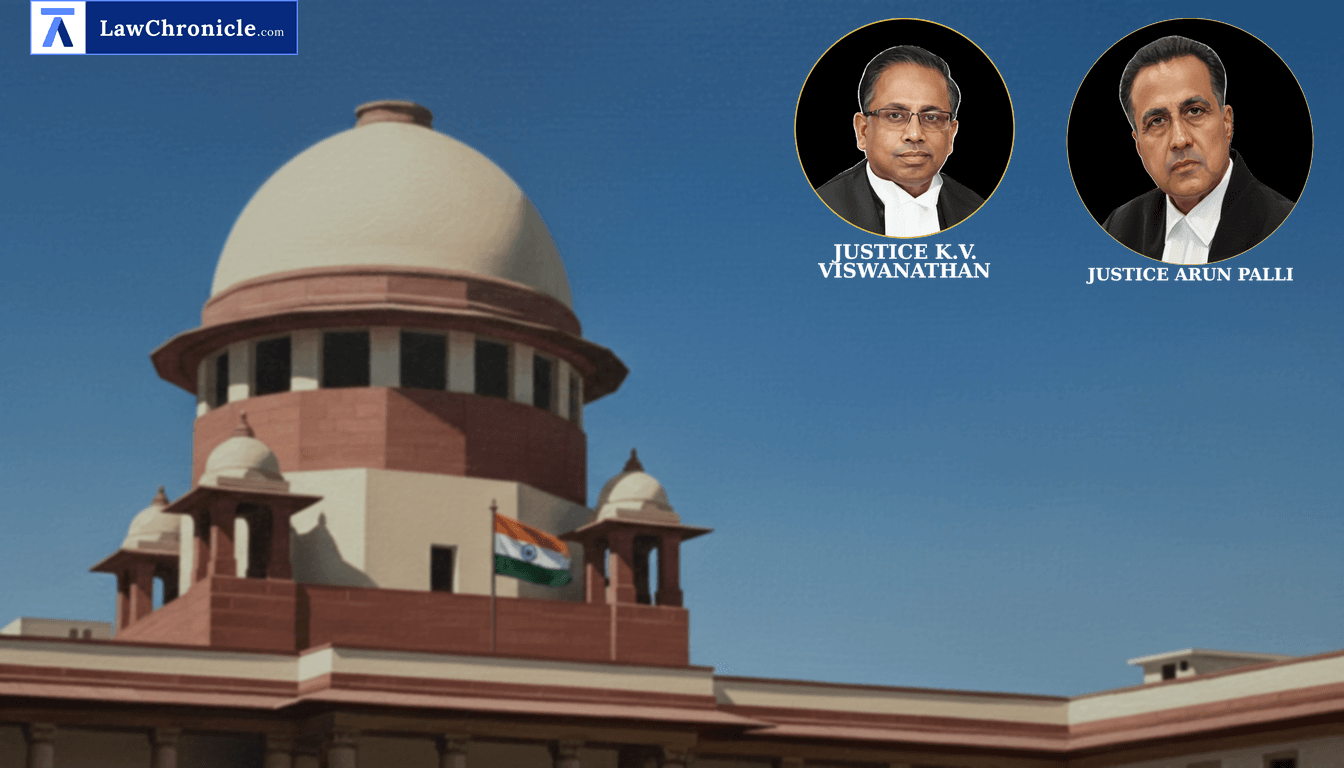
Criminal proceedings can be quashed on the basis of a settlement only if the actual victim of the crime and not merely a third-party informant is a party to the compromise. Drawing a clear distinction between a victim and a complainant, the Supreme Court ruled that allowing non-victim informants to settle disputes would lead to disastrous consequences for the real aggrieved parties.
In a judgment delivered by a Bench comprising Justice K. V. Viswanathan and Justice Arun Palli, the apex court set aside a High Court order that refused to quash criminal proceedings despite the real victim entering into a genuine settlement with the accused.
Key Takeaways
Victim Vs Informant Rights: Only the actual victim who suffered loss or injury can authorize a compromise to quash criminal proceedings under Section 482.
Compounding vs Quashing: Quashing criminal proceedings based on a settlement is distinct from compounding under statutory provisions, driven primarily by whether continuing prosecution amounts to an abuse of process.
Non-Victim Informants Barred: Third-party complainants or informants cannot hold criminal proceedings hostage or settle them independently if the primary victim has resolved the dispute.
Prevention of Judicial Clogging: Courts must weed out cases bearing commercial or civil overtones where key disputants have buried the hatchet and chances of conviction are bleak.
Court's Observations and Legal Analysis
The court emphasized that in criminal jurisprudence, the terms "victim" and "informant" carry distinct legal meanings, as recognized in Jagjeet Singh and Others vs. Ashish Mishra alias Monu and Another. It noted that Section 39 of the Code of Criminal Procedure, 1973 (corresponding to Section 33 of the Bharatiya Nagarik Suraksha Sanhita, 2023) allows any person aware of an offence to inform the police, but setting the law in motion does not automatically make an informant the victim of the crime.
Clarifying the scope of inherent powers under Section 482 of the Code of Criminal Procedure, 1973, the bench observed that while compounding under Section 359 of the Bharatiya Nagarik Suraksha Sanhita, 2023 (erstwhile Section 320 of the Code of Criminal Procedure, 1973) is strictly circumscribed by statute, quashing rests on whether the ends of justice warrant halting the prosecution.
The Court, in its reasoning, observed: "Disastrous consequences will arise if such informants (who are not victims) are allowed to enter into settlement and the real victim is left in limbo. Hence, what law contemplates is that it is the real victim who has to be a party to the settlement on the basis of which quashment of proceedings are sought under Section 482."
Reiterating the principles laid down in Gian Singh vs. State of Punjab ( "(2012) 10 SCC 303": 2012 CaseBase(SC) 854) and Naushey Ali and Others vs. State of Uttar Pradesh and Anr. ( "(2025) 4 SCC 78": 2025 CaseBase(SC) 363), the court noted that disputes bearing predominantly civil or commercial overtones, where the wrong is private in nature and the victim has settled, ought to be quashed to save judicial time.
The Court issued the following directions:
"Accordingly, we set aside the impugned judgment of the High Court dated 19.09.2024 in Misc. Criminal Case No. 33770 of 2019. The consequence will be that the complaint pending trial before the Second Additional Sessions Judge, Bhopal, in ST No. 459 of 2018 stands quashed against all the arrayed accused. Further, in view of our judgment, nothing further survives in CRR No. 2747 of 2019, pending before the High Court, and the same would also stand dismissed by this judgment."
Ratio
Criminal proceedings arising out of disputes with a civil or commercial flavour can be quashed under Section 482 of the Code of Criminal Procedure, 1973 on the ground of a settlement only when the real victim the person who suffered actual loss or injury is a party to the compromise, and a non-victim complainant cannot insist on continuing the prosecution once the primary victim has settled.
Background
The dispute pertained to 54.48 acres of land in Bhopal owned by Pradeep Singh Mehta. In 2011, Subhash Chandra Lalwani (Respondent No. 3) filed a private complaint under Section 200 of the Code of Criminal Procedure, 1973 alleging that the appellant, Anand Kumar @ Sanjay Lalwani, forged Mehta's power of attorney to form a firm named M/s Paradise Farms and mutated the land. The complainant alleged that 7.50 acres of the land had been given to him.
Cognizance was taken under Sections 466, 467, 468, 471, 420, 406, and 120B of the Indian Penal Code, 1860. In an earlier round of litigation, the High Court noted that the complainant produced no documentary evidence of owning 7.50 acres. Later, Mehta (the land owner) executed an affidavit stating that the partnership was genuine, the land was contributed voluntarily, he had no grievance against the appellant, and he sought quashing of the trial court proceedings in ST No. 459 of 2018.
Despite a verification report by the High Court Registrar confirming the genuine nature of the compromise between Mehta and the appellant, the High Court dismissed the quashing petition under Section 482 of the Code of Criminal Procedure, 1973 on 19.09.2024. The High Court reasoned that under Section 320 of the Code of Criminal Procedure, 1973, offences cannot be compounded based on a compromise with a witness when the original complainant is not a party to the settlement.
Allowing the appeal, the Supreme Court held that Mehta was the real victim who suffered the alleged injury and, having settled the matter, continuing the prosecution at the behest of the informant would be an abuse of the judicial process. Consequently, the Supreme Court set aside the High Court's order and quashed the criminal trial.
Case Details:
Case No.: Criminal Appeal No. ___ of 2026 (@ Special Leave Petition (Crl.) No. 19051/2025)
Neutral Citation: 2026 INSC 928
Case Title: Anand Kumar @ Sanjay Lalwani v. The State of Madhya Pradesh And Ors.
Appearances:
For the Petitioner(s): Mr. R. Basant, Sr. Adv.
For the Respondent(s): Ms. Meenakshi Arora, Sr. Adv., Mr. Sankalp Kochar, Adv., Mr. Rajan K. Chaurasia, Adv.
Source: 2026 CaseBase(SC) 834
 Breaking News