

[Raghav Chadha BJP News] Discussing Anti-Defection Law of Rajya Sabha
 Copy Link
 Share
Share Save
Save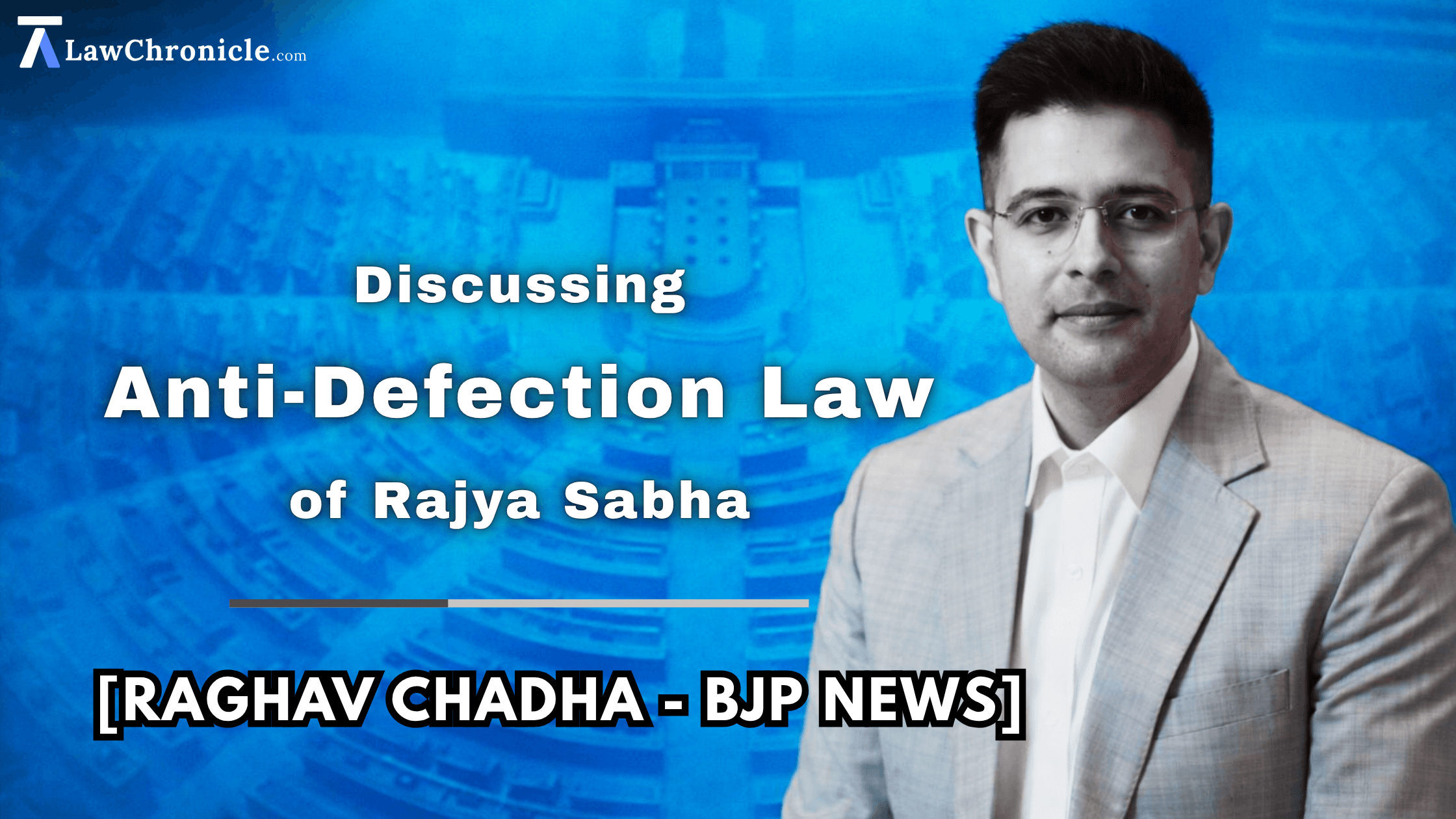
Raghav Chadha and six other AAP MPs have announced a merger into the BJP. It is claimed that the anti-defection law will not be attracted, invoking the two-thirds merger exception. Now the major question arises: Is the action of Raghav Chadha and 6 others shielded by the merger exception in the Tenth Schedule of the Constitution? Or, are all seven of them exposed to disqualification under the anti-defection law? Here is a scan through the legal twists that await under the Anti-Defection Law of Rajya Sabha.
Raghav Chadha BJP News
In recent months, Aam Aadmi Party’s Raghav Chadha has been all over the social media. He raised a lot of crucial matters in the Rajya Sabha, ranging from gig workers’ rights, 28-day recharge, food prices at Airports, etc. However, one announcement made on 24th April shook the political world. Seven Rajya Sabha members of Aam Aadmi Party (AAP) joined Bharatiya Janata Party. These include Raghav Chadha, Sandeep Pathak, Ashok Mittal, Harbhajan Singh, Swati Maliwal, Vikram Sahney, and Rajinder Gupta.
As claimed by Raghav Chadha and others who joined BJP, that anti-defection law will not be attracted since 2/3rd AAP members sought to merge into BJP. Let us look at the specific provisions that govern the anti-defection law in Rajya Sabha.
Anti-Defection Law and 10th Schedule
The anti-defection law finds its roots in the Tenth Schedule of the Constitution of India, inserted vide Constitution (Fifty-second Amendment) Act, 1985. It operates through Articles 102(2) and 191(2), which disqualify members of Parliament and State Legislatures respectively for defection. Article 102(2) expressly states that a person shall be disqualified for being a member of Parliament "if he is so disqualified under the Tenth Schedule." Article 191(2) is the parallel provision for Legislative Assembly or Legislative Council of a State.
Disqualification under Tenth Schedule
Paragraph 2(1) of the 10th Schedule has been traced below:
“A member of a House belonging to any political party shall be disqualified for being a member of the House—
(a) if he has voluntarily given up his membership of such political party; or
(b) if he votes or abstains from voting contrary to any direction issued by the political party, without obtaining prior permission, and such voting or abstention has not been condoned within fifteen days.”
This means joining a rival political party or announcing merger apparently constitutes a voluntary act.
Exception to Anti-Defection Law
The 10th Schedule on Disqualification provides an escape for genuine party mergers. In this context, Paragraph 4 of the said provision states that:
“4(1). A member of a House shall not be disqualified under sub-paragraph (1) of paragraph 2 where his original political party merges with another political party and he claims that he and any other members of his original political party—
(a) have become members of such other political party or, as the case may be, of a new political party formed by such merger; or
(b) have not accepted the merger and opted to function as a separate group.
4(2). For the purposes of sub-paragraph (1) of this paragraph, the merger of the original political party of a member of a House shall be deemed to have taken place if, and only if, not less than two-thirds of the members of the legislature party concerned have agreed to such merger.”
For escaping disqualification, there is a requirement of 2/3rd members of the House. If AAP has 10 members in the Rajya Sabha and 7 have signed, that is 70%, which numerically exceeds two-thirds. The numbers sound in favour of Raghav Chadha and the rest as per legal requirements for the Rajya Sabha legislature party. However, that’s not the only pre-condition. It is significant to note that the aforementioned provision requires merger of the “original political party” to attract the exception from disqualification under the anti-defection law.
Original Political Party
For the purpose of exception to disqualification under the 10th Schedule, original political party in relation to a member of a House, has been defined as “the political party to which he belongs for the purposes of subparagraph (1) of paragraph 2”.
The Aam Aadmi Party as a political party, its national leadership including Arvind Kejriwal, or its vast membership, has not merged with the BJP. In fact, Arvind Kejriwal and other AAP leaders including Punjab CM Bhagwant Mann and Sanjay Singh expressed anguish over the news of 7 AAP members joining BJP. How the leadership acts will decide what unveils further.
Who will decide Disqualification?
AAP leader Sanjay Singh said that the party shall write a letter to the Rajya Sabha Chairman against members who left AAP to join BJP.
Under Paragraph 6(1) of the Tenth Schedule, any question pertaining to disqualification of Raghav Chadha and others joining BJP shall be referred to and decided by the Chairman of the Rajya Sabha, whose decision will be final. The Chairman will be required to adjudicate whether the conditions of Paragraph 4 were met. Since there is scope for judicial review of the decision of Rajya Sabha Chairman, the matter may soon reach the Supreme Court of India.
What may Follow?
Based on the circumstances, Aam Aadmi Party may soon approach the Rajya Sabha Chairman seeking disqualification of Raghav Chadha, Ashok Mittal, and the rest of members who joined BJP. The Chairman may decide the question as per the applicable anti defection law under 10th Schedule. The said decision may pave the way for the Apex Court to lay down another landmark judgment on disqualification of Members of Parliament.
 Breaking News