


Re-agitating Dismissed Impleadment Applications Under Different CPC Provisions Barred by Res Judicata: SC
 Copy Link
 Share
 Save
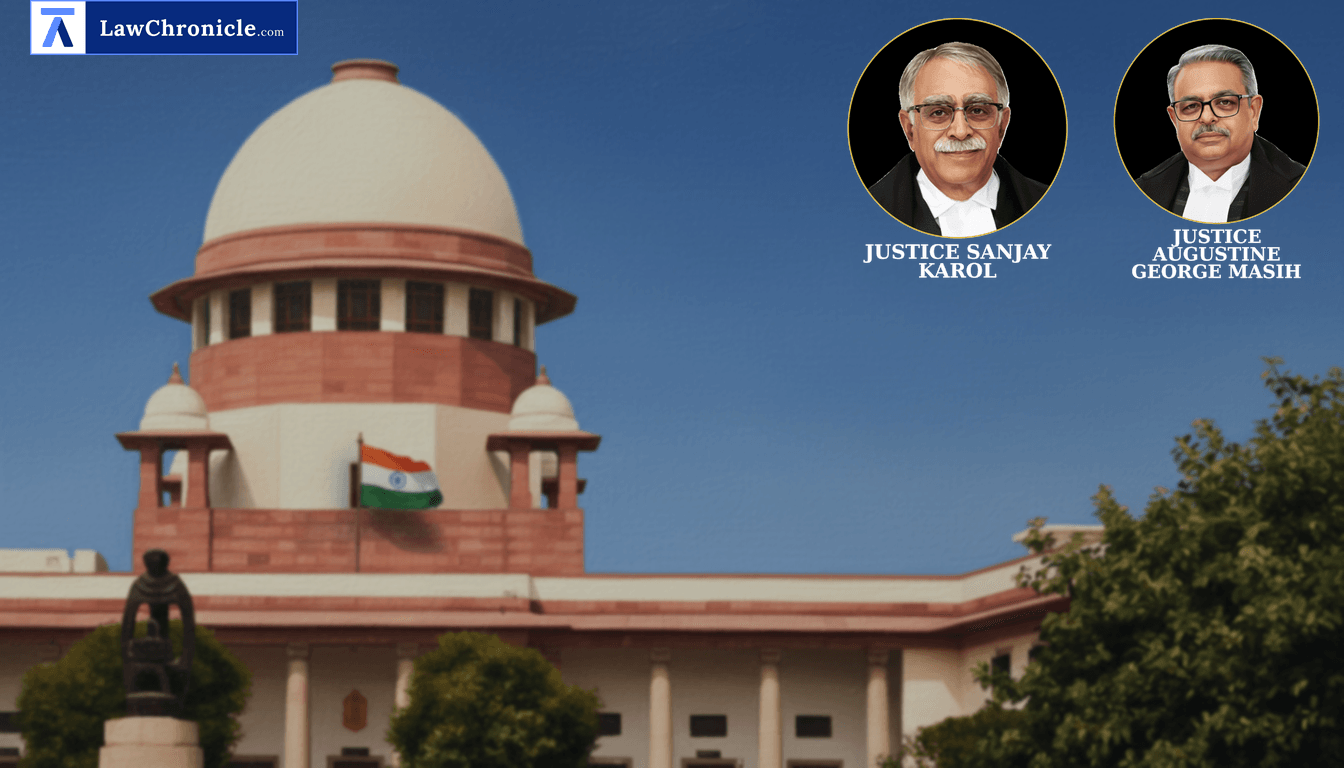
Subsequent purchasers cannot bypass a final judicial order rejecting their impleadment by simply filing a fresh application under a different procedural provision of the Code of Civil Procedure, 1908. The Supreme Court declared that while an erroneous decision on merits operates as res judicata preventing re-litigation in the main appeal, subsequent assignees can still be impleaded in cross-objections if a fresh cause of action arises due to non-prosecution by original owners.
A Division Bench comprising Justice Sanjay Karol and Justice Augustine George Masih delivered the ruling in an appeal challenging an interim order of the High Court of Punjab and Haryana. The High Court had recalled an earlier order, condoned a delay of 2,109 days, restored a second appeal, and allowed the impleadment of subsequent purchasers under Order XXII Rule 10 of the Code of Civil Procedure, 1908 after their previous application under Order I Rule 10 had been dismissed decades earlier.
Erroneous Decisions and Principles of Res Judicata
Addressing the binding nature of prior judicial orders, the Supreme Court emphasized that an erroneous decision on merits which has attained finality remains binding on coordinate benches at subsequent stages of the same litigation. The Bench clarified that the principle laid down in Allahabad Development Authority v. Nasiruzzaman and Others ( "(1996) 6 SCC 424": 1996 CaseBase(SC) 465) was inapplicable as no statutory prohibition or jurisdictional defect existed in the prior order.
The Court, in its reasoning, observed: "It is, by now, a settled position that the doctrine of res judicata is applicable on subsequent stage(s) of same proceedings if, the question or issue involved has been decided at an earlier stage of same litigation as held in S. Ramachandra Rao v. S. Nagabhushana Rao and Others ( "(2024) 17 SCC 361": 2022 CaseBase(SC) 887). Further, it is also well settled, as laid down in several decisions, that a judicial decision binds whether it is right or wrong. An error of law or fact, committed by a judicial or quasi-judicial body cannot be impeached otherwise than in appeal, unless it relates to a matter of jurisdiction. The findings would be binding on the parties as held in Mathura Prasad Bajoo Jaiswal and Others v. Dossibai N.B. Jeejeebhoy ( "(1970) 1 SCC 613": 1970 CaseBase(SC) 430) and State of West Bengal v. Hemant Kumar Bhattacharjee and Others ( "1962 SCC OnLine SC 319": 1962 CaseBase(SC) 252). In the case of Dr. Shah Faesal and Others v. Union of India and Another ( "(2020) 4 SCC 1": 2020 CaseBase(SC) 909), Sulthan Said Ibrahim v. Prakasan and Others ( "2025 SCC OnLine SC 1218": 2025 CaseBase(SC) 589) and other catena of judgments have settled that ruling of a coordinate bench binds subsequent coordinate benches."
Distinction Between Order I Rule 10 and Order XXII Rule 10 CPC
Examining the procedural framework under Order I Rule 10 and Order XXII Rule 10 read with Section 146 of the Code of Civil Procedure, 1908, the Supreme Court observed that while the two provisions serve distinct purposes, a second application under Order XXII Rule 10 seeking the same relief on identical facts remains barred by res judicata if the earlier Order I Rule 10 application was adjudicated on merits.
The Court noted that although dismissal under Order I Rule 10 does not automatically bar an application under Order XXII Rule 10 in all cases, switching statutory provisions to re-agitate the same claim is impermissible, as supported by B.S. Lalitha and Others v. Bhuvanesh and Others ( "2026 SCC OnLine SC 860": 2026 CaseBase(SC) 432). However, the Court distinguished the cross-objections where no prior impleadment application had been made. Pointing to principles in Thomson Press (India) Limited v. Nanak Builders and Investors Private Limited and Others ( "(2013) 5 SCC 397": 2013 CaseBase(SC) 1039) and Amit Kumar Shaw and Another v. Farida Khatoon and Another ( "(2005) 11 SCC 403": 2005 CaseBase(SC) 5), the Bench held that non-prosecution by original sellers gave rise to a fresh cause of action for the transferees to defend their interest in the cross-objections.
The Court has the following directions:
"Consequently, the impugned judgment and order passed by the High Court is set aside in part, to the extent that it directs the restoration of the main appeal and the impleadment of the subsequent purchasers therein. Conversely, the High Court order allowing the application for impleadment of the subsequent purchasers as respondents in the cross-objections is sustained and upheld."
Key Takeaways
Procedural Switching Prohibited: Litigants cannot avoid a final adverse order under Order I Rule 10 of the CPC by seeking identical impleadment under Order XXII Rule 10.
Binding Nature of Erroneous Orders: Prior decisions on merits bind coordinate benches in subsequent stages of the same suit even if based on an erroneous factual premise.
Fresh Cause in Cross-Objections: Subsequent purchasers may be impleaded in cross-objections if the original owners abandon the appeal, creating a risk of collusion or prejudice.
Ratio
When an application for impleadment under Order I Rule 10 of the CPC has been adjudicated and rejected on merits, a subsequent application under Order XXII Rule 10 based on the same transfer and underlying facts is barred by the principles of res judicata. An erroneous judicial decision on merits that has attained finality remains binding upon the parties and coordinate benches at subsequent stages of the same proceeding, unless it suffers from lack of jurisdiction or statutory prohibition.
Background:
The dispute originated from a property declaration suit filed by Bhagwan Dai, widow of Girdhari Lal, against Shakuntla Devi (Respondent No. 1). The Trial Court dismissed the suit and upheld a Will executed in favor of Varinder Kumar (Respondent No. 2). On appeal, the First Appellate Court partly reversed the trial court's decree, recognizing the plaintiff's adoption of Sanjiv Kumar (Appellant) and granting her full ownership rights over property no. 4677 under Section 14(1) of the Hindu Succession Act, 1956 while restraining alienations.
Respondent Nos. 1 and 2 filed a second appeal in 1990 before the High Court, wherein the Appellant filed cross-objections seeking full ownership. During pendency, Respondent Nos. 3 and 4 purchased a part of the property via a registered sale deed. Their application under Order I Rule 10 CPC was dismissed by the High Court in May 2000 on the premise of lis pendens and an existing injunction. In 2018, both the appeal and cross-objections were dismissed for default; while the Appellant secured restoration of the cross-objections, the original owners did not seek restoration of the appeal. Subsequently, Respondent Nos. 3 and 4 filed fresh applications under Order XXII Rule 10 CPC, Order XLI Rule 19 CPC, and Section 5 of the Limitation Act, 1963.
The High Court allowed their applications on November 13, 2024, holding that its 2000 order was based on a factual error and did not operate as res judicata. Aggrieved, the Appellant approached the Supreme Court. The Apex Court partly allowed the appeal, holding that impleadment and restoration in the main appeal were barred by res judicata, but upholding their impleadment in the cross-objections to protect their interests against potential collusion.
Case Details:
Case No.: Civil Appeal No. of 2026 (Arising out of SLP (C) No.1052 of 2025)
NeutralCitation: 2026 INSC 747
Case Title: Sanjiv Kumar v. Shakuntla Devi and Others
Source: 2026 CaseBase(SC) 693
Similar Articles
 Breaking News


