


Refusal of Leave to Defend Is Not the Rule: Rajasthan HC Quashes Decree Against Footwear Firm
 Copy Link
 Share
 Save
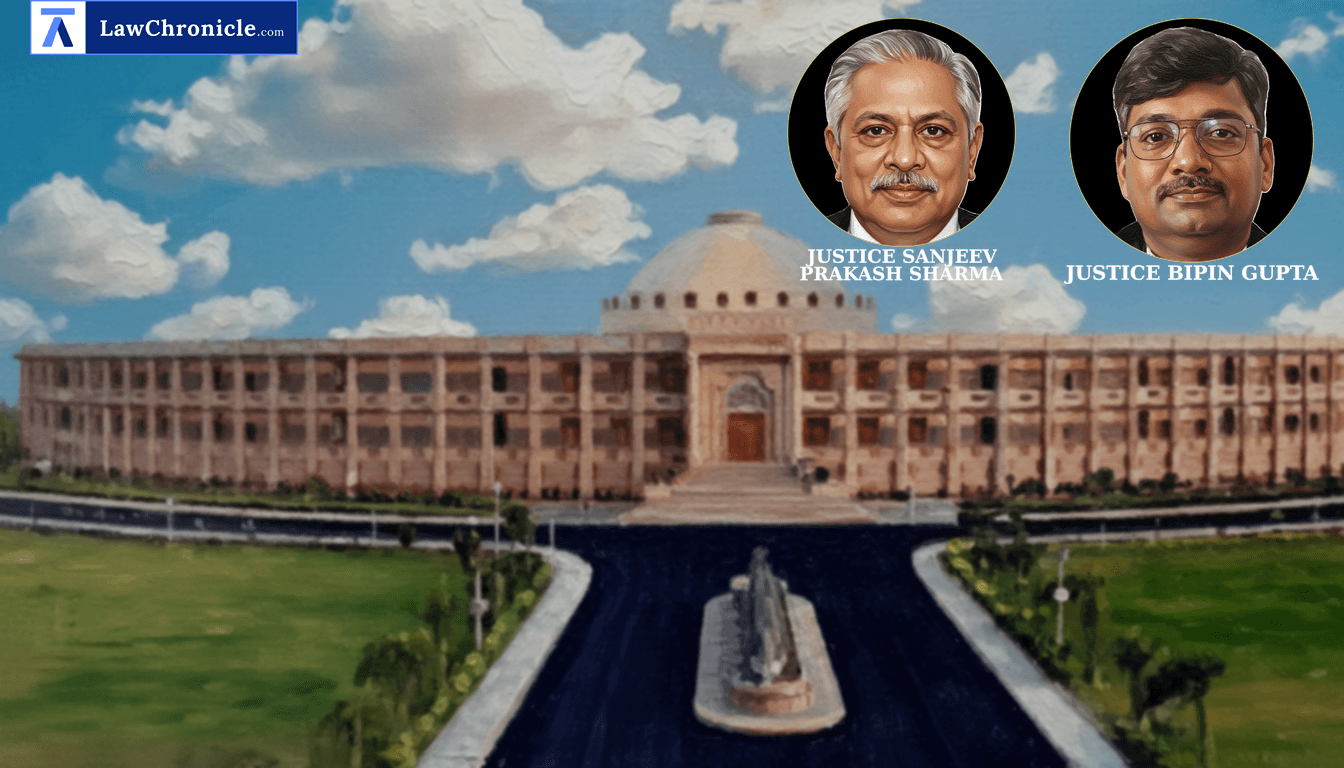
The Rajasthan High Court has set aside a decree passed by a Commercial Court against a footwear proprietor, holding that summary procedures under Order XXXVII of the Code of Civil Procedure, 1908 should not be used to shut out legitimate defenses. The High Court clarified that denial of leave to defend is an exception, while granting leave to contest the suit remains the rule when substantial triable issues are disclosed.
A division bench comprising Acting Chief Justice Mr. Sanjeev Prakash Sharma and Justice Bipin Gupta was hearing an appeal against the decision of the Commercial Court, Kota. The lower court had previously dismissed the application for leave to defend filed by a proprietor and subsequently decreed a recovery suit for Rs. 5,14,000/- in favor of UCO Bank.
The Principle of 'Audi Alteram Partem' in Summary Suits
The Court observed that while summary procedures aim for expeditious disposal of commercial disputes, they must maintain a delicate balance with the principles of natural justice. The Court highlighted that the legislative intent behind Order XXXVII Rule 3(5) of the Code of Civil Procedure, 1908 imposes a mandatory obligation to grant leave to defend if the defendant establishes a prima-facie substantial defense.
The Court, in its reasoning, observed: "The legislative choice of such language clearly indicates that where the defendant applies for leave to defend and discloses facts which prima-facie establish a substantial or triable defence, the Court is bound to grant leave, except in cases where the defence appears illusory, sham, vexatious, or devoid of bona-fide. In this manner, the principle of ‘audi alteram partem’ is not wholly excluded under Order XXXVII CPC, but operates in a restricted form consistent with the object of the summary procedure."
Judicial Discretion and Triable Issues
Referencing the legal principles established in B.L. Kashyap & Sons Ltd. vs. JMS Steels & Power Corporation & Anr. and Sudin Dilip Talaulikar vs Polycap Wires Pvt. Ltd. & Ors. ( "2019 7 SCC 577": 2019 CaseBase(SC) 4114), the High Court noted that even if the probability of the defense's success is doubtful, the Court may impose conditions rather than denying the opportunity to defend altogether. The bench further relied on State of Hyderabad vs. Rabo Bank ( "(2015) 10 SCC 521": 2015 CaseBase(SC) 69) to reiterate that summary procedures cannot be employed to non-suit a defendant at the threshold when genuine questions of fact or law arise.
Background:
The dispute originated when UCO Bank (the respondent) filed a suit for the recovery of Rs. 5,14,000/- against M/s Rajesh Footwear. The Bank alleged that the appellant had defaulted on a Cash Credit limit and a General Emergency Credit Line (GECL) loan. When the Bank initiated a summary suit, the appellant sought leave to defend, arguing that his account was declared a Non-Performing Asset (NPA) without due notice and that his residential property had already been auctioned to satisfy the dues.
The Commercial Court had dismissed the appellant's application, concluding that no substantial defense was raised. However, the High Court found that the Bank had not satisfactorily established whether the previous auction related to the same loan transaction or an independent liability. This ambiguity, coupled with the dispute over the mandatory NPA declaration notice, constituted "substantial triable issues" that required a full trial. Consequently, the High Court allowed the appeal and remanded the matter for fresh adjudication.
Case Details:
Case No.: D.B. Civil First Appeal No. 1917/2025
NeutralCitation: 2026:RJ-JP:20542-DB
Case Title: M/s Rajesh Footwear vs. UCO Bank
Appearances:
For the Petitioner(s): Mr. Jai Kishan Yogi
For the Respondent(s): Mr. C. P. Sharma
Source: 2026 CaseBase(RAJ) 13
Similar Articles

 Breaking News


