


Research Institute Professors Cannot Claim Retirement Parity With Educational Institutions: Gauhati HC
 Copy Link
 Share
 Save
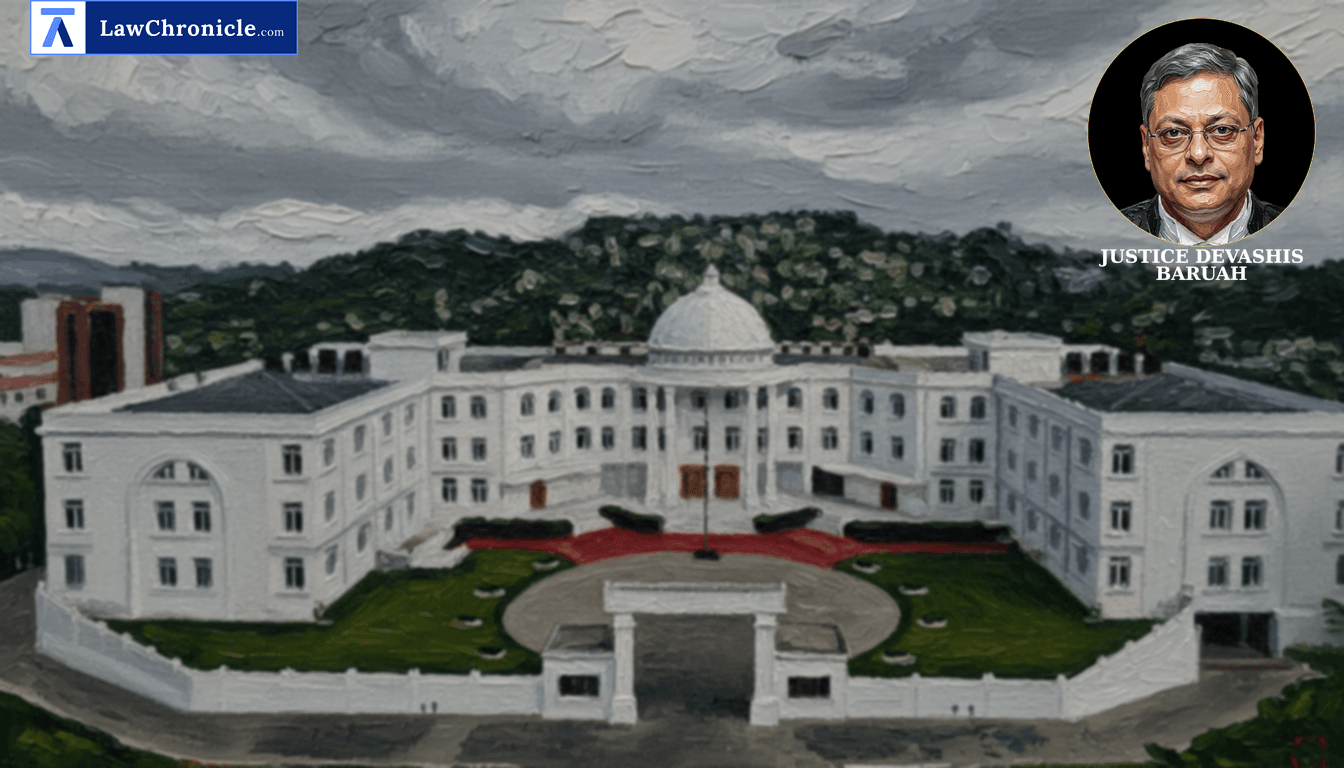
The Gauhati High Court restricted attempts to equate research institutes with educational institutions for service benefits, ruling that professors at autonomous research bodies cannot demand a retirement age of 65 years as a matter of constitutional right.
A Single Judge Bench of Justice Devashis Baruah delivered this significant ruling while dismissing a writ petition filed by a professor seeking to extend his service tenure. The petitioner had challenged the state's refusal to enhance the superannuation age at the Omeo Kumar Das Institute of Social Change and Development (OKDISCD) from 60 to 65 years, arguing that such an enhancement was mandatory in light of UGC guidelines and state cabinet decisions for educational institutions.
Key Takeaways
Policy Sovereignty over Superannuation
Determining the age of retirement is an exclusive policy function of the State, and Courts cannot legislate or compel the government to enhance service tenures.
Autonomy Defeats Parity Claims
Employees of autonomous bodies registered under the Societies Registration Act, 1860 are governed by their specific Service Regulations, and cannot claim automatic parity with government or university staff.
Double Concurrence Required
For institutes funded jointly by the State and Central agencies like the ICSSR, any change in service conditions requires the joint concurrence of both the State and the Central Government.
Court on Intelligible Differentia
The Gauhati High Court rejected the petitioner's argument that research institutes are fundamentally the same as educational institutions. It observed that while there may be overlaps in function, they constitute distinct categories. The Bench noted that the petitioner was governed by Regulation 32.1 of the Omeo Kumar Das Institute of Social Change and Development Services (Faculty & Other Academic Staff) Regulations, 2022, which explicitly sets the age at 60 years.
The Gauhati High Court distinguished Research Institutes and Educational Institutes by stating that "...an Educational Institution and Research Institute are different though they may have overlappings... the question of violation of Article 14 of the Constitution does not arise when there is an intelligible differentia between the Research Institute and an educational institution inasmuch as discrimination would only arise when two persons are similarly situated and treated differently."
Judicial Restraint in Policy Matters
Citing the precedent in Central Council for Research in Ayurvedic Sciences and Another Vs. Bikartan Das and Others ( "(2023) 16 SCC 462": 2023 CaseBase(SC) 1076), the Gauhati High Court emphasized that superannuation is governed by specific statutory rules of a post. The Bench further relied on T. M. Sampath and Others Vs. Secretary, Ministry of Water Resources and Others ( "(2015) 5 SCC 333": 2015 CaseBase(SC) 369) and State of Maharashtra and Another Vs. Bhagwan and Others ( "(2022) 4 SCC 193": 2022 CaseBase(SC) 564) to highlight that employees of autonomous bodies cannot, as a matter of right, claim the same benefits as government employees simply because the body is state-funded.
The Court issued the following directions:
"The writ petition stands dismissed. No costs."
Ratio
Enhancement of the age of superannuation is a policy decision of the Government, and the Court cannot legislate to alter it. Parity under Article 14 of the Constitution of India, 1950 cannot be claimed between employees of two different establishments, particularly when an autonomous body is governed by its own unique service regulations.
Background
The petitioner, a professor at OKDISCD (a research institute funded 45% by the State of Assam and 45% by Indian Council of Social Science Research (ICSSR)), sought a declaration that his retirement age should be 65 years. He relied on a 2012 Cabinet decision by the Government of Assam which raised the retirement age for professors in educational institutions and medical colleges. However, the State Government and the Union of India (Respondent No. 8) argued that the institute is a 'Research Institute' and not an 'Educational Institution'.
The Gauhati High Court noted that the Constitution of India, 1950 does not mandate identical service conditions across different types of state-linked entities. Since the Service Regulations of the institute specifically prescribed 60 years, and there was no joint notification from both funding governments to enhance it, the petitioner had no legitimate expectation for an extension.
Case Details:
Case No.: WP(C)/6330/2022
Neutral Citation: 2026:GAU-AS:15538
Case Title: DR. BHUPEN SARMAH Vs. THE STATE OF ASSAM AND 7 ORS.
Appearances:
For the Petitioner(s): Mr. T. Chakraborty, Advocate
For the Respondent(s): Mr. T. C. Chutia, Addl. Sr. GA, Assam; Ms. J. Sarmah, Advocate; Mr. R. K. D. Choudhury, Dy. S.G.I.; Mr. D. Nath, Advocate
Source: 2026 CaseBase(GAU) 1472
Similar Articles
 Breaking News


