Routine Case Management Orders Not Appealable Under Letters Patent: Madras High Court
 Copy Link
 Share
 Save
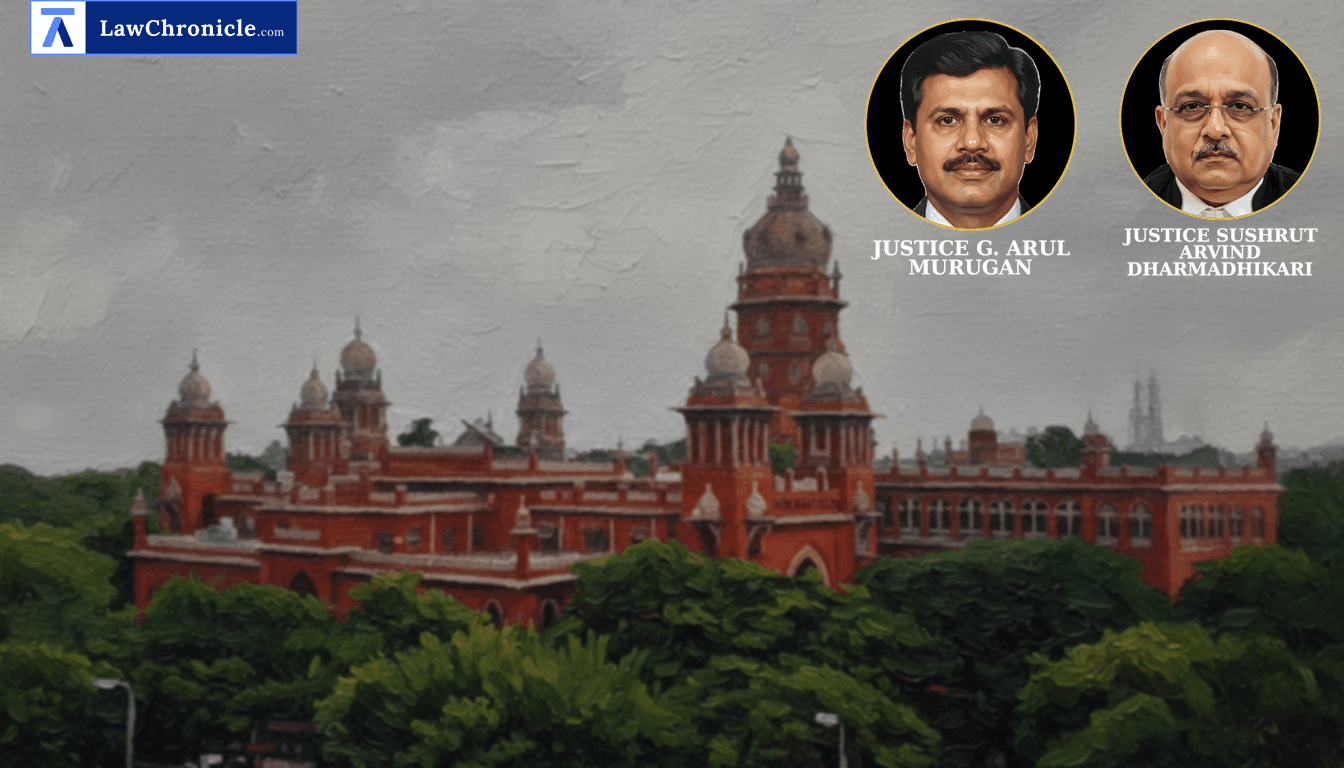
The Madras High Court has clarified that routine procedural entries and docket management directives do not constitute a 'judgment' and therefore cannot be challenged through an intra-court appeal.
A Division Bench comprising Chief Justice Sushrut Arvind Dharmadhikari and Justice G. Arul Murugan dismissed a writ appeal challenging a Single Judge's decision to tag a writ petition with connected matters, emphasizing that such administrative-judicial steps do not determine the substantial rights of the parties.
The Definition of 'Judgment' under Letters Patent
The primary legal question before the Court was whether a routine case-management entry or an adjournment order could be classified as a 'judgment' under Clause 15 of the Letters Patent. The Court underscored that for an order to be appealable, it must possess characteristics of finality.
"The phrase 'judgment' cannot be distorted to encompass every interlocutory or case-management directive passed for the orderly conduct of a proceeding. To qualify as an appealable judgment, the order must possess the characteristics of finality; it must conclusively determine, or at the very least vitally affect, the substantial rights and obligations of the parties regarding the main controversy or an independent ancillary issue."
Impact on Judicial Efficiency and Prevention of Vexatious Appeals
The Bench observed that elevating ministerial exercises to the status of appealable judgments would disrupt the institutional hierarchy. The Court noted that a procedural order directing a case to be listed alongside an allied matter is a salutary step intended to prevent conflicting judicial pronouncements.
The Court, in its reasoning, observed: "If such ministerial and docket-management exercises are elevated to the status of appealable judgments, it would open the floodgates of vexatious appellate litigation, severely disrupting the institutional hierarchy and the functional independence of the writ courts."
Directions Issued to the Appellants
While the Court found the appeal not maintainable, it acknowledged the concerns regarding the pending recruitment process. The Court has the following directions:
"Therefore, while dismissing the writ appeal as not maintainable, we grant liberty to the appellants to move the learned Single Judge dealing with W.P.No.12491 of 2026 for an expeditious disposal of the main writ petition on its own merits."
Background:
The dispute arose from a recruitment examination where parallel challenges were pending. In W.P.(MD) No. 2052 of 2026, a Single Judge had directed a CBCID investigation. Furthermore, a Division Bench in W.P.Nos.436 and 438 of 2026 had permitted authorities to fill vacancies subject to keeping 47 posts vacant. The appellants argued that by tagging their petition (W.P. No. 12491 of 2026) with a distinct matter and not considering it on independent merits under Rule 19 of the Madras High Court Rules, the Single Judge had effectively paralyzed the appointment process, causing financial hardship.
The respondents, represented by the Government Pleader, maintained the procedural regularity of the listing. The High Court ultimately held that an e-court status update or an adjournment does not possess the traits of a 'judgment' within the meaning of Clause 15 of the Letters Patent. Consequently, the appeal was dismissed as not maintainable without an adjudication on the substantive merits of the selection process.
Case Details:
Case No.: W.A.No.1546 of 2026
NeutralCitation: 2026:MHC:2328
Case Title: R.Naresh and others Vs. The Principal Secretary to Government and others
Appearances:
For the Petitioner(s): Mr. M.Gnanasekar
For the Respondent(s): Mr. K.Kumaran Government Pleader
Source: 2026 CaseBase(MAD) 303
 Breaking News