Sabarimala Review: Was Justice Indu Malhotra Right?
 Copy Link
 Share
Share Save
Save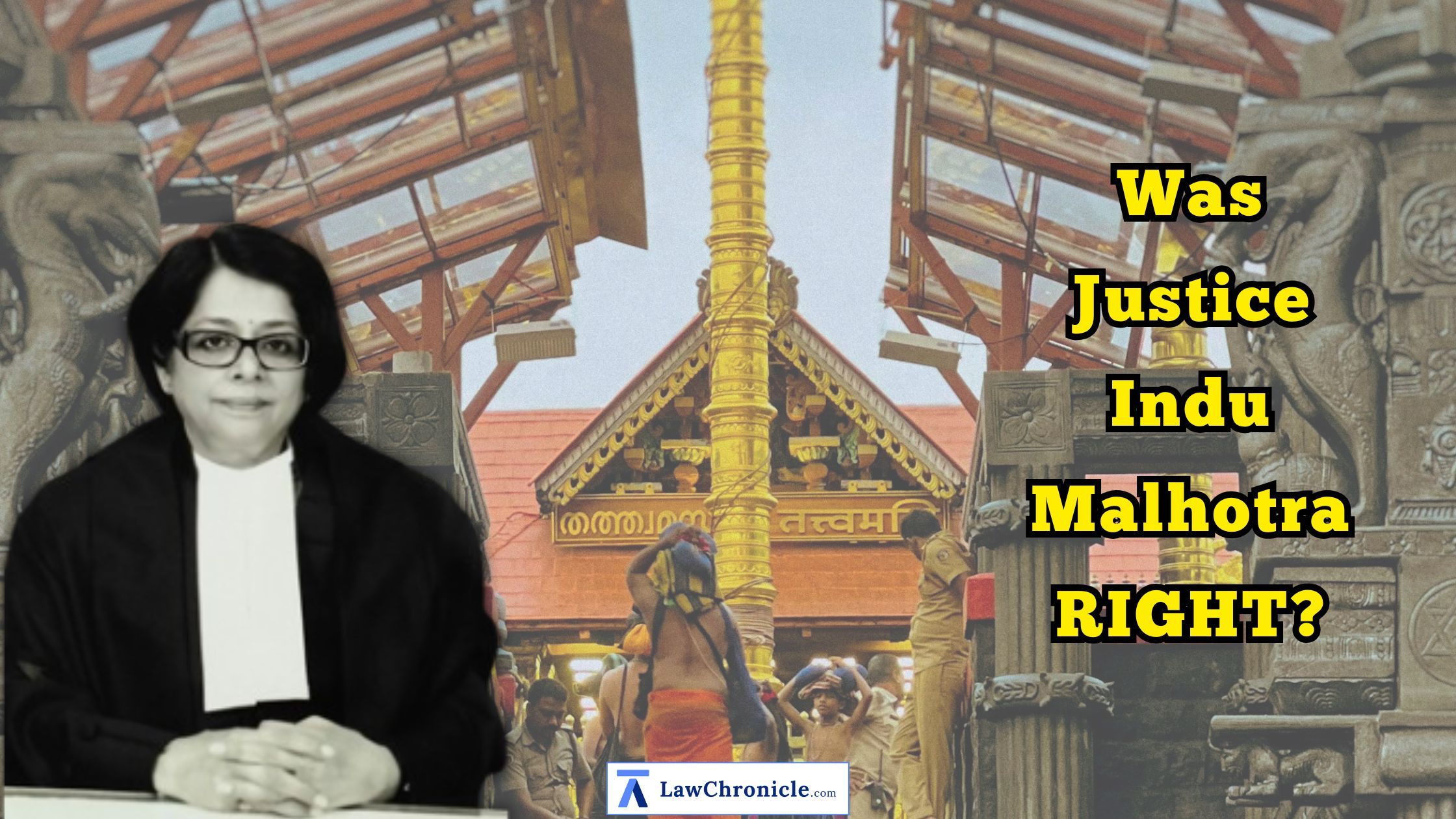
In 2018, a Supreme Court ruling upheld women’s right to equality over religious faith. Yes, this is about the Sabarimala case which witnessed a lot of debates during proceedings, and even after the matter was settled with the 2018 judgment. Since Sabarimala review proceedings are all set to begin in April, it is important to explore its scope through Justice Indu Malhotra’s dissenting opinion in the case. Let us have a look at her reasoning to analyze whether women of all ages could, and should, be allowed to enter Lord Ayyappa’s Sabarimala temple.
Sabarimala Case Judgment
There were 5 Judges on the Bench who heard both sides of the arguments in Sabarimala case. The main question pertained to exclusion of women of menstruating age from the Sabarimala Temple. One side sought non-discriminatory entry for all women in Lord Ayyappa temple. The other side argued against the plea stating celibacy of deity, arduousness of pilgrimage for women and notions of purity/pollution associated with menstruation.
With a majority of 4:1, the Apex Court decided on the matter. That’s how Indian Young Lawyers Association And Others v. State Of Kerala And Others, 2018 CaseBase(SC) 589 became a landmark. Rule 3(b) of the Kerala Hindu Places of Public Worship (Authorisation of Entry) Rules, 1965, was declared ultra vires and unconstitutional. The exclusion of women aged 10-50 from the Sabarimala Temple was held unconstitutional, violating Articles 14, 15, 17, 21, and 25 of the Constitution.
Dissent in Sabarimala Case
As mentioned earlier, there were 5 Supreme Court Judges on the Bench. It was the then Chief Justice Dipak Misra, Justice RF Nariman, Justice AM Khanwilkar, Justice DY Chandrachud and Justice Indu Malhotra. In other words, five Judges were asked to decide on women’s equal right to practice religion and worship. Of them, all 4 male Judges held women equally entitled to profess, practise and propagate religion, except the woman judge. Justice Indu Malhotra was the only Judge who found that the petitioners had satisfied the Court that the Ayyappans or worshippers of the Sabarimala Temple were entitled to protection under Article 26 of Constitution of India. Let’s gather how she reasoned her stance.
Justice Indu Malhotra on Sabarimala
The discussion and analysis in Justice Indu Malhotra’s judgment starts with the far-reaching ramifications and implications, for all places of worship of various religions across India. She expressed her views that “In a secular polity, issues which are matters of deep religious faith and sentiment, must not ordinarily be interfered with by Courts.” Her version also questioned the standing of petitioners, who were not the devotees of Lord Ayyappa, whose right to worship may have been denied.
Justice Indu Malhotra in her dissenting opinion also stated that “In matters of religion and religious practises, Article 14 can be invoked only by persons who are similarly situated, that is, persons belonging to the same faith, creed, or sect.” Her judgment reflects upon the worshippers of Lord Ayyappa who believe in the manifestation of the deity as a ‘Naishtik Brahmachari’, a celibate. Justice Malhotra was loud and clear in her thoughts when she said that “Religious customs and practises cannot be solely tested on the touchstone of Article 14 and the principles of rationality embedded therein”.
In crux, Justice Indu Malhotra's dissenting opinion in Sabarimala case can be summed up as:
- Courts should not ordinarily interfere in matters of deep religious faith
- Sabarimala is a separate religious denomination
- Essential religious practice is for the religious community to decide
- Non-devotees should not be allowed to challenge long-standing religious customs
- Article 25 should not be overridden merely on general equality principles unless the practice is oppressive or exclusionary in a constitutionally impermissible way.
Sabarimala Review Scope
The 2018 Sabarimala case judgment was delivered by a Bench of 5 judges. In 2019-20, Kantaru Rajeevaru v. Indian Young Lawyers Association And Ors. (2020 CaseBase(SC) 98), the maintainability of reference to a larger bench was answered. Now, in 2026, a 9-Judge Bench of the Supreme Court is all set to review the Sabarimala 2018 judgment. As per reports, the proceedings shall commence from 7th April.
Since the Supreme Court 5-Judge Bench had declared women of all ages entitled to enter the Sabarimala temple, the 9-Judge Bench may consider, or say reconsider, the following facets:
1. Validity of Religious Denomination Claim
- Whether the devotees of Ayyappa at the Sabarimala temple constitute a separate religious denomination under Article 26?
- If yes, do they have the autonomy to manage religious affairs?
2. Essential Religious Practice (ERP) Test
- Whether the exclusion of women (10–50 years) is an essential religious practice?
- Should courts decide what is “essential” in a religion?
3. Article 25 versus Article 26
- The Supreme Court 9-Judge Bench will be required to balance women’s right to equality and worship with the Temple’s right to manage religious affairs.
4. Role of Constitutional Morality
- Whether “constitutional morality” can override long-standing religious customs?
- While the question for now pertains to the Sabarimala temple, it will have a long-standing impact on gender rights, even beyond Hindu religion.
Expected Consequences in Sabarimala Review
If 2018 judgment is upheld
If the Sabarimala review leads the 9-Judge Bench to uphold the 2018 judgment, it will mean:
- Women of all ages can enter Sabarimala.
- Stronger precedent for gender equality in religious spaces.
- ERP doctrine may be narrowed.
If 2018 judgment is modified/reversed
If the Sabarimala case judgment of 2018 is reversed, it will lead to:
- Greater autonomy to religious denominations.
- Stronger protection of faith-based exclusions.
- The Essential Religious Practice (ERP) test may be reformulated or diluted.
Inference
In 2006, it all started with news stories about women being restricted from entering Lord Ayyappa’s Sabarimala temple. The Apex Court in 2018 through Sabarimala case judgment settled held women equally entitled as men to worship Lord Ayyappa, regardless of their age. One Judge who dissented to the majority stance had different views even being a woman herself. Justice Indu Malhotra’s say on Sabarimala reflects upon the far-reaching impact of judicial decisions on religious freedom.
 Breaking News