Sanctity Is Reward Of Legality: SC Quashes Flawed SARFAESI Auction Sale
 Copy Link
 Share
 Save
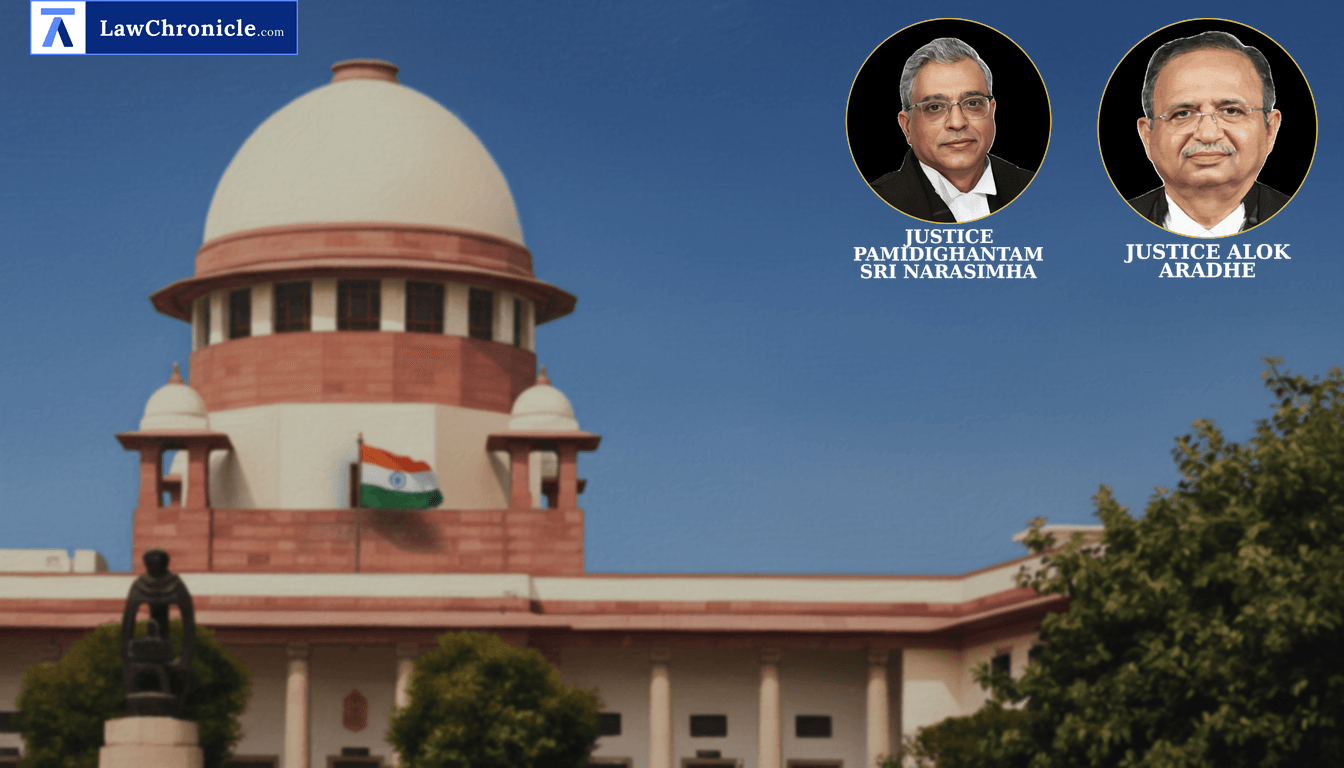
The Supreme Court recently emphasized that an auction sale conducted in violation of statutory procedures and judicial restraint orders carries no sanctity in law and cannot strip a borrower of its rights. Striking down a decade-long property transfer, the Supreme Court ruled that procedural safeguards under debt recovery laws are mandatory conditions that cannot be bypassed to benefit non-bidders or bypass mandatory cooling-off periods.
A Bench of Justice Pamidighantam Sri Narasimha and Justice Alok Aradhe set aside the judgment of the Madras High Court, which had validated a sale certificate issued under the Securitisation And Reconstruction Of Financial Assets And Enforcement Of Security Interest Act, 2002. The apex court held that an auction process riddled with fatal procedural flaws cannot be protected under the guise of the finality of auction sales.
Key Takeaways
Legality Precedes Finality: Protection given to confirmed auction sales applies only when proceedings strictly comply with statutory provisions; illegalities void the sale.
Restraint Orders Are Absolute: Actions taken in violation of tribunal or court stay orders, including accepting bids or earnest money, are bereft of legal effect.
No Third-Party Nominees: Sale certificates cannot be issued in favour of non-bidding entities or partnership firms formed after the auction date.
Mandatory Notice Window: Truncating the mandatory 30-day notice period violates the borrower's substantive right of redemption under Section 13(8) of the Securitisation And Reconstruction Of Financial Assets And Enforcement Of Security Interest Act, 2002.
Court's Rationale on SARFAESI Safeguards
The Supreme Court scrutinized the sequence of events and noted multiple irremediable flaws in the auction process. Highlighting that statutory safeguards are the very condition upon which statutory power exists, the Apex court emphasized that procedures under Rules 8 and 9 of the Security Interest (Enforcement) Rules, 2002 are mandatory.
The Supreme Court explained that "It is a principle of long standing that where a statute requires a thing to be done in a particular manner, it must be done in that manner or not at all, and other modes of performance are necessarily forbidden... The constitutional validity of the SARFAESI Act was upheld precisely because the power so conferred is hedged in by procedural safeguards designed to protect the borrower. The safeguards are thus the very condition upon which the power exists."
Addressing the argument surrounding the finality of public auctions, the Bench clarified that legality is a prerequisite for finality. The Court, in its reasoning, observed that “Sanctity is the reward of legality, not a substitute for it. The decisions relied upon by the Purchaser concerned auctions, whose legality was not in doubt and are, therefore, of no assistance to it.”
Ratio
An auction sale executed in breach of mandatory statutory rules under the Securitisation And Reconstruction Of Financial Assets And Enforcement Of Security Interest Act, 2002 and Security Interest (Enforcement) Rules, 2002, or in defiance of an active judicial restraint order, is void ab initio. The protection of finality accorded to auction sales does not extend to transactions vitiated by material procedural illegalities, non-disclosure to the borrower, or issuance of title certificates to ineligible non-bidding entities.
Background
The dispute arose over 'The Fernhill' resort in Ooty, owned by Sterling Holiday Resorts Limited (Borrower). In 1991, the Borrower secured loans from IFCI and TFCI by mortgaging the resort. Following defaults, recovery proceedings were initiated under the Recovery of Debts Due to Banks and Financial Institutions Act, 1993, alongside enforcement measures under Section 13(2) and Section 13(4) of the Securitisation And Reconstruction Of Financial Assets And Enforcement Of Security Interest Act, 2002.
In March 2010, the Authorised Officer issued an auction notice with a reserve price of Rs. 20 crores. However, the Debts Recovery Appellate Tribunal (DRAT) stayed further proceedings subject to a deposit of Rs. 1 crore, which the Borrower timely made. Despite the stay, IFCI received bids. Following subsequent litigation, the High Court set aside the DRAT's order on September 6, 2011. Within six days, IFCI opened the bids, declared an individual as the successful bidder, and issued a sale certificate to M/s P.M. Associates, a partnership firm formed on the day the bids were opened that had not submitted a bid itself.
Subsequently, the Borrower settled all outstanding debts under the DRT decree. IFCI cancelled the sale certificate and refunded the bid amount with interest, which the Purchaser encashed. The Purchaser then challenged the cancellation before the Madras High Court. The High Court ruled in favour of the Purchaser, holding that the Authorised Officer could not unilaterally cancel a sale certificate and directed hand-over of physical possession.
The Supreme Court reversed the High Court's decision, relying on statutory principles enunciated in Taylor v. Taylor and Ramchandra Keshav Adke v. Govind Joti Chavare ( "(1975) 1 SCC 559": 1975 CaseBase(SC) 534) regarding mandatory performance, as well as precedents such as J. Rajiv Subramaniyan & Anr. v. Pandiyas & Ors., Mathew Varghese v. M. Amritha Kumar & Ors., and Mardia Chemicals Ltd. & Ors. v. Union of India & Ors. ( "(2004) 4 SCC 311": 2004 CaseBase(SC) 23) concerning SARFAESI compliance. The Bench also drew upon Surjit Singh & Ors. v. Harbans Singh & Ors. ( "(1995) 6 SCC 50": 1995 CaseBase(SC) 1373), Delhi Development Authority v. Skipper Construction Co. Pvt. Ltd. & Anr. ( "(1996) 4 SCC 622": 1996 CaseBase(SC) 407), and Divya Manufacturing Co. Pvt. Ltd. v. Union Bank of India & Ors. ( "(2000) 6 SCC 69": 2000 CaseBase(SC) 1038) regarding judicial restraint, along with constitutional guarantees under Article 300A of the Constitution of India, 1950 as affirmed in Vidya Devi v. State of Himachal Pradesh & Ors. ( "(2020) 2 SCC 569": 2020 CaseBase(SC) 1040). The Supreme Court concluded that the auction violated Rule 9(1) by concluding before 30 days, failed to notify the Borrower, and invalidly issued title to a non-bidder nominee.
Case Details:
Case No.: Civil Appeal Nos. 10077-10078 of 2014
Neutral Citation: 2026 INSC 1071
Case Title: Sterling Holiday Resorts Limited v. M/s P.M. Associates & Ors.
Source: 2026 CaseBase(SC) 8195
 Breaking News