SC: 120-Day Limit for Written Statements Applies Equally to Counter-Claims
 Copy Link
 Share
Share Save
Save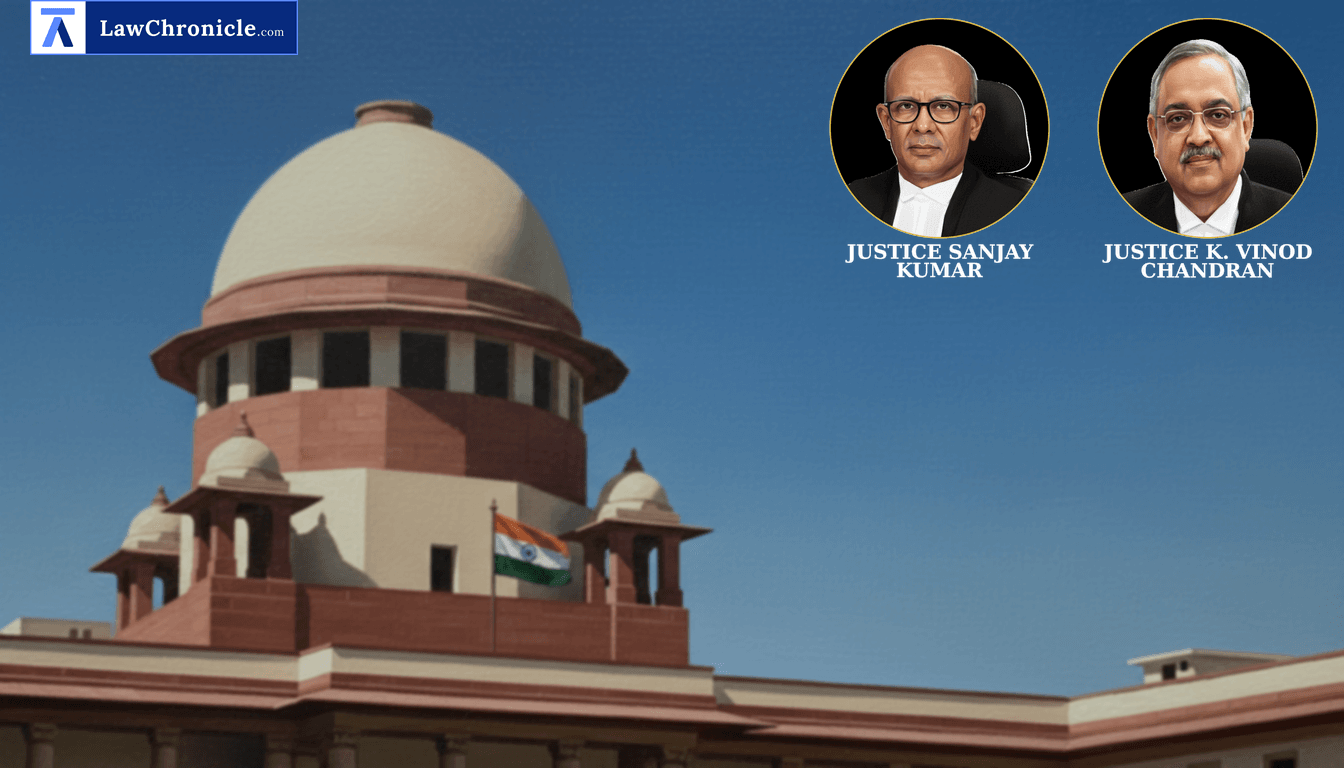
The Supreme Court has solidified the uncompromising nature of timelines in commercial litigation, ruling that the mandatory 120-day outer limit for filing written statements applies with equal force to plaintiffs responding to a defendant's counter-claim. This decision shuts the door on procedural leniency, confirming that any failure to meet this statutory deadline results in an automatic forfeiture of the right to defend against cross-claims.
A bench comprising Justice Sanjay Kumar and Justice K. Vinod Chandran delivered this significant verdict while hearing an appeal against the Calcutta High Court's refusal to condone a 238-day delay in filing a response to a counter-claim. The Court was primarily tasked with deciding whether the strict temporal requirements of the Commercial Courts Act, 2015 and the Code of Civil Procedure, 1908 govern the plaintiff’s reply to a counter-claim just as they govern a defendant’s written statement.
The Mandatory Nature of Order VIII Rule 1
The Court analyzed the intersection of Order VIII Rule 1, Rule 6A, and Rule 6G of the Code of Civil Procedure, 1908. It observed that the legislative intent behind the Commercial Courts Act, 2015 was to ensure the 'speedy disposal of high value commercial disputes' and create a responsive legal system. The Court noted that under Order VIII Rule 6G, the rules relating to a written statement by a defendant 'shall apply' to a written statement filed in answer to a counter-claim. This means the 120-day limit comprising the initial 30 days and a maximum extension of 90 days is absolute.
The Court, in its reasoning, observed: "In the context of a commercial suit governed by the CC Act, designed for quicker resolution of commercial disputes, extending the strict temporal requirement relating to the filing of a written statement by a defendant to the filing of a written statement to a counter-claim is rational, as it achieves the same purpose, viz., speedy and timely completion of the pleadings in the suit so as to enable its faster disposal."
Rejection of Liberal Interpretation by High Courts
The Appellants argued that since the Trial Court had not specifically fixed a time frame under Order VIII Rule 6A(3) of the Code of Civil Procedure, 1908, the penal provisions of the 120-day cutoff should not apply. They relied on several High Court precedents that had taken a liberal view. However, the Supreme Court explicitly disagreed with the approaches taken by the Bombay and Madras High Courts. The Bench clarified that while a Court may initially fix a shorter time, the 'temporal outer limit' defined in the proviso to Order VIII Rule 1, as amended by the Commercial Courts Act, 2015, cannot be breached.
Regarding the maintainability of the appeal before the High Court Division Bench, the Supreme Court relied on BGS SGS SOMA JV vs. NHPC Limited ( "(2020) 4 SCC 234": 2019 CaseBase(SC) 2108) and Kandla Export Corporation and another vs. OCI Corporation and another ( "(2018) 14 SCC 715": 2018 CaseBase(SC) 173) to reiterate that an appeal under Section 13(1A) of the Commercial Courts Act, 2015 is only permissible for orders specifically enumerated under Order XLIII of the Code of Civil Procedure, 1908 or Section 37 of the Arbitration and Conciliation Act, 1996. Since an order under Order VIII is not listed, the appeal was rightfully dismissed as non-maintainable.
The Court has the following directions:
"The appeals are, accordingly, dismissed. Interim order dated 23.05.2025 shall stand vacated. Pending application(s), if any, shall also stand dismissed. Parties shall bear their own costs."
Key Takeaways:
Absolute Cut-off for Plaintiffs
Plaintiffs in commercial suits must treat counter-claims with the same urgency as defendants treat plaints, as the 120-day forfeiture rule applies to both.
Judicial Discretion Curtailed
Courts lack the inherent power to extend the 120-day limit for filing written statements in commercial disputes, even if the delay appears genuine or the court failed to set a specific deadline earlier.
Strict Appellate Limits
Parties cannot challenge interlocutory orders regarding written statements in commercial suits unless they are specifically listed as appealable under the Code of Civil Procedure, 1908 or arbitration law.
Speedy Disposal Priority
The ruling reinforces the Commercial Courts Act, 2015 as a self-contained code intended to prevent the 'multiplicity of proceedings' from becoming a tool for procedural delay.
Ratio Decidendi:
A plaintiff in a commercial suit governed by the Commercial Courts Act, 2015 is bound by the mandate of the proviso to Order VIII Rule 1 of the Code of Civil Procedure, 1908. They must file a written statement to a counter-claim ordinarily within 30 days, extendable only up to a maximum of 120 days from the date of service/receipt of the counter-claim upon showing sufficient cause. Failure to do so entails a mandatory forfeiture of the right to file the pleading.
Background:
The dispute originated from a recovery suit filed by A.K. Ghosh & Company against Biman Bose and others regarding unpaid dues for printing paper. The defendants filed their written statement along with a counter-claim on July 18, 2023. The plaintiffs failed to file their response until March 15, 2024 a delay of 238 days. The Calcutta High Court dismissed the application to take the belated response on record, citing the strict limits under the Commercial Courts Act, 2015. The Division Bench subsequently dismissed the appeal on merits and maintainability, prompting the current challenge before the Supreme Court. The Apex Court relied on SCG Contracts (India) Private Limited vs. K.S. Chamankar Infrastructure Private Limited and others to affirm that the 120-day limit is a hard deadline that cannot be bypassed by pursuing other applications.
Case Details:
Case No.: Civil Appeal Nos. 2026 (@ SLP (C) Nos. 15817 & 15818 of 2025)
NeutralCitation: 2026 INSC 684
Case Title: A.K. Ghosh & Company and others versus Biman Bose and others
Source: 2026 CaseBase(SC) 641
 Breaking News