SC: Benefit Suspension Rule During Criminal Trial Inapplicable to Compassionate Appointments
 Copy Link
 Share
Share Save
Save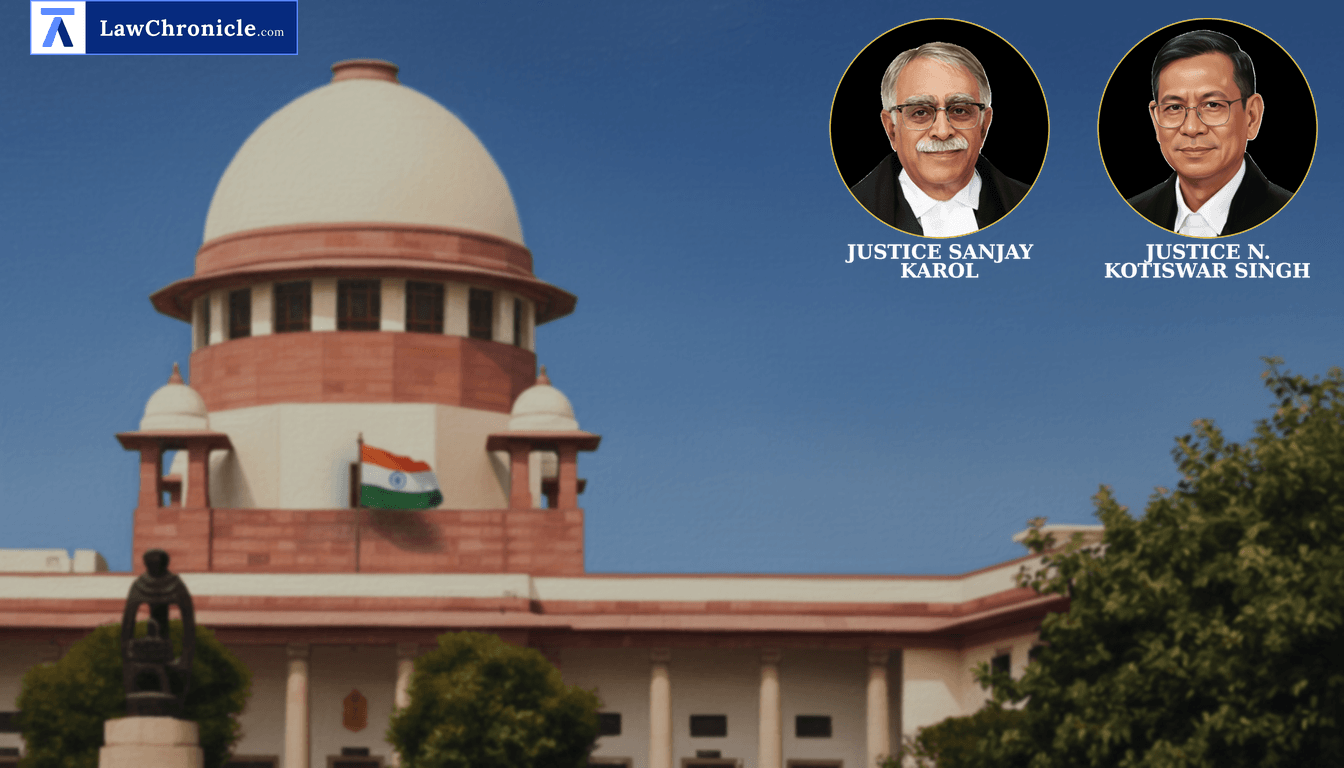
The Supreme Court has clarified that statutory provisions intended to suspend financial assistance due to criminal proceedings cannot be arbitrarily extended to deny compassionate appointments, marking a significant distinction between different forms of welfare relief.
A bench comprising Justice Sanjay Karol and Justice Nongmeikapam Kotiswar Singh heard an appeal challenging a High Court decision that had upheld the deferment of a compassionate appointment claim due to a pending criminal appeal involving the claimant's mother. The Court scrutinized the Haryana Civil Services (Compassionate Financial Assistance or Appointment) Rules, 2019 to determine if the restrictive clauses governing financial aid could be imported into the realm of public employment.
The Distinction Between Financial Assistance and Appointment
The Court observed that the Haryana Civil Services (Compassionate Financial Assistance or Appointment) Rules, 2019 maintain a deliberate structural distinction between 'Compassionate Financial Assistance' and 'Compassionate Appointment'. While Rule 23(1) of the Haryana Civil Services (Compassionate Financial Assistance or Appointment) Rules, 2019 allows for the suspension of financial assistance if a family member is charged with murdering the government employee, the Court found no such restrictive language applicable to appointments.
The Court, in its reasoning, observed: "The language of Rule 23(1) is unambiguous and admits of only one reading. The provision employs the expression ‘compassionate financial assistance’, and that expression alone throughout... To read the former as including the latter would not be an act of statutory interpretation; it would be an act of judicial legislation."
Analysis of Sequential Hierarchy and Eligibility
The Court further analyzed Rule 5(1)(f) and Rule 5(1)(g) of the Haryana Civil Services (Compassionate Financial Assistance or Appointment) Rules, 2019, noting that the 'failing' mechanism which creates a strict priority list for financial assistance is notably absent in the rules governing appointments. Consequently, the presence of a living widow does not automatically bar a child's claim for appointment, especially when the widow has renounced her claim.
While upholding the constitutional validity of Rule 23(1) under Article 14 of the Constitution of India as a preventive measure for financial aid, the Court emphasized that validity does not equate to applicability across different legal domains.
Directions Issued to the Haryana Government
The Court has the following directions:
"(i) The Appellant’s claim shall be considered and decided in strict conformity with the eligibility conditions, procedures, and requirements prescribed under the Rules of 2019.
(ii) Rule 23(1) of the Rules of 2019, by its express language and its marginal heading, applies only to claims for ‘compassionate financial assistance’. It does not, by its text or by any permissible process of interpretation, extend to a claim for ‘compassionate appointment’. The Respondent-State erred as a matter of law in invoking Rule 23(1) to defer the Appellant’s claim for compassionate appointment. The High Court equally erred in upholding that application.
(iii) The two forms of relief under the Rules of 2019 are governed by separate and independent statutory frameworks throughout the enactment. The deliberate structural separation of the two across all definitional, procedural, eligibility, and administrative provisions of the Rules confirms that the omission of ‘compassionate appointment’ from Rule 23(1) was intentional and not inadvertent.
(iv) The sequential bar applicable to claims for compassionate financial assistance under Rule 5(1)(f), expressed through the cascading “failing” formulation in each sub-clause thereof, has no counterpart in Rule 5(1)(g), which governs compassionate appointment. Rule 5(1)(g) contains no “failing” language. The High Court erred in importing the sequential bar from Rule 5(1)(f) into the domain of Rule 5(1)(g). No absolute statutory bar prevents the consideration of the Appellant’s claim for appointment on the sole ground that the widow’s prior claim under Rule 5(1)(g) has not been conclusively determined.
(v) Rule 23(1) of the Rules of 2019 is constitutionally valid and does not offend Article 14 of the Constitution of India. It is preventive and regulatory in character, and the classification it creates has a rational and proximate nexus with the object of the provision. However, Rule 23(1) has no application to the facts of the present case, as the Appellant’s claim is for compassionate appointment and not for financial assistance
(vi) The Rules of 2019 truly present an anomaly: the lesser form of compassionate relief, financial assistance, carries an express suspension clause under Rule 23(1) in cases of criminal proceedings for the murder of the deceased employee, while the substantially greater form of relief, compassionate appointment, with its lifelong service benefits, pension, and emoluments, carries no corresponding provision. It is strongly desirable that the Rule-making authority/State Government of Haryana address this legislative lacuna by introducing appropriate amendments to the Rules of 2019. "
Background:
The dispute arose following the death of Gajender Singh Chauhan, a Junior Basic Teacher in Haryana, in 2021. His wife was initially accused of murder under Section 302 of the Indian Penal Code, 1860 but was later acquitted by a trial court on the 'benefit of doubt'. However, a criminal appeal remained pending. The State authorities kept the son's (Atul Chauhan) claim for compassionate appointment in abeyance, citing the pending criminal proceedings and the priority of the mother's claim.
The High Court had previously dismissed the son's writ petition, relying on Tinku v. State of Haryana ( "2024 SCC OnLine SC 3292": 2024 CaseBase(SC) 907) to reiterate that such appointments are not vested rights and justifying the suspension under the Haryana Civil Services (Compassionate Financial Assistance or Appointment) Rules, 2019. However, the Supreme Court set aside the High Court's judgment, noting a 'legislative lacuna' where the rules were silent on suspending appointments during criminal trials, unlike the explicit suspension for financial assistance.
Case Details:
Case No.: CIVIL APPEAL NO. _______ OF 2026 (@ SLP (C) No. 25892 of 2025)
NeutralCitation: 2026 INSC 640
Case Title: ATUL CHAUHAN V. STATE OF HARYANA & ORS.
Source: 2026 CaseBase(SC) 570
 Breaking News