SC: CNG Sales via Petrol Pumps Attract Service Tax Under Business Auxiliary Service
 Copy Link
 Share
Share Save
Save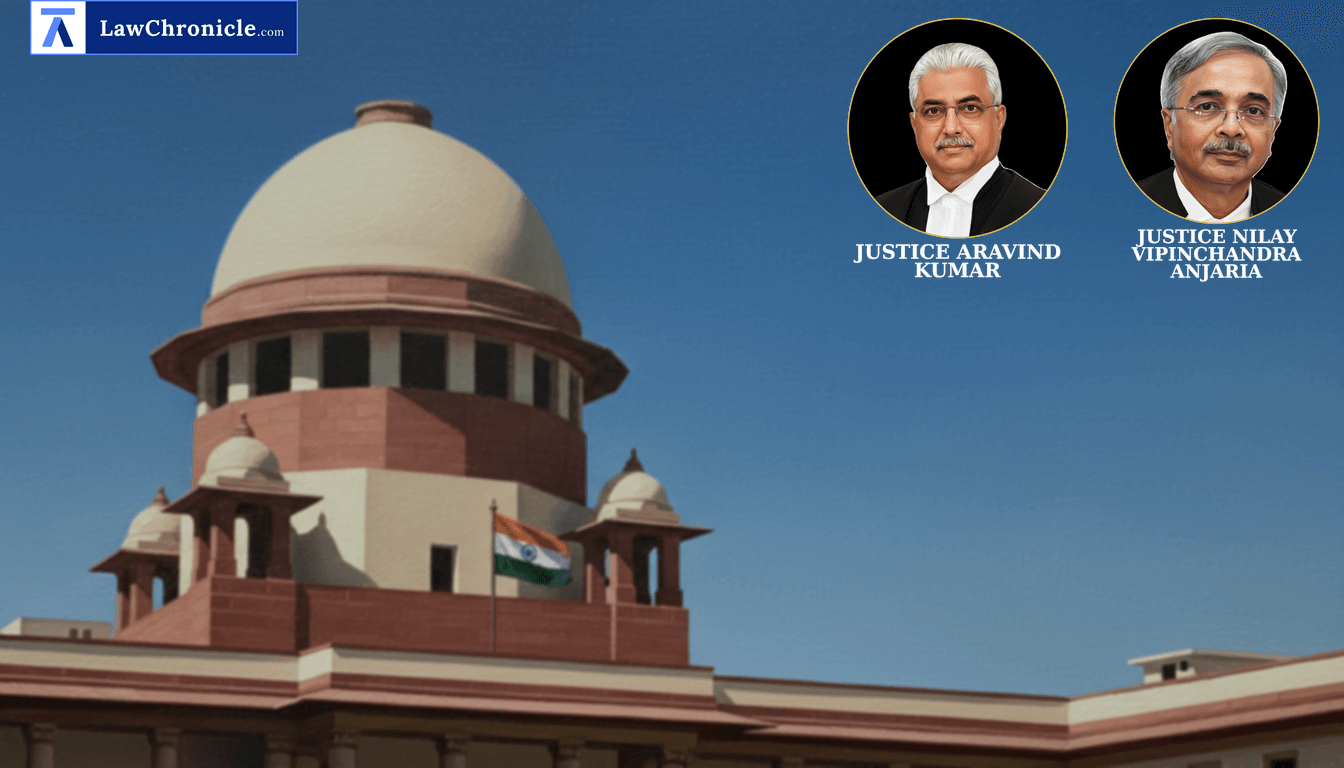
The Supreme Court has redefined the legal landscape for fuel marketing, ruling that public sector oil corporations act as 'commission agents' for gas companies rather than independent buyers, thereby exposing vast profit margins to service tax liability. This landmark decision clarifies that the retention of title and price control by a gas supplier transforms a retail outlet into a service facilitator, effectively ending the 'principal-to-principal' defense previously used to bypass Finance Act, 1994 obligations.
In a decisive verdict, a bench comprising Justice Aravind Kumar and Justice N.V. Anjaria set aside the CESTAT Mumbai's order, which had previously held that oil marketing companies were merely buying and selling goods. The Court examined the complex contractual arrangements between Mahanagar Gas Limited (MGL) and major corporations to determine the true nature of their jural relationship.
Defining the 'Principal-Agent' Nexus in Fuel Distribution
The Court scrutinized whether the supply of Compressed Natural Gas (CNG) through retail outlets constituted an outright sale or a service arrangement. It was observed that the oil corporations provided essential infrastructure, manpower, and sites while MGL retained absolute ownership of the gas and equipment. The Bench noted that the respondent-Corporations acted as facilitators, promoting sales on behalf of MGL without exercising real dominion over the goods.
The Court, in its reasoning, observed: "The whole status of the respondent-Corporations becomes that of a facilitator, who by providing different kind of agreed upon services, arrange and smoothen the sale by MGL to the vehicle owners. The respondent-Corporations acted in the process, in capacity of an agency without any real and effectual dominion over the goods. Their task was to promote the sale on behalf of MGL and make the marketing of goods convenient. A facilitator cannot be a buyer. It only acts on behalf of supplier-principal to become an agent."
Retention of Control and Title Prevents Outright 'Sale'
Under the Sale of Goods Act, 1930, a sale requires the transfer of general property in goods for a price. However, the Court found that the Agreements ensured MGL maintained control over pricing, risk, and unsold stock. Citing Hafiz Din Mohammad Haji Abdulla vs. The State of Maharashtra, the Bench emphasized that even if a party is designated as a 'seller', the court must look at the substance of the contract to ascertain the true relationship.
The Court noted that the risk did not pass to the oil corporations at any point. Furthermore, upon termination of the agreement, all unused stock was to be returned to MGL. The Bench relied on M/s Snow White Industrial Corporation, Madras versus Collector of Central Excise, Madras to highlight that such 'return of stock' clauses are definitive indicators of an agency rather than a sale.
Directives Issued by the Supreme Court
The Court has the following directions:
"The respondent Corporations cannot escape the payment of service tax. The view taken by the adjudicating authority in determining the amounts payable towards service tax by the respondent Corporations, and the reasons recorded therefor, were eminently proper. The order of CESTAT reversing the same cannot stand valid. Resultantly, the impugned common order of the Customs, Excise & Service Tax Appellate Tribunal, West Zonal Bench, Mumbai dated 04.06.2014... is hereby set aside... The appellant is entitled to enforce the demand towards the service tax against the respondent Corporations and for the demand of service tax as adjudicated."
Key Takeaways
Redefinition of Commission vs. Discount
Profit margins received by retailers in controlled-price scenarios are to be treated as taxable commissions rather than trade discounts if the retailer lacks ownership of the goods.
End of Statutory Avoidance
Public Sector Undertakings cannot avoid service tax by labelling agency agreements as 'principal-to-principal' sales when the operational control remains with the supplier.
Standard for Business Auxiliary Service
Marketing and distribution activities for goods belonging to another entity squarely fall under Section 65(19) of the Finance Act, 1994, especially when the distributor is remunerated via a fixed margin per unit sold.
Impact on Distribution Contracts
Future litigants must ensure that 'title' and 'risk' are substantially transferred if they wish to qualify a transaction as a 'sale' and avoid service tax under the agency category.
Ratio
Where a party provides infrastructure and manpower to facilitate the sale of goods belonging to another, while the latter retains absolute title, risk, and price-fixing authority, the relationship is one of 'Principal and Agent'. Remuneration received in such a setup, regardless of its nomenclature as 'profit margin', constitutes a commission for 'Business Auxiliary Service' taxable under the Finance Act.
Background:
The Commissioner of Service Tax, Mumbai, challenged a CESTAT order that had quashed tax demands against Bharat Petroleum (BPCL) and Hindustan Petroleum (HPCL). The Department contended that these corporations provided sites and manpower for MGL's CNG sales and received a commission, which qualified as 'Business Auxiliary Service' under Finance Act, 1994. The oil corporations argued they were buyers of CNG and the transaction was a sale on which VAT was paid. The Supreme Court analyzed the 1998 and 1999 agreements, noting that MGL installed the equipment and owned the gas until it reached the vehicle's tank. The Court followed the logic in Union of India and Others vs. Future Gaming Solutions (P) Ltd. and Another and K. Arumugam vs. Union of India regarding the nature of agency and service tax, ultimately allowing the appeals and restoring the original orders confirming the tax demand.
Case Details:
Case No.: CIVIL APPEAL NOS. 2471-2473 OF 2015
NeutralCitation: 2026 INSC 723
Case Title: Commissioner of Service Tax Mumbai Vs. M/S Bharat Petroleum Corporation Ltd. Etc.
Appearances:
For the Petitioner(s): Mr. Raghavendra P Shankar, Additional Solicitor General; Mr. Gurmeet Singh Makker, Advocate-on-Record
For the Respondent(s): Mr. M.H. Patil, Counsel; M/s. S. Narain & Co., Advocate-on-Record
Source: 2026 CaseBase(SC) 673
 Breaking News