SC: Employees Cannot Be Penalized for Authorities Procedural Errors
 Copy Link
 Share
Share Save
Save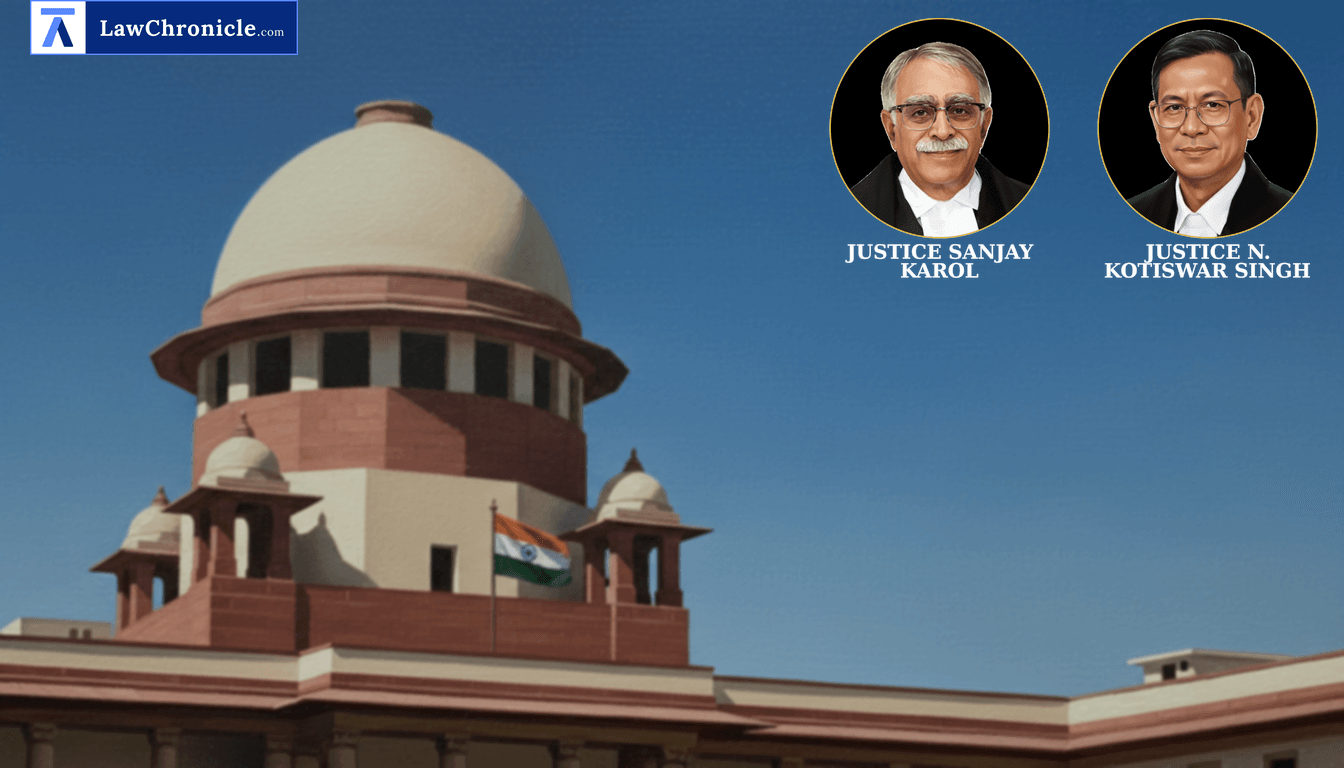
The Supreme Court has protected the livelihoods of employees who served for over a decade, holding that procedural lapses in the internal decision-making of an appointing authority cannot render an otherwise fair selection process void ab initio. The judgment underscores the principle that candidates should not be penalized for administrative failures over which they have no control.
A bench of Justice Sanjay Karol and Justice Nongmeikapam Kotiswar Singh adjudicated the appeal challenging the annulment of appointments in a cooperative society. The Court examined the tension between strict statutory adherence and the equitable rights of long-serving employees.
Court Identifies Three Stages of Recruitment
The Court observed that the recruitment process is severable into three distinct phases: the notification of vacancies, the actual selection method (interviews), and the final administrative resolution for appointment. While the first two stages were found to be transparent and compliant with constitutional mandates, the defect lay solely in the final stage due to the absence of specific official members during the Board of Directors' meeting.
The Court, in its reasoning, observed: "In our opinion, the presence of the non-elected official members of the BOD is to ensure that the recruitment rules have been strictly adhered to in making the appointment... their absence will not render the appointments illegal as their role is essentially supervisory in nature. We, thus find force in the submission made on behalf of Appellants that for the irregularity committed by the officials, the Appellants ought not be made to suffer, as no allegations had been made as regards the validity of advertisement or the manner in which interview was conducted."
Directions Issued to the Respondent Society
To rectify the procedural lapse without discarding a decade of service, the Court has the following directions:
"The Respondent co-operative society to reconvene a meeting of the BOD to reconsider the recommendation made by the selection committee for appointment of the Appellants to the posts of Salesmen-cum-Clerk, Peon-cum-Chowkidar in which meeting, the non-elected official members namely, Assistant Registrar of Cooperative Society, Inspector of Cooperative Society and District Manager, HAFED, shall be present to examine appointments to the advertised posts. However, we make it clear that the reconvened BOD shall not be entitled to re-examine the first two phases of the recruitment process... The BOD shall, accordingly, take a fresh decision regarding the third stage of the recruitment process... it shall examine whether the Appellants fulfilled the essential qualifications and did not suffer from any disqualification and whether they were the candidates who were indeed recommended for appointment."
Background:
The dispute originated from appointments made in 2014 for the posts of Clerk-cum-Salesman and Peon-cum-Chowkidar in a Cooperative Marketing Society. Members of the society challenged the appointments under Section 27 of the Haryana Cooperative Societies Act, 1984, alleging that the selection violated Rule 3 of the Primary Cooperative Marketing-cum-Processing Societies Limited Staff Service Rules, 2003 because the meeting that approved the appointments lacked the mandatory presence of the Assistant Registrar, Inspector of Cooperative Societies, and District Manager of HAFED.
Both a Single Judge and a Division Bench of the Punjab and Haryana High Court had previously upheld the termination of the Appellants, citing that the Primary Cooperative Marketing-cum-Processing Societies Limited Staff Service Rules, 2003 was mandatory and any deviation rendered the appointments void. However, the Supreme Court distinguished between a 'fundamental flaw' (like lack of advertisement or fraud) and a 'curable irregularity' (like quorum defects). Applying Section 36 of the Haryana Cooperative Societies Act, 1984, the Court held that procedural defects in committee acts do not automatically invalidate them if the underlying selection was fair. The Court set aside the High Court judgment and ordered a fresh review by a properly constituted Board within one month.
Case Details:
Case No.: Civil Appeal No. of 2026 (@ SLP (C) No. 23061 of 2025)
NeutralCitation: 2026 INSC 641
Case Title: Gaurav Mehla & Ors. v. State of Haryana & Ors.
Source: 2026 CaseBase(SC) 569
 Breaking News