


SC on Enhancement of Compensation for Land Acquisition: Appellate Order doesn't Renew 3-month Window
 Copy Link
 Share
 Save
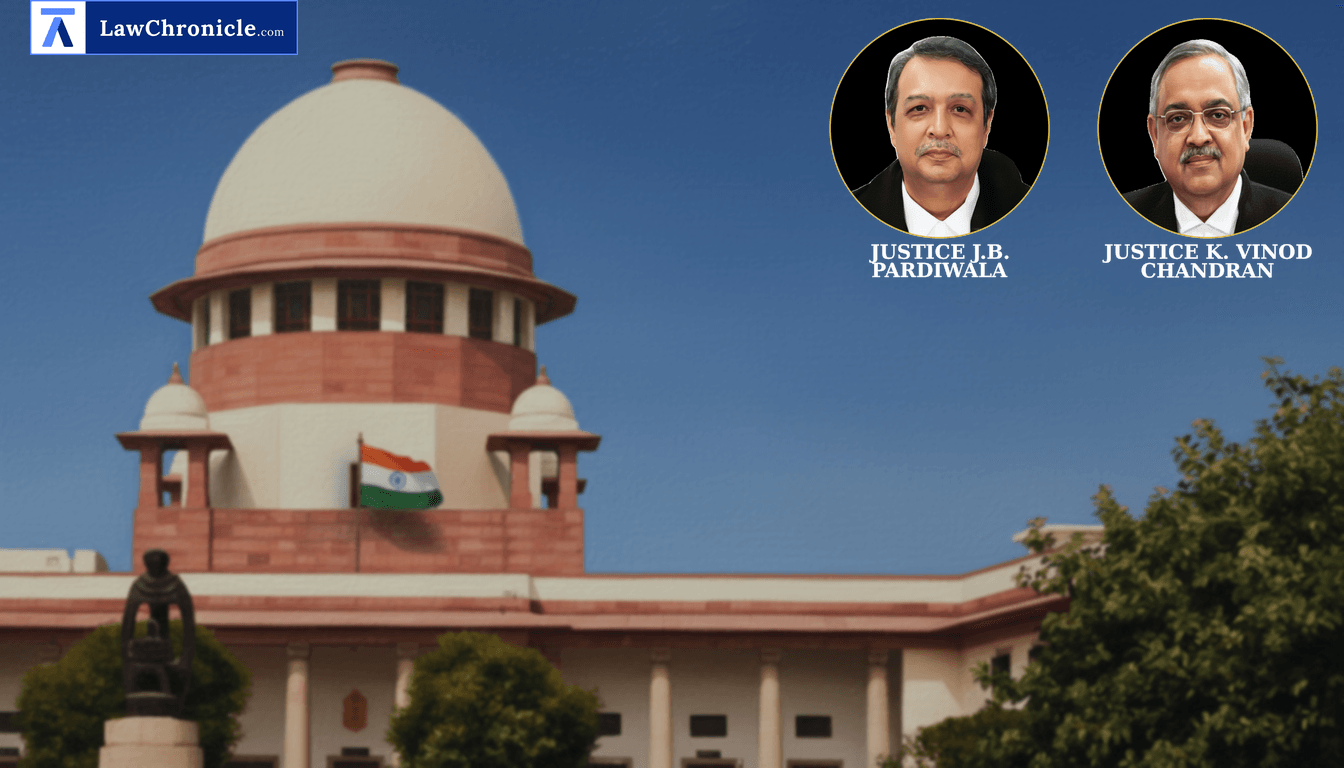
The Supreme Court in accordance with Land Acquisition Law ruled that landowners cannot claim redetermination of compensation under Land Acquisition Act, 1894 based on subsequent appellate orders if they failed to apply within three months of the initial enhancement.
A Division Bench comprising Justice J. B. Pardiwala and Justice K. Vinod Chandran set aside a High Court order that had permitted an application under Section 28A of the Land Acquisition Act, 1894 filed beyond the limitation period counted from the first appellate judgment. The Apex Court addressed the procedural boundaries of redetermining enhancement of compensation for land acquisition when references are initially rejected.
Key Takeaways
Strict Limitation Applies: The three-month limitation period under Section 28A of Land Acquisition Act runs strictly from the date of the award or the first appellate order granting enhancement, not from subsequent orders following precedent.
No Date of Knowledge Benefit: Limitation under Section 28A must be applied with all statutory rigor and cannot be extended on equitable grounds or date of knowledge.
Single Application Rule: Litigants are entitled to only one application under Section 28A for redetermination of compensation.
Scope of Appellate Enhancement: While Section 28A can be invoked following an enhancement of compensation for land acquisition by a High Court when a reference was rejected in toto, subsequent appellate orders do not give rise to fresh causes of action.
Appellate Court and Enhancement of Compensation in Land Acquisition
The Supreme Court observed that when a reference under Section 18 of the Land Acquisition Act, 1894 is rejected in toto without enhancement, a cause of action under Section 28A arises only when the High Court enhances compensation in First Appeal. However, subsequent orders merely following the first decision do not extend or reset the limitation period.
The Apex Court, in its reasoning, observed: "In the present case, we are bound by Banwari and Others v. Haryana State Industrial and Infrastructure Development Corporation Limited (HSIIDC) and Another ( "2024 SCC OnLine SC 3685": 2024 CaseBase(SC) 717) which found the entitlement arising from an order made by the High Court in First Appeal, though, contrary to earlier Co-ordinate and a larger Bench decisions, but in the peculiar circumstance of the reference having been rejected and no cause of action under Section 28A having arisen on the rejection of the reference. We are also bound by the three Judge Bench decision in Union of India and Another v. Pradeep Kumari and Others ( "(1995) 2 SCC 736": 1995 CaseBase(SC) 1210) with respect to successive awards and the context in which such a declaration was made; which context of lands in different villages being covered by successive awards or a later award enhancing the earlier award, not arising in the present case.....We also have to emphasize that there is no question of successive orders in First Appeal, conferring fresh cause of action under Section 28A, since in First Appeal, the High Court being a Court of Record is bound by an order passed at the first instance, by a Coordinate Bench."
Ratio
When a land acquisition reference under Section 18 is rejected in toto, an application for redetermination of compensation under Section 28A of the Land Acquisition Act, 1894 is maintainable based on an appellate order of the High Court granting enhancement for the first time. However, the limitation period of three months commences strictly from the date of such initial appellate order granting enhancement of compensation for land acquisition, and subsequent orders passed in other appeals merely relying on the first order do not confer a fresh cause of action or extend limitation.
Background
The dispute originated from land acquisition proceedings where an award was passed on February 15, 1977. The predecessors-in-interest of the private respondents accepted compensation without seeking a reference under Section 18 of the Land Acquisition Act, 1894. Other landowners sought references, which were rejected by the Additional District Judge, Ghaziabad on November 25, 1981.
An appeal arising from the rejection was disposed of by the High Court on April 18, 2022 (Annexure P1), following an earlier appellate decision dated July 8, 2019 in First Appeal No. 593 of 1982. On May 23, 2022, the respondents filed an application under Section 28A of the Land Acquisition Act, 1894 claiming enhanced compensation within three months of the April 18, 2022 order.
The Collector rejected the application as non-maintainable because it was based on an appellate order rather than a Reference Court award. On a challenge, the High Court accepted the respondents' claim, relying on Union of India and Another v. Pradeep Kumari and Others ( "(1995) 2 SCC 736": 1995 CaseBase(SC) 1210) and Banwari and Others v. Haryana State Industrial and Infrastructure Development Corporation Limited (HSIIDC) and Another ( "2024 SCC OnLine SC 3685": 2024 CaseBase(SC) 717).
Reversing the High Court's decision, the Supreme Court analyzed several precedents including Jose Antonio Cruz Dos R. Rodriguese and Another v. Land Acquisition Collector and Another, Union of India and Another v. Hansoli Devi and Others ( "(2002) 7 SCC 273": 2002 CaseBase(SC) 990), Union of India and Another v. Hansoli Devi and Others, Popat Bahiru Govardhane and Others v. Special Land Acquisition Officer and Another, Bharatsing s/o Gulabsingh Jakhad and Others v. State of Maharashtra and Others ( "(2018) 11 SCC 92": 2017 CaseBase(SC) 234), and Babua Ram and Ors. v. State of U.P. and Anr.. The Court held that Union of India and Another v. Pradeep Kumari and Others ( "(1995) 2 SCC 736": 1995 CaseBase(SC) 1210) applied to successive Reference Court awards and did not enable fresh limitation periods from repetitive High Court orders. Relying on Popat Bahiru Govardhane and Others v. Special Land Acquisition Officer and Another, the Supreme Court reiterated that limitation laws must be applied strictly. Since the first enhancement by the High Court occurred on July 8, 2019, the three-month period expired on October 7, 2019, rendering the 2022 application time-barred. The appeal was accordingly allowed.
Case Details:
Case No.: Civil Appeal No. 2026 of 2026 (Arising out of SLP (C) No. 18801 of 2025)
Case Title: New Okhla Industrial Development Authority & Anr. v. Rajveer Singh & Ors.
Source: 2026 CaseBase(SC) 7017
Similar Articles
 Breaking News


