

SC Exercises Plenary Powers to Suspend Senior Advocate's Contempt Conviction
 Copy Link
 Share
Share Save
Save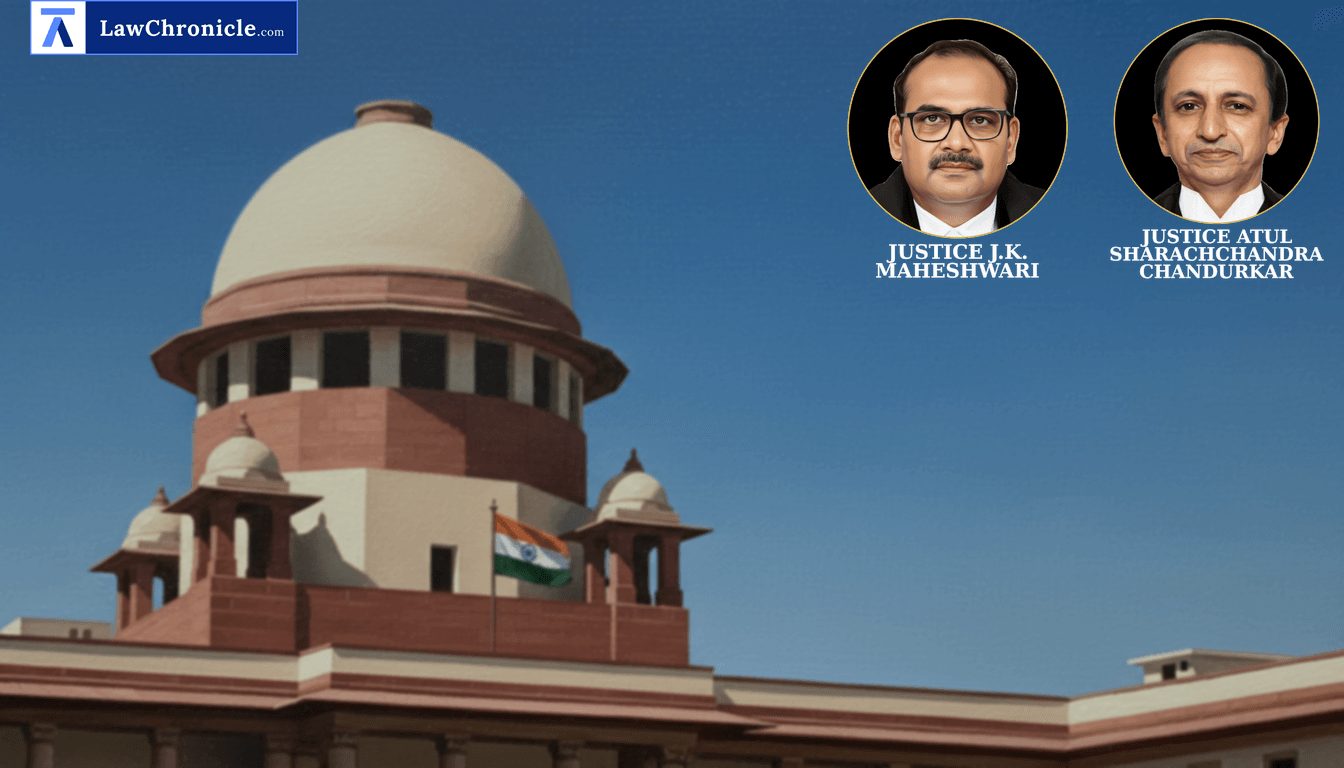
In a significant exercise of its extraordinary jurisdiction, the Supreme Court has provided a final window for reform to a Senior Advocate by staying his conviction for criminal contempt while mandating periodic judicial monitoring of his conduct.
A bench comprising Justice J.K. Maheshwari and Justice Atul S. Chandurkar heard the appeal against the judgment of the Gujarat High Court which had found the appellant guilty of 'criminal contempt' under Section 2(c)(i) of the Contempt of Courts Act, 1971. The appellant, who served as the President of the Gujarat High Court Advocates’ Association, was sentenced to imprisonment till the rising of the court and a fine for making scandalous allegations against the High Court administration and its Registry during a live press conference in 2020.
While the Supreme Court refused to interfere with the factual findings of the High Court on merits, it invoked Article 142 of the Constitution of India, 1950 to indefinitely suspend the conviction and sentence. The Court noted that the appellant had already suffered the deprivation of his senior designation for a considerable period and had tendered multiple unconditional apologies.
The Court has the following directions:
"(i) The reasons assigned in the impugned order by the High Court do not warrant any interference by this Court, yet, extending a final act of forgiveness, we are inclined to exercise our plenary powers under Article 142 of the Constitution of India to suspend / keep in abeyance the conviction as well as sentence of the Appellant as a consequence of this judgment, indefinitely.
(ii) In the meanwhile, no disqualification or disadvantage arising out of the Appellant’s conviction under the 1971 Act shall attract, including but not limited to disqualification under Section 24-A of the Advocates Act, 1961.
(iii) The Full Court of the High Court shall undertake periodic review of the Appellant’s conduct at an interval of every two years in light of the undertaking of the Appellant quoted in paragraph 50 of this judgment. If the Appellant is found to have carried out any further act of similar nature, the High Court shall be at liberty to file an application in the instant disposed of appeal seeking to give immediate effect to the Appellant’s conviction and sentence as directed by the High Court in the present proceedings.
(iv) Lastly, we request the High Court to take a fresh decision in respect of the incident of 2024 and the question of withdrawal of senior designation, in light of the present judgment, completely uninfluenced by the Appellant’s conviction for contempt by the High Court in the impugned judgment. Needless to say, the decision of retaining / withdrawing the Appellant’s senior gown can also be made a subject of the periodic review every two years which we have directed above."
The Doctrine of Judicial Magnanimity and Reform
The Court, in its reasoning, observed: "The Court's magnanimity is unparalleled; it is a testament to the measured patience of the Court that justice must be tempered with mercy. The relationship between the Bar and the Bench is like two sides of the same coin, forever complementing each other. Candor and honesty on either side must also be met with patience and dignity on the other. A frictionless relationship between the Bar and the Bench only furthers the purpose of justice and forwards the cause of those seeking justice."
The Court highlighted that while the appellant's remarks, such as calling the Court a 'gambling den' were intemperate and lowered the authority of the institution, the stresses of the COVID-19 pandemic and the pressures of leading the Bar were mitigating factors that warranted a chance for redemption.
The Status of Senior Designation
Addressing the parallel proceedings regarding the withdrawal of the appellant's senior gown under the High Court of Gujarat Designation of Senior Advocate Rules, 2018, the Court clarified that criminal contempt proceedings under the Contempt of Courts Act, 1971 are distinct from the administrative recall of a senior designation. However, the Court acknowledged the professional and social impact of losing the designation, which the appellant had already endured for over a year. The Bench emphasized that the senior status carries a duty to maintain the dignity of the entire legal ecosystem.
Background:
The dispute originated from a live Facebook press conference held by the appellant on June 5, 2020. During this session, the appellant alleged that the High Court Registry practiced favouritism, corruption, and 'forum shopping,' specifically claiming that matters of 'billionaires' were prioritized over those of ordinary litigants and junior advocates. The Gujarat High Court took suo motu cognizance, noting that the remarks scandalized the court and its administration.
Following a 3-Judge Committee report that found the allegations baseless, the High Court convicted the appellant and rejected his apology, labelling it a 'paper apology' intended to avoid punishment. The High Court also noted the appellant's history of similar incidents in 2006 and 2016. In Yatin Narendra Oza v. Khemchand Rajaram Koshti, the Supreme Court had previously accepted the appellant's apology for separate contemptuous remarks, warning him to be more cautious in the future.
In the current appeal, the Supreme Court observed that the 2016 warning should have tempered the appellant's conduct. Despite this, the Court chose a path of 'forgiveness with vigil,' ensuring that the appellant remains under observation for any future infractions while the conviction remains in abeyance.
Case Details:
Case No.: CRIMINAL APPEAL NO. 669 OF 2020
NeutralCitation: 2026 INSC 470
Case Title: YATIN NARENDRA OZA vs. SUO MOTU, HIGH COURT OF GUJARAT AND ANOTHER
Appearances:
For the Petitioner(s): Mr. K.K. Venugopal, Mr. Kapil Sibal, Dr. Abhishek Manu Singhvi, Mr. Arvind Datar, Mr. Sushil Kumar Jain (Senior Counsels)
For the Respondent(s): Mr. Vijay Hansaria (Senior Counsel for High Court)
Source: 2026 CaseBase(SC) 399
 Breaking News