SC: Expired Driving Licence Relieves Insurer; Vehicle Owner Liable
 Copy Link
 Share
Share Save
Save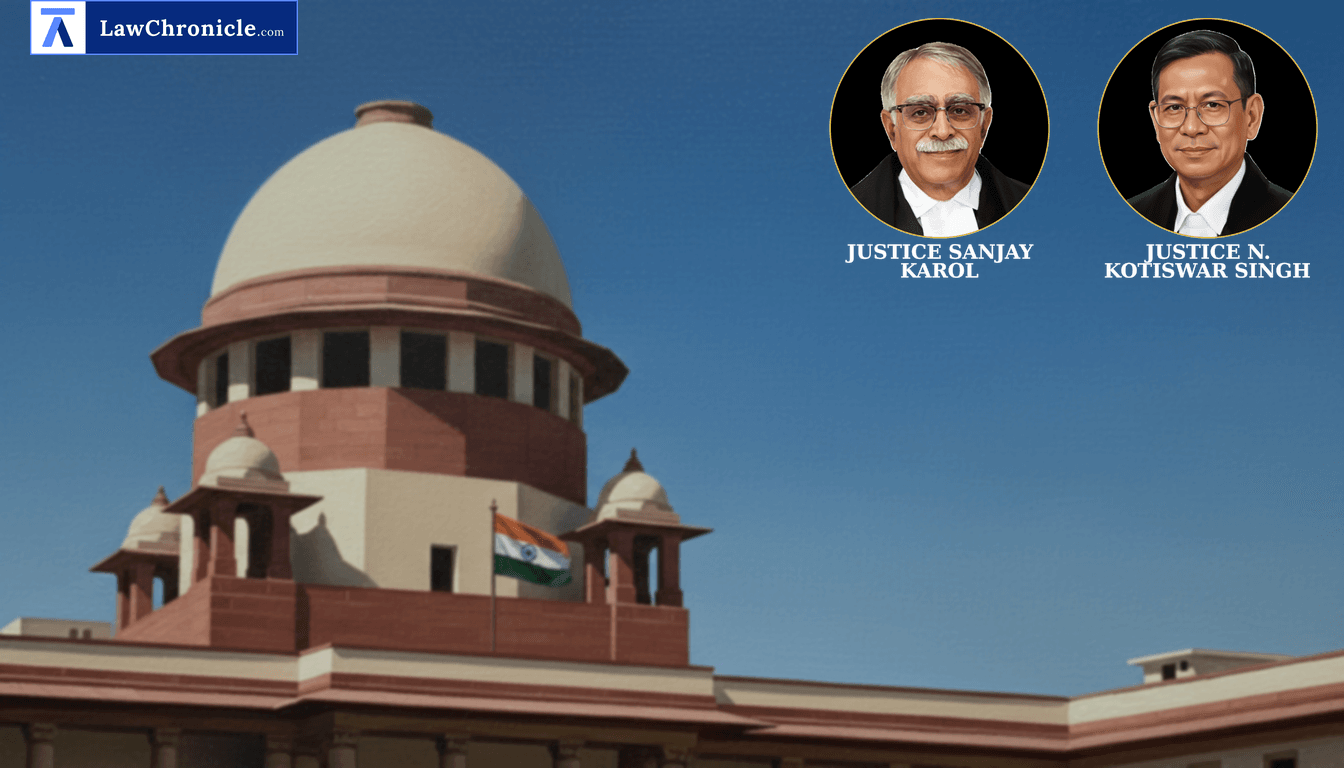
Holding vehicle owners strictly responsible for ensuring their drivers maintain a valid driving license, the Supreme Court has ruled that insurance companies cannot be saddled with liability if an accident occurs during an un-renewed gap period. The decision reinforces that an insurer's liability abates when an employer displays gross negligence by allowing an unlicensed driver to operate a vehicle on public roads.
A bench of Justice Sanjay Karol and Justice Nongmeikapam Kotiswar Singh allowed the appeal filed by an insurance firm against a High Court judgment that had shifted the compensation burden onto the insurer. The Supreme Court set aside the High Court's findings, restored the decision of the Motor Accidents Claim Tribunal, Panipat, and invoked the 'pay and recover' principle.
Invalid License and Secondary Evidence Standard
The dispute centered around a road accident that took place on October 14, 2009. The Motor Accidents Claim Tribunal held the driver and owner exclusively liable because the driver lacked a valid driving license on the date of the accident. However, the High Court reversed this finding by relying on a zonal communication from the transport authority alleging a loss of electronic data during an agency migration.
Reevaluating the evidentiary value of official documents under Section 61 to 64 and Section 65 of the Indian Evidence Act, 1872, the Supreme Court held that official records must be produced to prove an official document unless strict conditions for admitting secondary evidence are satisfied. Citing Neeraj Dutta v. State (NCT of Delhi) and Tharammel Peethambaran v. T. Ushakrishnan, the Court reiterated that primary evidence remains the rule and secondary evidence is an exception requiring a solid factual foundation.
The Court observed that the driver paid a penalty for renewing the license for the intervening gap period between 2007 and 2010. The Court, in its reasoning, observed: "When in question was an official document, and the law is that the certain circumstances have to be established before secondary evidence can be taken to prove the same, we fail to understand the undue importance which is placed by the High Court on the statement of RW3, more so, in view of the fact that the Tribunal has explicitly recorded there being a contradiction with documentary evidence..."
Owner's Duty to Verify and Renew License
Addressing the statutory duty under Section 3 and Section 5 of the Motor Vehicles Act, the bench observed that vehicle owners cannot wash their hands of the obligation to verify that their driver holds an effective license. Referring to Telangana State Level Police Recruitment Board v. Penjarla Vijay Kumar, Beli Ram v. Rajinder Kumar, and National Insurance Co. Ltd. v. Hem Raj, the bench emphasized that handing over a motor vehicle to an unlicensed driver exposes the public to grave risks.
While discharging the insurer from ultimate liability, the Court invoked the 'pay and recover' directive, enabling the insurance company to recover the disbursed award amount from the owner and driver.
The Court has the following directions:
"The Ministry of Road, Transport and Highways, Government of India, as also the respective counterparts of the States should, we may suggest, undertake campaigns through all mediums such as awareness drives, social media, etc. to drive home this importance; introduce measures to ensure strict compliance; and also streamline the process of issuance/renewal of licenses. Other issues such as regulation of driving schools, the affordability thereof, and accessibility in terms of regional languages, when it comes to applications and tests, etc. also need urgent attention."
Key Takeaways
Insurer Liability Abatement: Insurers are not liable to satisfy claims if the driving license was expired at the time of the accident and was not renewed within time.
Strict Owner Responsibility: Vehicle owners owe a duty to society and must verify the validity of their driver's license continuously under Section 5 of the Motor Vehicles Act.
Evidentiary Standard for Official Documents: Secondary evidence explaining gaps in official records cannot be accepted blindly without satisfying the mandatory conditions under Section 65 of the Indian Evidence Act, 1872.
Pay and Recover Principle: Insurers may be directed to pay the award to third-party claimants initially, with full liberty to recover the complete sum from the vehicle owner and driver.
Ratio
An insurance company is relieved of its liability to indemnify the owner under a motor insurance policy if the driver of the offending vehicle does not possess an effective driving license on the date of the accident. Vehicle owners are under a statutory mandate to ensure their drivers hold valid licenses, and failure to do so constitutes a breach of policy conditions warranting the application of the pay-and-recover doctrine.
Background:
The case arose out of a motor accident on October 14, 2009, involving a two-wheeler driven by the claimant and an offending vehicle driven by Om Prakash and owned by Rajinder Singh. The Tribunal quantified the compensation at Rs. 86,95,947/- with interest but exonerated Reliance General Insurance Company Ltd., holding that the driver lacked a valid license on the accident date. On appeal, the High Court increased the compensation to Rs. 1,08,08,909/- and fastened the liability on the insurer, accepting the driver's explanation regarding transport department data loss.
The Supreme Court analyzed the evidence, noted the payment of late renewal penalties indicating a lapse in license validity, and held that the High Court erred in accepting uncorroborated oral assertions over documentary evidence. The Supreme Court allowed the appeal, exonerated the insurer from final liability, and granted it liberty to recover the awarded amount from the driver and owner.
Case Details:
Case No.: Civil Appeal Nos. of 2026 (Arising out of SLP(C) Nos.6743-6744 of 2023)
NeutralCitation: 2026 INSC 767
Case Title: Reliance General Insurance Company Ltd. v. Om Parkash & Ors.
Source: 2026 CaseBase(SC) 704
 Breaking News