

SC: High Court Cannot Issue Broad Policy Directions While Exercising Bail Jurisdiction
 Copy Link
 Share
Share Save
Save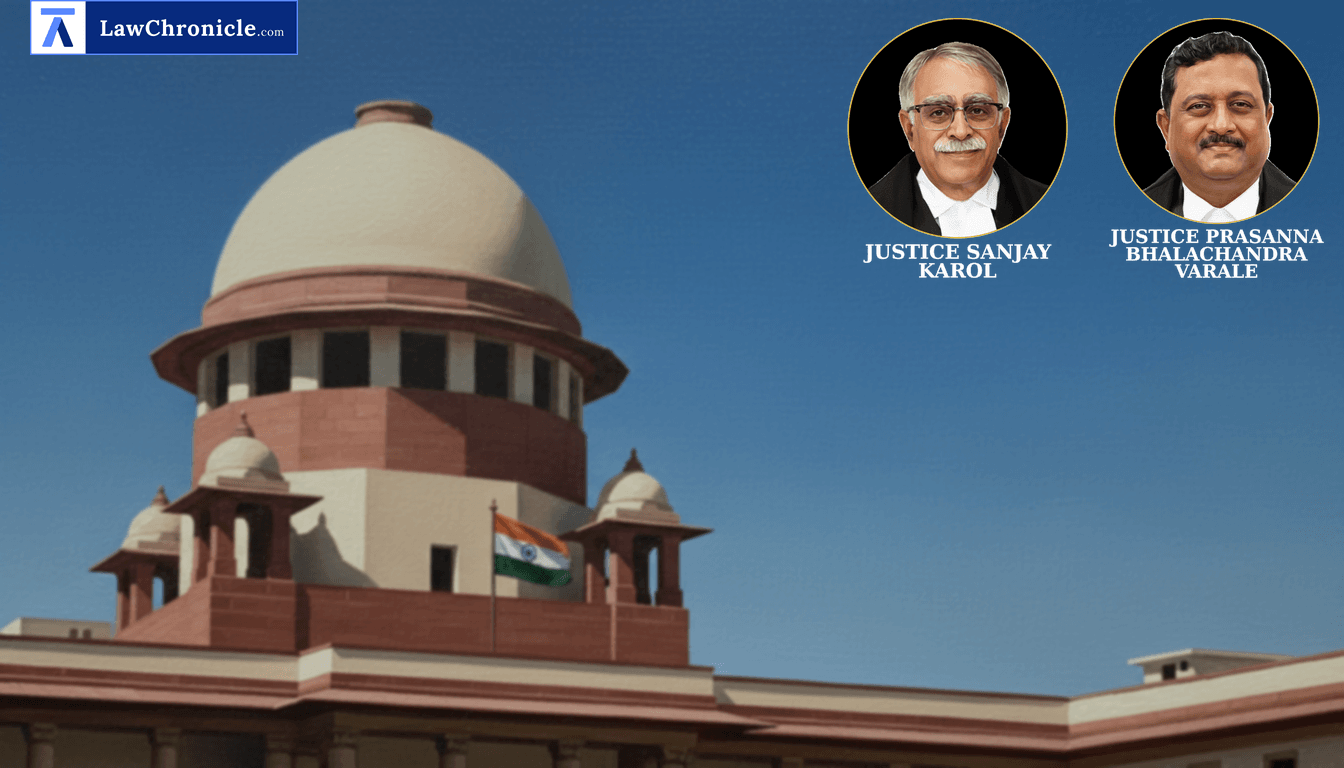
The Supreme Court set aside directions issued by the High Court aimed at reforming the criminal justice system's witness summoning process, holding that statutory bail powers cannot be used to usurp constitutional or legislative domains. In a significant ruling, a bench of Justice Sanjay Karol and Justice Prasanna B. Varale emphasized the distinction between constitutional and statutory powers, clarifying that the scope of bail jurisdiction is limited to the custody of the accused.
Supreme Court Defines Limits of Bail Jurisdiction
The matter reached the apex court following an appeal against a High Court order which, while dealing with a second bail application under the BNSS 2023, had reiterated extensive directions to the State authorities regarding the execution of summons and coercive measures. The High Court had previously directed the Additional Chief Secretary (Home) and the Director General of Police to create accountability systems for officials failing to serve summons under the Cr.P.C..
Judicial Reasoning on Statutory vs Constitutional Power
The Court, in its reasoning, observed: "The constitutional power cannot overshadow the statutory power, enlarging its scope beyond what has been envisaged by the statute. In other words, while both powers rest with the High Court, one power cannot usurp the ambit of another, unless otherwise permitted by law." The bench relied on the precedent set in State of U.P. v. Anurudh, which established that a Court's jurisdiction under Section 439 of the Cr.P.C. (or Section 483 of BNSS 2023) is strictly limited to adjudicating whether a person should be released or remain incarcerated.
Distinction Between Derivative and Sovereign Powers
The apex court highlighted that while High Courts are constitutional courts, the error in the impugned order stemmed from exercising a statutory power bail jurisdiction as if it were an inherent constitutional power. It noted that statutory powers are derivative and must conform strictly to the parameters laid down by the enabling law, such as the Juvenile Justice (Care and Protection of Children) Act 2015 or the Indian Penal Code 1860.
Background:
The appellant, Rambalak, was involved in a case registered under Sections 419, 420, 467, 468, and 471 of the Indian Penal Code 1860. While his bail was under consideration, the High Court observed that the criminal justice system in Uttar Pradesh suffered from delays in witness production. Consequently, in cases like Bhanwar Singh @ Karamvir v. State of U.P. and Jitendra v. State of U.P., the High Court had issued mandates for creating nodal officers and 'witness registers' to ensure accountability.
The Supreme Court, while confirming the interim bail granted to the appellant on 26th November 2025, allowed the appeal to the extent of setting aside the High Court's policy-level directions. However, to ensure administrative stability, it permitted the state to continue the reforms independently of the set-aside judicial orders.
Case Details:
Case No.: Criminal Appeal No. 2026 (@ SLP (Crl.) No. 16332 of 2025)
NeutralCitation: 2026 INSC 511
Case Title: Rambalak v. State of U.P.
Appearances:
For the Respondent(s): Ms. Akriti Chaubey (Amicus Curiae)
Source: 2026 CaseBase(SC) 442
 Breaking News