SC analyses just compensation in motor accident cases; enhances minor’s compensation by 83%
 Copy Link
 Share
Share Save
Save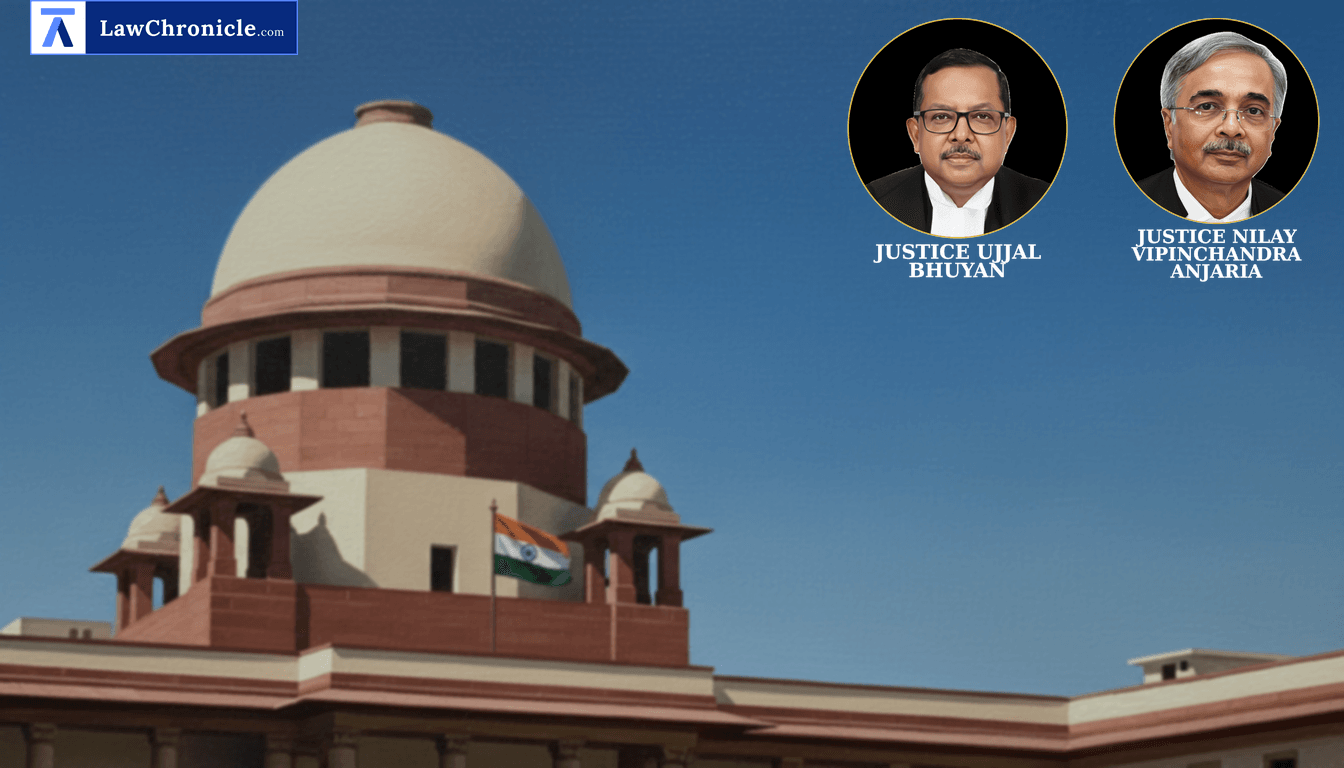
The Supreme Court recently emphasized that Courts must calculate just compensation in motor accident cases considering loss of future income of minors based on minimum wages for skilled workers while factoring in complete functional disability. The Bench expressed that child victims suffering catastrophic, permanent injuries in motor vehicular accidents cannot be treated as ordinary non-earning individuals. Overturning the High Court's reduced calculations, the apex court enhanced the compensation package by 83% to account for lifelong care, attendant charges, and total functional loss.
A bench comprising Justice Ujjal Bhuyan and Justice N.V. Anjaria was hearing a civil appeal challenging the judgment and order of the Orissa High Court, which partly modified the award granted by the Motor Accident Claims Tribunal (MACT), raising the initial compensation. The High Court applied reduced multiplier and restricted allowances for future care. The Supreme Court re-evaluated the entire framework of compensation under Section 168 of the Motor Vehicles Act, 1988 to ensure the award truly satisfies the mandate of 'just compensation'.
Compensation for Child in Car Accident
Addressing the distinct nature of catastrophic injuries suffered by minor children, the Supreme Court clarified that bodily loss at a tender age alters the child's entire existence and permanently deprives them of human dignity, social interaction, and independent living. The Court emphasized that physical disability certified by medical boards must be distinguished from functional disability, which measures the actual loss of earning capacity and normal life pursuits. Examining the facts, the bench observed that a 90% physical disability in an infant, resulting in lifelong paraplegia, translates to 100% functional disability, rendering the child completely incapable of engaging in any future gainful employment.
The Court has following directions:
"Respondent No. 2 i.e. M/s New India Assurance Company Limited is directed to deposit the entire amount of compensation as determined supra alongwith accrued interest within a period of six weeks from the date of receipt of a copy of this judgment before the 3rd Motor Accident Claims Tribunal, Cuttack which shall thereafter disburse the same to the appellant-claimant after following the due procedure."
Just Compensation in Motor Accident Cases
Evaluating the statutory framework and precedent on personal injury awards, the Supreme Court, in its reasoning, expressed that "The expression ‘just compensation’ is not defined in the MV Act. However, the legislative intent is clear. Compensation awarded should be just, fair and reasonable. It should neither be a windfall nor a pittance. Since loss arising from death or permanent disability cannot be measured with mathematical precision, some amount of approximation and judicial discretion is inevitable. Therefore, the endeavour of the court should be to assess and award compensation which is realistic and which reasonably compensates the claimant for the pecuniary as well as the non-pecuniary losses suffered on account of the accident."
In its analysis for just compensation in motor accident cases, the Supreme Court Bench stated that “While pecuniary damages compensate measurable financial losses, non-pecuniary damages seek to redress the enduring impact of the injury upon the quality, enjoyment and normal incidents of life. Together, these heads constitute the framework within which the courts assess ‘just compensation’ in cases involving permanent disability arising out of catastrophic injuries due to the accident.”
Key Takeaways
Functional Disability Test Applied: High Court and MACT errors were corrected by determining that a certified physical disability can result in 100% functional disability if it entirely destroys the victim's future earning capacity.
Skilled Worker Minimum Wage Baseline: Loss of future earnings for injured children must be computed on the matrix of minimum wages payable to a skilled worker in the relevant State, rather than treating them as unskilled or non-earning persons.
Multiplier Method Mandatory For Attendant Charges: The multiplier system, using the highest multiplier of 18 for young children, must be applied to calculate lifelong attendant expenses to account for inflation, interest rates, and uncertainty of life.
Ratio
Compensation for child in car accident suffering catastrophic permanent disability targeting loss of future earnings must be calculated using the minimum wages of a skilled worker alongside an addition for future prospects and an appropriate multiplier of 18. Furthermore, where physical impairment permanently destroys the capacity to lead an independent life or earn a livelihood, functional disability must be assessed at 100%, and lifelong attendant charges must be quantified using the multiplier method.
Background of Compensation for Child in Car Accident
The dispute arose out of a severe motor vehicular accident on June 16, 2015, when a Hyundai i10 car carrying six-month-old girlchild and her parents was violently hit by a rashly driven tanker. The infant suffered severe spinal cord and neurological injuries, leaving her diagnosed with post-traumatic myelopathy with paraplegia and certified with 90% permanent locomotor disability. A charge-sheet was subsequently filed against the tanker driver under Sections 279, 337, and 338 of the Indian Penal Code, 1860.
The mother filed a claim for Compensation for child in car accident vide petition under Section 166 of the Motor Vehicles Act, 1988 before the MACT, Cuttack. The Tribunal found the tanker driver negligent, held the insurer liable, and awarded Rs. 30,12,960 with 6% interest per annum. On appeal in MACA No. 283 of 2022, the Orissa High Court enhanced the sum to Rs. 45,40,800. However, the High Court reduced the multiplier from 18 to 15 while assessing loss of future earnings and awarded a flat sum for future attendant charges rather than using a multiplier calculation.
In evaluating the appeal, the Supreme Court placed reliance on established jurisprudence, including Phillips v. London & South Western Railway Co. and Divisional Controller, KSRTC v. Mahadeva Shetty ( "(2003) 7 SCC 197": 2003 CaseBase(SC) 177) for determining 'just compensation' in motor accident cases. The Apex Court referred to Raj Kumar Vs. Ajay Kumar ( "(2011) 1 SCC 343": 2010 CaseBase(SC) 368) and Shankar Dutt Vs. United India Insurance Co. Ltd. ( "2026 SCC OnLine SC 1193": 2026 CaseBase(SC) 613) for defining functional disability against physical disability.
Precedents on Compensation for Child in Car Accident
Relying on Kajal Vs. Jagdish Chand ( "(2020) 4 SCC 413": 2020 CaseBase(SC) 1600), Master Ayush Vs. Reliance General Insurance Company Limited ( "(2022) 7 SCC 738": 2022 CaseBase(SC) 356), Baby Sakshi Greola Vs. Manzoor Ahmed Simon ( "(2024) SCC OnLine SC 3692": 2024 CaseBase(SC) 897), Divya Vs. National Insurance Company Limited ( "(2024) 12 SCC 436": 2022 CaseBase(SC) 1258), Hitesh Nagjibhai Patel Vs. Bababhai Nagjibhai Rabari, Hansraj Vs. Mukesh Nath ( "2026 SCC OnLine SC 812": 2026 CaseBase(SC) 387), and Abhimanyu Partap Singh Vs. Namita Sekhon ( "(2022) 8 SCC 489": 2022 CaseBase(SC) 906), the Supreme Court ruled that child victims cannot be treated as non-earning individuals and that minimum wages for skilled workers must be applied.
The Court also referenced Syed Basheer Ahamed Vs. Mohammed Jameel ( "(2009) 2 SCC 225": 2009 CaseBase(SC) 619), National Insurance Company Limited Vs. Pranay Sethi ( "(2017) 16 SCC 680": 2017 CaseBase(SC) 551), R.D. Hattangadi Vs. Pest Control (India) Pvt. Ltd. ( "(1995) 1 SCC 551": 1995 CaseBase(SC) 1318), S. Ettiappan Vs. D. Kumar ( "(2026) 1 TAC 84": 2024 CaseBase(MAD) 8017), and K.S. Muralidhar Vs. R. Subbulakshmi ( "2024 SCC Online SC 3385": 2024 CaseBase(SC) 863) to emphasize that non-pecuniary damages, pain and suffering, and attendant expenses must reflect full, fair, and humane compensation. Consequently, the Supreme Court allowed the appeal, modified the High Court judgment, and enhanced the total compensation payable by the insurer from Rs. 45,40,800 to Rs. 83,38,360, with interest at the rate of 9% per annum from the date of filing the claim petition till realization.
Case Details:
Case No.: CIVIL APPEAL NO. 7067 OF 2026
Neutral Citation: 2026 INSC 785
Case Title: GAYATREE PATTNAIK FOR SHREEJITA PATTNAIK v. ARUNDHATI SAHOO AND ANR.
Source: 2026 CaseBase(SC) 718
 Breaking News