SC: Landowners Cannot Stall Public Projects by Raising Belated Natural Justice Pleas
 Copy Link
 Share
Share Save
Save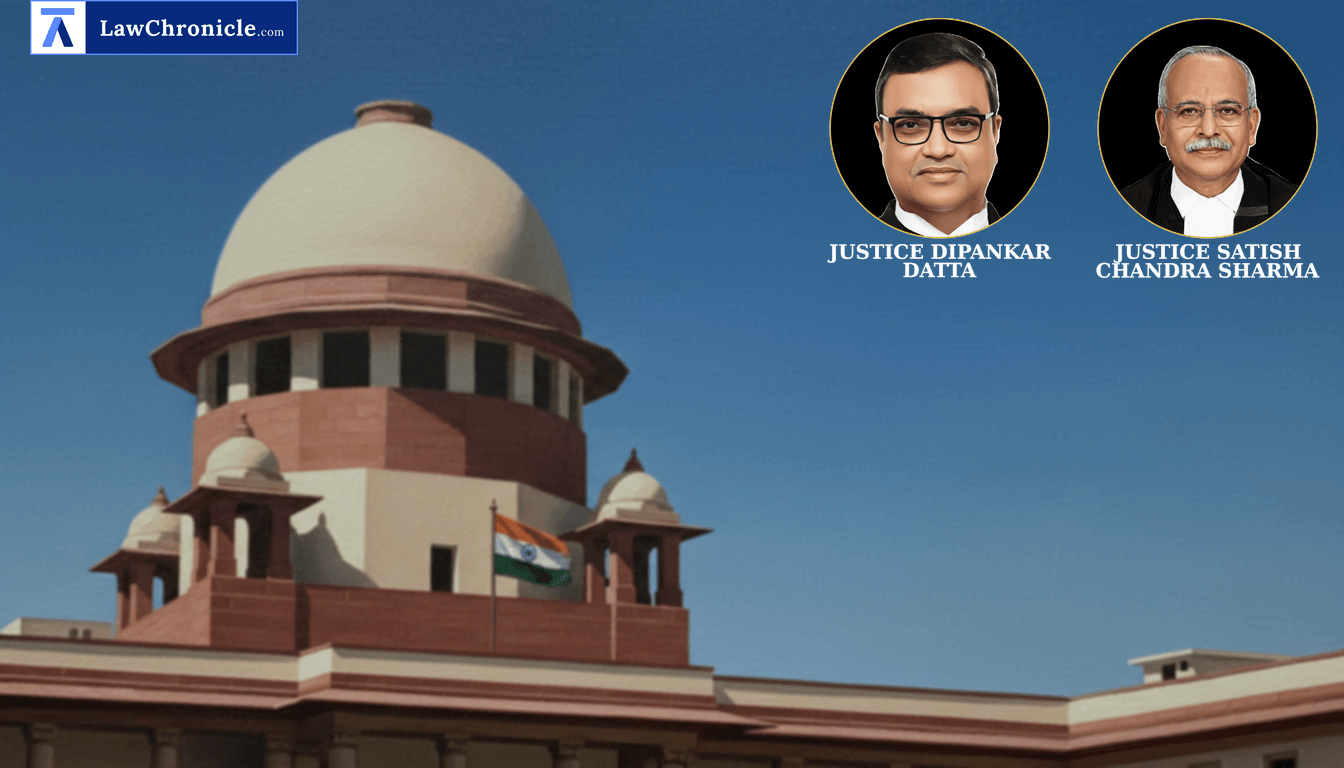
In a decisive stance against litigation aimed at stalling critical public infrastructure, the Supreme Court has ruled that a landowner’s lack of diligence during land acquisition proceedings cannot be salvaged by technical pleas of natural justice violations. The Court clarified that while the right to a hearing is a mandatory safeguard, it is not an "unqualified" right that can be invoked by parties who abandon their own participation through silence and absence.
Justice Dipankar Datta and Justice Satish Chandra Sharma heard the appeals filed by landowners who sought to invalidate the acquisition of 27 hectares of land for the construction of a metro car depot as part of Phase II of the Jaipur Metro Rail Project. The appellants challenged the Division Bench's decision to reverse a Single Judge's order which had originally quashed the acquisition proceedings on the ground that the Land Acquisition Officer (LAO) failed to provide a personal hearing under Section 5A of the Land Acquisition Act, 1894.
The Balance Between Procedural Safeguards and Public Infrastructure
The Bench examined whether the LAO’s failure to fix a hearing date after the appellants missed a rejoinder deadline constituted a fatal blemish on the acquisition process. The Court observed that the appellants had appeared on multiple previous dates but failed to appear or seek an adjournment on the specific date set for their rejoinder.
The Court, in its reasoning, observed: "A party might choose not to prosecute its own objection; but the LAO cannot be expected to compel such party to prosecute its objection. Absence of the appellants on 9th April, 2012 coupled with their subsequent silence, appears to have goaded the LAO to proceed on the footing that the appellants had nothing further to submit beyond the written objections. We see no infirmity in the approach."
Court Directions Regarding Environmental Compensation
Addressing concerns regarding the ecological impact and the uprooting of trees on the subject land, the Court refused to classify the land as a "deemed forest" in the absence of statutory records. The Court has the following directions:
"The impugned judgment has issued directions with respect to plantation of trees which may be uprooted on account of construction of the metro car depot. The acquisition proceedings cannot be quashed on account of uprooting trees on a small area of the subject land."
The Court further noted that any removal of trees would remain subject to applicable environmental norms and compensatory measures already mandated by the authorities.
Judicial Restraint in Planning and Survey Decisions
The appellants also contended that no proper survey preceded the Section 4 notification and that alternative government lands were available. Relying on National Highways Authority of India v. Madhukar Kumar ( "(2022) 14 SCC 661": 2021 CaseBase(SC) 1528) and Sooraram Pratap Reddy v. Collector, the Court reiterated that the state is the best judge of public purpose and the suitability of specific land parcels. It clarified that Section 4(2) of the Land Acquisition Act, 1894 permits a survey after the notification, not before.
Key Takeaways:
Waiver of Natural Justice Rights
Failure to pursue objections or appear before administrative authorities can be construed as an abandonment of the right to be heard, preventing subsequent challenges on procedural grounds.
Public Purpose Primacy
Judicial intervention is limited in matters of infrastructure planning; courts will not substitute their own wisdom for that of expert authorities regarding land suitability or project requirements.
Ecological Classification
Mere proliferation of vegetation or trees does not transform a land parcel into a 'deemed forest' unless specifically identified in a Master Plan or statutory revenue records.
Statutory Sequence in Acquisition
Under the Land Acquisition Act, 1894, the power to conduct detailed surveys and soil testing is a consequence of the preliminary notification, not a prerequisite for its issuance.
Ratio Decidendi:
The right to hearing under Section 5A of the Land Acquisition Act, 1894 is a mandatory procedural safeguard, but it is subject to the diligent participation of the landowner. Substantial compliance is achieved when the authority provides multiple opportunities that the party fails to utilize. Furthermore, administrative reports under Section 5A are not required to be speaking orders with the trappings of a judicial decree; brief reasons supporting the recommendation for a public purpose are sufficient to satisfy the requirements of the Constitution of India, 1950.
Background:
The dispute arose when the Government of Rajasthan issued a notification in 2011 to acquire land in Village Sheopura for the Jaipur Metro Rail Project. The landowners filed objections under Section 5A but failed to attend a crucial proceeding on April 9, 2012. The LAO subsequently forwarded a report recommending acquisition, leading to a Section 6 declaration. The High Court's Single Judge quashed the acquisition, but the Division Bench restored it, leading to the present appeal. The Supreme Court relied on precedents like Kamal Trading v. State of West Bengal, Farid Ahmed vs. Municipal Corporation of Ahmedabad, and New Okhla Industrial Development Authority v. Darshan Lal Bohra ( "2024 SCC OnLine SC 1690": 2024 CaseBase(SC) 986) to analyze the scope of Section 5A. The Court finally dismissed the appeals, allowing the metro project to proceed while granting appellants liberty to seek enhanced compensation.
Case Details:
Case No.: CIVIL APPEAL NO.8269 OF 2026
NeutralCitation: 2026 INSC 682
Case Title: Alok Kotahwala & Ors. Vs. Jaipur Metro Rail Corporation Limited & Ors.
Appearances:
For the Petitioner(s): Mr. Mukul Rohatgi, Senior Advocate; Mr. Shyam Divan, Senior Advocate; Mr. Abhay Kumar Bhandari, Senior Advocate
For the Respondent(s): Mr. Tushar Mehta, Solicitor General
Source: 2026 CaseBase(SC) 639
 Breaking News