SC: Mandatory Opportunity Notice Under FERA Is Condition Precedent For Prosecution
 Copy Link
 Share
Share Save
Save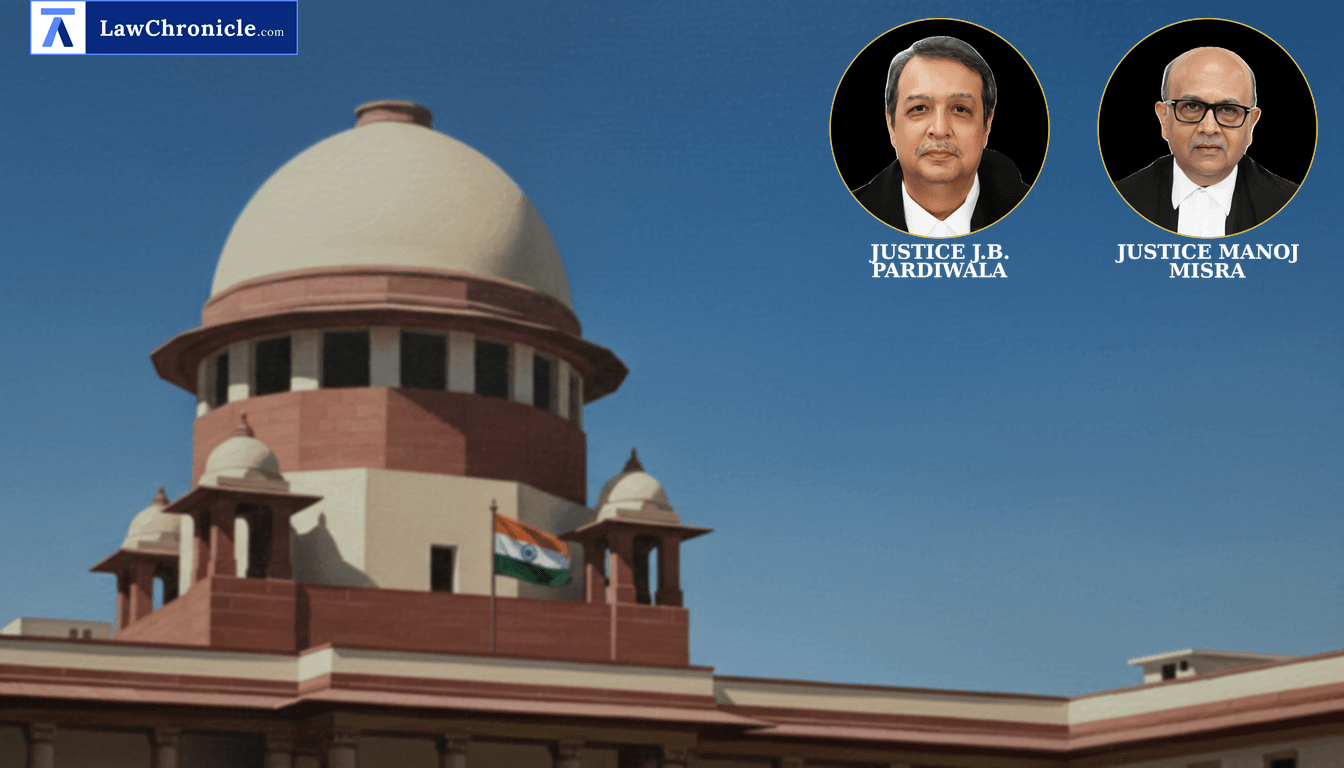
In a decisive reinforcement of the right to a fair trial, the Supreme Court has quashed decades-old criminal complaints against a global banking major, ruling that the failure to serve a mandatory 'opportunity notice' under Foreign Exchange Regulation Act, 1973 and an unexplained 23-year delay constitute a fatal violation of fundamental rights. The judgment establishes that statutory prerequisites for criminal prosecution under economic laws must be strictly satisfied at the threshold, and the judiciary cannot allow litigants to remain in a state of 'suspended animation' indefinitely due to the prosecution's lethargy.
Establishing a significant precedent for economic offences, a bench comprising Justice J.B. Pardiwala and Justice Manoj Misra addressed the interplay between the inherent powers of the High Court and statutory revisional remedies. The Court heard an appeal challenging a Bombay High Court order that had refused to quash complaints against the appellants involving alleged unauthorised foreign exchange credits dating back to 1991-1992. The appellants argued that the prosecution was instituted without the mandatory notice required under the proviso to Section 61(2) of the Foreign Exchange Regulation Act, 1973 and that their right to a speedy trial under Article 21 of the Constitution of India, 1950 was violated.
High Court Errs in Treating Revisional Remedy as Absolute Bar to Section 482
The Supreme Court observed that the High Court was incorrect in holding that the availability of an alternative remedy of revision under Section 397 of the Code of Criminal Procedure, 1973 operated as an absolute bar to a petition under Section 482 of the Code of Criminal Procedure, 1973. Relying on Dhariwal Tobacco Products Ltd. v. The State of Maharashtra and Prabhu Chawla v. State of Rajasthan ( "(2016) 16 SCC 30": 2016 CaseBase(SC) 173), the Court reiterated that the inherent power of the High Court remains available to prevent abuse of the process of any court. The Court also cited Akanksha Arora v. Tanay Maben ( "2024 SCC OnLine SC 3688": 2024 CaseBase(SC) 733) to emphasize that nomenclature is immaterial, and the High Court can always convert a petition under Section 482 into a revision under Section 397, and vice-versa, to ensure substantive justice.
Mandatory Compliance of Section 61(2) Opportunity Notice
Central to the judgment was the interpretation of Section 61(2) of the Foreign Exchange Regulation Act, 1973. The Court held that the service of an opportunity notice is a mandatory requirement. Drawing from Devashis Bharracharya v. Union of India, Sanjay Malviya v. R.K. Rawal, CEO, Enforcement Directorate, United India Airways Ltd. v. Chief Enforcement Officer, Enforcement Directorate, and Shilpi Modes v. Directorate of Enforcement, the Bench noted that the prosecution failed to produce any proof of service of the said notice despite being granted multiple opportunities. The Court, in its reasoning, observed: "The service of an opportunity notice under the proviso to Section 61(2) of FERA is a mandatory requirement, without compliance of which no complaint under Section 56 or 57 of FERA respectively, can validly be instituted, and no Magistrate can validly take cognizance of the offence alleged therein. This opportunity must be meaningful and adequate, and not a mere technical or notional compliance, given the drastic penal consequences that follow from proceedings under FERA."
Chronic Delay as Violation of Article 21
Examining the 23-year delay, the Court applied the 'balancing test' from Abdul Rehman Antulay v. R.S. Nayak ( "(1992) 1 SCC 225": 1991 CaseBase(SC) 481) and P. Ramachandra Rao v. State of Karnataka ( "(2002) 4 SCC 578": 2002 CaseBase(SC) 116). It found that the respondent-complainant failed to take steps to serve summons for years and ignored time-bound directions from the High Court. Referring to Kailash Chandra Kapri v. State of Uttar Pradesh ( "2026 SCC OnLine SC 858": 2026 CaseBase(SC) 549), the Court held that keeping an accused in 'suspended animation' for over three decades is incompatible with the constitutional guarantee of quick and timely justice.
Court's Final Directions
The Court has following directions:
"The complaint bearing Criminal Case Nos. 1503-1504 of 2002, and the summoning order dated 30.05.2002 issued therein, are liable to be quashed as against the appellants herein only. We accordingly pass such order. In view of the above, the appeals succeed and are hereby allowed. Accordingly, the impugned judgment and order of the High Court is hereby set aside. Pending applications, if any, shall stand disposed of. The Registry is hereby directed to circulate one copy each of this judgment to all the High Courts."
Key Takeaways
Strict Adherence To Procedural Safeguards
Statutory preconditions for prosecution, like the opportunity notice in economic laws, are mandatory and cannot be waived or satisfied through notional compliance.
Revisional Bar Is Not Absolute
The existence of an alternative remedy under Section 397 CrPC does not oust the High Court's inherent jurisdiction under Section 482 to quash proceedings to prevent the abuse of law.
Prosecution's Burden In Case Of Delay
Inordinately long delays attributable to the prosecution's inaction provide a presumptive proof of prejudice to the accused, warranting the quashing of proceedings under Article 21.
Judicial Duty At Cognizance Stage
Magistrates are under a statutory duty to satisfy themselves regarding the satisfaction of mandatory legal preconditions before issuing summons or taking cognizance.
Ratio
The service of an opportunity notice under the proviso to Section 61(2) of FERA is a mandatory condition precedent for a valid prosecution. Furthermore, an unexplained and persistent delay in the trial, caused by the prosecution's lack of diligence, constitutes a violation of the fundamental right to a speedy trial under Article 21 of the Constitution, necessitating the quashing of proceedings to prevent the abuse of the legal process.
Background:
The dispute began with allegations that Standard Chartered Bank and its officer, Ms. B. Mchugh, contravened Foreign Exchange Regulation Act, 1973 provisions regarding foreign exchange remittances in 1991-92. Complaints were filed in 2002, just before the sunset period of FERA expired. However, summons were not served effectively for a decade. The Bombay High Court in 2012 refused to quash the proceedings, suggesting that the appellants should have filed a Revision instead of a quashing petition and that delay alone was not enough to quash. The Supreme Court overturned this, finding both a procedural failure (no notice) and a substantive constitutional violation (delay).
Case Details:
Case No.: CRIMINAL APPEAL NOS. 2142-2143 OF 2013
NeutralCitation: 2026 INSC 727
Case Title: Standard Chartered Bank & Anr. Versus Enforcement Officer Ministry Of Home Affairs & Anr.
Appearances:
For the Petitioner(s): Mr. Shyam Divan, Senior Counsel
For the Respondent(s): Ms. Ruchi Kohli, Senior Counsel
Source: 2026 CaseBase(SC) 676
 Breaking News