SC Prefers Regularisation Over Demolition in Navi Mumbai Mall Case
 Copy Link
 Share
Share Save
Save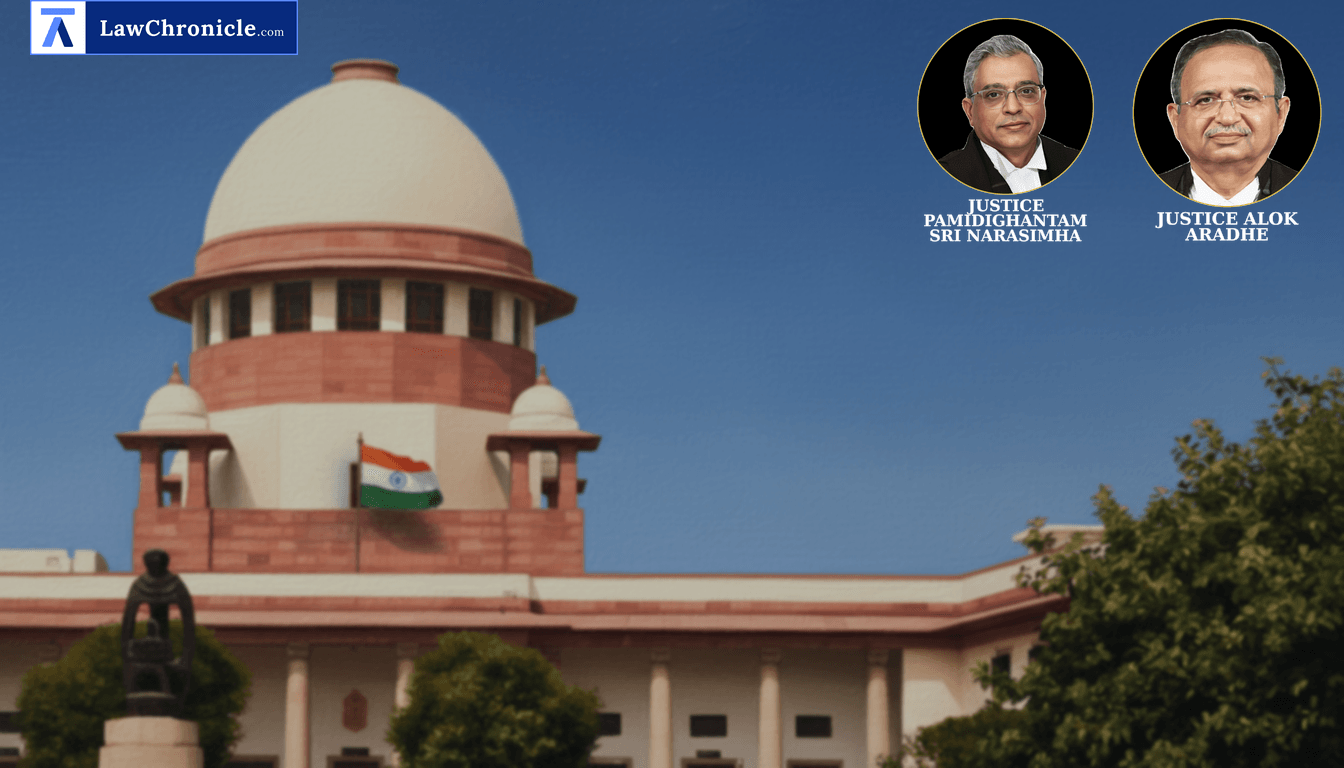
The Supreme Court of India in K. Raheja Corp. Private Limited v. The State of Maharashtra & Ors. Etc. prioritised public interest and economic stability by choosing regularisation over the demolition of a fully operational commercial complex, despite initial irregularities in its allotment. The decision underscores the application of the doctrine of proportionality in cases where irreversible third-party rights and substantial economic investments have crystallised over decades
A bench of Justice Pamidighantam Sri Narasimha and Justice Alok Aradhe adjudicated upon the appeals challenging a Bombay High Court order that had directed the restoration of a plot in Navi Mumbai to its original state. The bench navigated the complex intersection of administrative irregularity and the pragmatic necessity of preserving large-scale urban infrastructure that provides thousands of livelihoods.
The Doctrine of Proportionality and Irreversibility
While the Court acknowledged the findings of the Sankaran Committee regarding the irregular nature of the original allotment, it held that the High Court's direction to demolish the shopping mall and hotel was unsustainable. The Court noted that an investment of Rs. 450 crores had been made, and the complex had been operational since 2009, employing approximately 8,000 individuals.
In its reasoning, the Court observed: "A remedy that causes public harm disproportionate to the public benefit it achieves is not a remedy that law ought to countenance. Public law must be sensitive to the distinction between remedies that restore public welfare and remedies that merely punish, when punishment comes at the cost of the very public the law seeks to protect."
Shift from Sankaran to Banthia Methodology
The Court rejected the Developer's plea for parity with other allottees under the 2005 policy, noting that a large commercial enterprise cannot be treated the same as individual allottees or housing societies. Crucially, the bench discarded the 2005 valuation methodology proposed by the Sankaran Committee, opting instead for the more recent and realistic market valuation recommended by the Banthia Committee.
The Court, in its reasoning, observed: "Regularisation is not a continuation of the original transaction; it is a fresh grant of legal legitimacy, prospective in nature, for which the Developer must pay what the land was actually worth at the time of the court's judgment."
Court Directions
The Court has following directions:
"(i) The Developer shall pay a sum of Rs.3,18,31,37,664/- (Rupees Three Hundred Eighteen Crores and Thirty-One Lakhs Thirty-Seven Thousand Six Hundred Sixty-Four only) for the entire area of the subject plot, being the fair market value as established by the ready reckoner rates applicable to Sector 30A, Vashi, Navi Mumbai, as of November 2014. (ii) The amount already paid by the Developer towards the purchase price of the subject plot at the rate of Rs.10,250/- per sq. metre shall be duly adjusted and deducted from the total amount payable. (iii) The Developer shall additionally pay a sum of Rs. 1 crore in lieu of the obligation to develop a garden on Plot No. 40, which remained unfulfilled. (iv) Subject to the payment of the aforesaid amount within a period of four months from the date of this judgment, the allotment of the subject plot in favour of the Developer shall stand regularised. (v) Needless to state that the dispute with regard to plot No. 39/16 which is the subject matter of W.P. No. 368 of 2015 shall be decided by the High Court on its own merits."
Background:
The dispute originated from the allotment of land in Sector 30A, Vashi, Navi Mumbai, by the City and Industrial Development Corporation Limited (CIDCO) in 2003. The plot, originally reserved for Information Technology use, was converted for commercial use and allotted to the Developer without a competitive tender process. Two Public Interest Litigations (PILs) were filed in the High Court challenging the allotment. While the High Court found the allotment illegal under Article 14 of the Constitution of India, 1950, it granted liberty for regularisation.
The Supreme Court, while hearing the appeals, considered the reports of two committees. The Sankaran Committee had identified a loss of Rs. 50 crores in 2005. Later, the Banthia Committee recommended regularisation based on 2014 market values. The Court ultimately used the Ready Reckoner rates of 2014 to calculate a total regularisation fee and interest amounting to over Rs. 318 crores, modifying the High Court's order to ensure financial restitution to CIDCO under the Maharashtra Regional and Town Planning Act, 1966 framework without resorting to demolition.
Case Details:
Case No.: CIVIL APPEAL NOS. 13092–13093 OF 2025
NeutralCitation: 2026 INSC 551
Case Title: K. RAHEJA CORP. PRIVATE LIMITED v. THE STATE OF MAHARASHTRA & ORS. ETC.
Source: 2026 CaseBase(SC) 460
 Breaking News