


SC Quashes MHA's Cryptic Rejection of Premature Release for Convict in Jail for 22 Years
 Copy Link
 Share
 Save
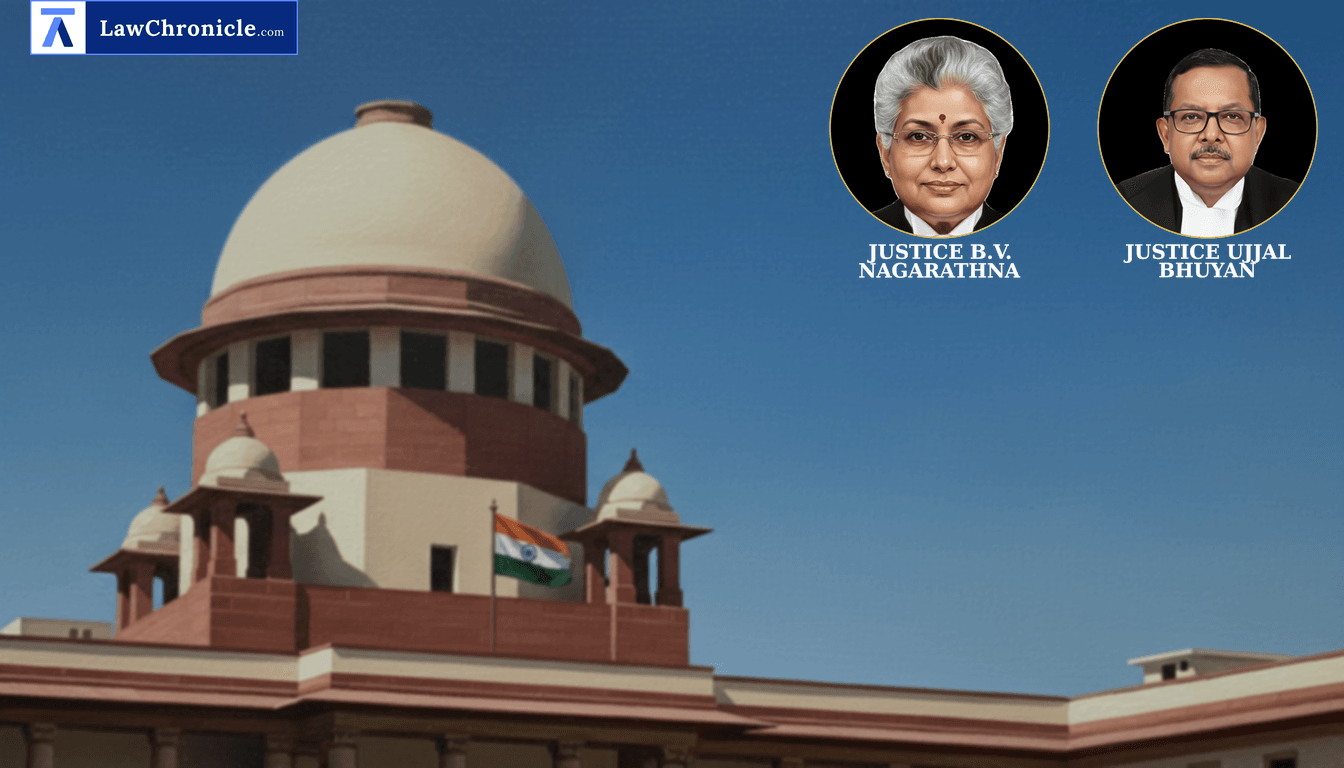
Emphasizing the need for reasoned executive decisions and the reformative objectives of the criminal justice system, the Supreme Court quashed the Ministry of Home Affairs’ decision denying the premature release of a life convict who had spent over two decades behind bars.
Deeply critical of the executive's 'non-speaking' and 'cryptic' approach, a bench of Justice B.V. Nagarathna and Justice Ujjal Bhuyan held that the denial of remission cannot rest solely on the 'heinousness' of the original crime. The Court highlighted that while the State of Uttarakhand had recommended the petitioner's release based on his good conduct, the Central Government had rejected the plea without providing any cogent reasons, thereby violating principles of natural justice.
The Requirement of Reasoned Executive Decisions
The Court observed that any order affecting the liberty of an individual must reflect a due application of mind. The impugned letter from the Ministry of Home Affairs (MHA) merely stated that it did not 'concur' with the State’s proposal without disclosing any basis for the disagreement.
The Court, in its reasoning, observed: "It is a settled principle of law that any order affecting rights of a person and particularly his liberty must be with reasons and must reflect due application of mind. Recording of reasons is not an empty formality, it is a safeguard against arbitrariness and ensures transparency, fairness, and accountability in decision-making. The absence of reasons renders it bald and makes it impossible to ascertain whether relevant factors were duly considered or not."
Moving Beyond Retributive Justice
Addressing the argument that the crime was too heinous for remission, the Court noted that the gravity of the offence is factored into the initial sentencing and should not be the sole hurdle during the remission stage. Invoking the philosophy of Plato, the Bench noted that punishment should serve as medicine for the 'healing' of the offender rather than mere retroactive vengeance.
The Court further emphasized that the petitioner's case was bolstered by his 22-year incarceration and the fact that a co-accused had already been released by the Government of Uttar Pradesh in 2023. Denying the petitioner similar relief, the Court held, would constitute a violation of the constitutional requirement of fairness and non-arbitrariness.
Directives Issued to the Authorities
The Court has the following directions:
"Since we have held that the petitioner is entitled to the benefit of premature release/remission and since he is already on interim bail, his surrender shall not be required, and the respondents shall treat him as having been prematurely released/remitted in terms of the present order."
Background:
The case originated from a 2003 murder investigation initially handled by the U.P. State Police and later transferred to the CBI under the Delhi Special Police Establishment Act, 1946. While the crime occurred in Lucknow, the trial was transferred to Uttarakhand by the Supreme Court in 2007. The petitioner was convicted under Section 302 and 120B of the Indian Penal Code, 1860 and sentenced to life imprisonment.
Over the years, the petitioner sought remission, leading to a complex jurisdictional battle. Initially, based on Radheshyam Bhagwandas Shah Alias Lala Vakil Vs. State of Gujarat and Another, the plea was directed to Uttar Pradesh. However, following the landmark ruling in Bilkis Yakub Rasool vs. Union of India ( "(2024) 5 SCC 481": 2024 CaseBase(SC) 531), which overruled Radheshyam Bhagwandas Shah Alias Lala Vakil Vs. State of Gujarat and Another, the Supreme Court clarified that the 'appropriate government' for remission under Section 432 of the Code Of Criminal Procedure, 1973 is the state where the trial and conviction occurred in this case, Uttarakhand.
Because the CBI had investigated the case, Section 477 of the Bharatiya Nagarik Suraksha Sanhita, 2023 (corresponding to Section 435 of the Code Of Criminal Procedure, 1973) required the concurrence of the Central Government. Despite the State of Uttarakhand recommending release, the MHA refused. The Court ultimately relied on principles established in State (NCT of Delhi) vs. Prem Raj, State of Haryana vs. Mahender Singh ( "(2007) 13 SCC 606": 2007 CaseBase(SC) 369), and Satish vs. State of U.P. regarding the legal rights of convicts to be considered for remission and the factors governing such decisions, such as those laid out in Laxman Naskar vs. State of W.B. and Laxman Naskar vs. Union of India. The Bench also cited Mohd. Giasuddin vs. State of A.P. to highlight the reformative philosophy that should guide sentencing and release.
Case Details:
Case No.: WRIT PETITION (CRIMINAL) NO.446 OF 2023
NeutralCitation: 2026 INSC 490
Case Title: ROHIT CHATURVEDI VERSUS STATE OF UTTARAKHAND & OTHERS
Source: 2026 CaseBase(SC) 426
Similar Articles

 Breaking News


