SC Quashes Section 74 CGST Notice Issued Without Satisfying Foundational Facts
 Copy Link
 Share
Share Save
Save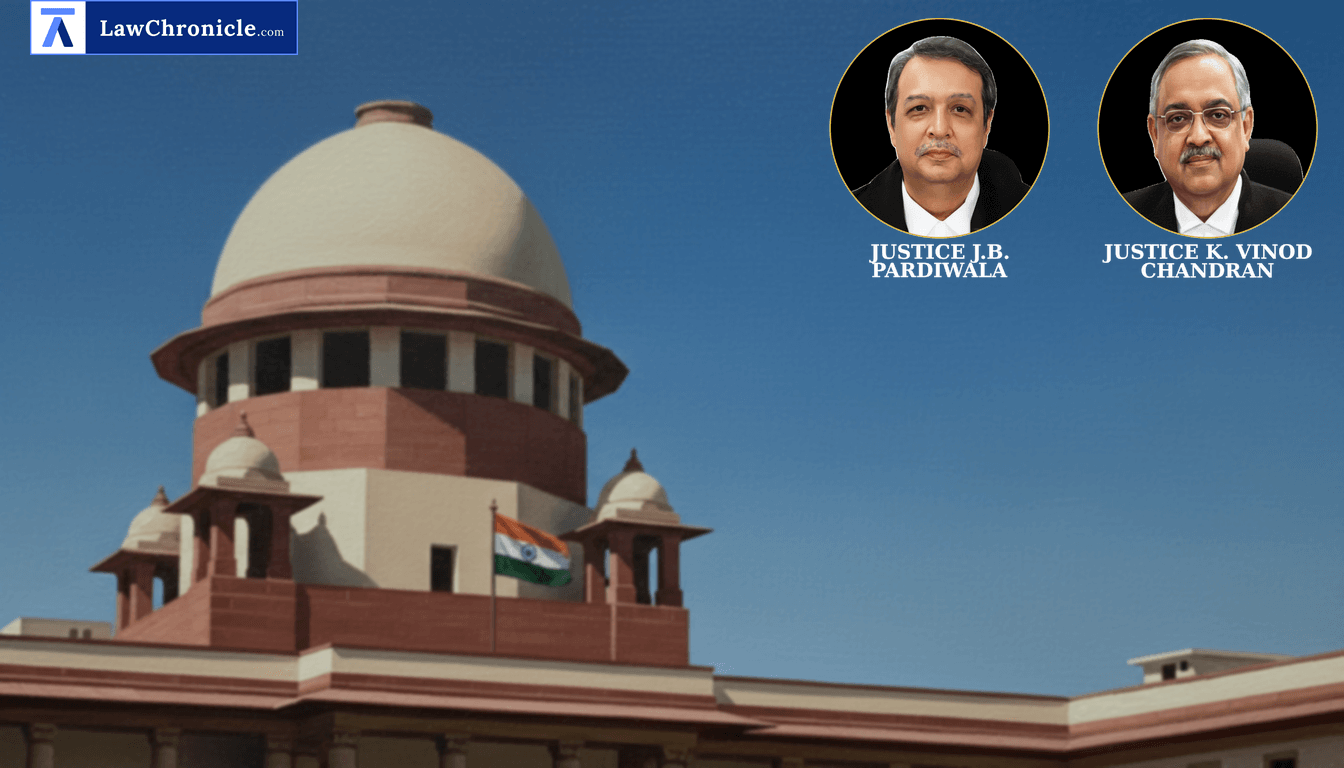
Mechanical invocation of extended limitation under GST laws without concrete evidence of intentional tax evasion is a fatal procedural defect that renders show cause notices legally unsustainable. The Supreme Court declared that revenue authorities cannot rely on bland assertions or mere recitation of statutory terms to invoke extended limitation periods without establishing actual mental application and foundational facts.
A bench comprising Justice J.B. Pardiwala and Justice K. Vinod Chandran set aside a Show Cause Notice (SCN) and the consequential Order-in-Original issued against a major corporate assessee, ruling that the revenue department failed to establish any subjective satisfaction or foundational grounds justifying the invocation of extended limitation under Section 74 of the Central Goods and Services Tax Act, 2017.
Key Takeaways
Foundational Facts Mandatory
Mere mechanical recitation of statutory words like fraud or suppression cannot justify invoking extended limitation under Section 74.
Protective Assessments Alien to GST
Revenue authorities cannot issue notices under the guise of 'protective demand' once proceedings are transferred to the call book.
Assessing Officer's Independent Satisfaction
SCNs triggered purely by external audit objections without independent satisfaction of the Assessing Officer are invalid.
Court's Analysis on Extended Limitation and Departmental Procedure
The Supreme Court observed that the department initiated proceedings primarily relying on an audit objection raised by the Comptroller and Auditor General of India. However, the Assessing Officer himself lacked initial conviction, transferring the matter to the 'call book' while contesting the issue before the Public Accounts Committee. Subsequently, a fresh notice proposing a 'protective demand' was issued solely because the normal limitation period was nearing its end.
Addressing the mandatory preconditions for invoking Section 74, the Court held:
"The foundational facts which led to the inference arrived at of fraud/willful misrepresentation/suppression should be evident from the notice itself. The mere employment of such words will not indicate an application of mind, upon which alone the satisfaction can be arrived at. The words are not to be mechanically recited in the notice to enable recovery outside the normal limitation provided under the statute."
The Court clarified that even though the initial SCN and consequential order dated December 26, 2025, were set aside due to lack of foundational facts, the department retains the liberty to initiate fresh proceedings under Section 74, provided proper foundational facts are set out in the notice and the final order is passed before February 28, 2027.
Ratio
To invoke the extended period of limitation under Section 74 of the CGST Act, 2017, the Show Cause Notice must explicitly contain foundational facts demonstrating fraud, wilful misstatement, or suppression of facts; generic recitation of statutory terms without independent application of mind by the Assessing Officer renders the notice void.
Background
The dispute arose when show cause notices were issued to the appellant for three financial years (2018-2019 to 2020-2021) alleging mismatch of input tax credit (ITC) and short payment of tax, following audit observations. The appellant challenged the invocation of Section 74 of the Central Goods and Services Tax Act, 2017, arguing that there was no element of fraud, willful misstatement, or suppression of facts, which are statutory prerequisites for extending the limitation period from three years to five years.
The department argued that proceedings were initiated prior to the expiry of limitation under Section 73 and relied on statutory exclusions granted during the pandemic period under IN RE Cognizance for Extension of Limitation. However, the Court observed that the SCN dated June 13, 2025, fell past the extended normal limitation period of February 28, 2025, and could not be sustained under Section 74 without concrete foundational facts. Consequently, the Supreme Court allowed the appeal and set aside the impugned SCN and Order-in-Original while granting liberty to the department to re-initiate appropriate proceedings in accordance with law.
Case Details:
Case No.: Civil Appeal No. of 2026 (Arising out of SLP (C) No.16859 of 2026)
Neutral Citation: 2026 INSC 920
Case Title: M/s Tata Steel Limited v. Union of India through the Secretary Ministry of Finance and Ors.
Appearances:
For the Petitioner(s): Dr. A.M. Singhvi, Sr. Adv., Mr. Kavin Gulati, Sr. Adv.
For the Respondent(s): Mr. S. Dwarakanath, learned A.S.G.
Source: 2026 CaseBase(SC) 829
 Breaking News