


SC Quashes Sports Quota Policy Shift in Punjab MBBS Admissions
 Copy Link
 Share
 Save
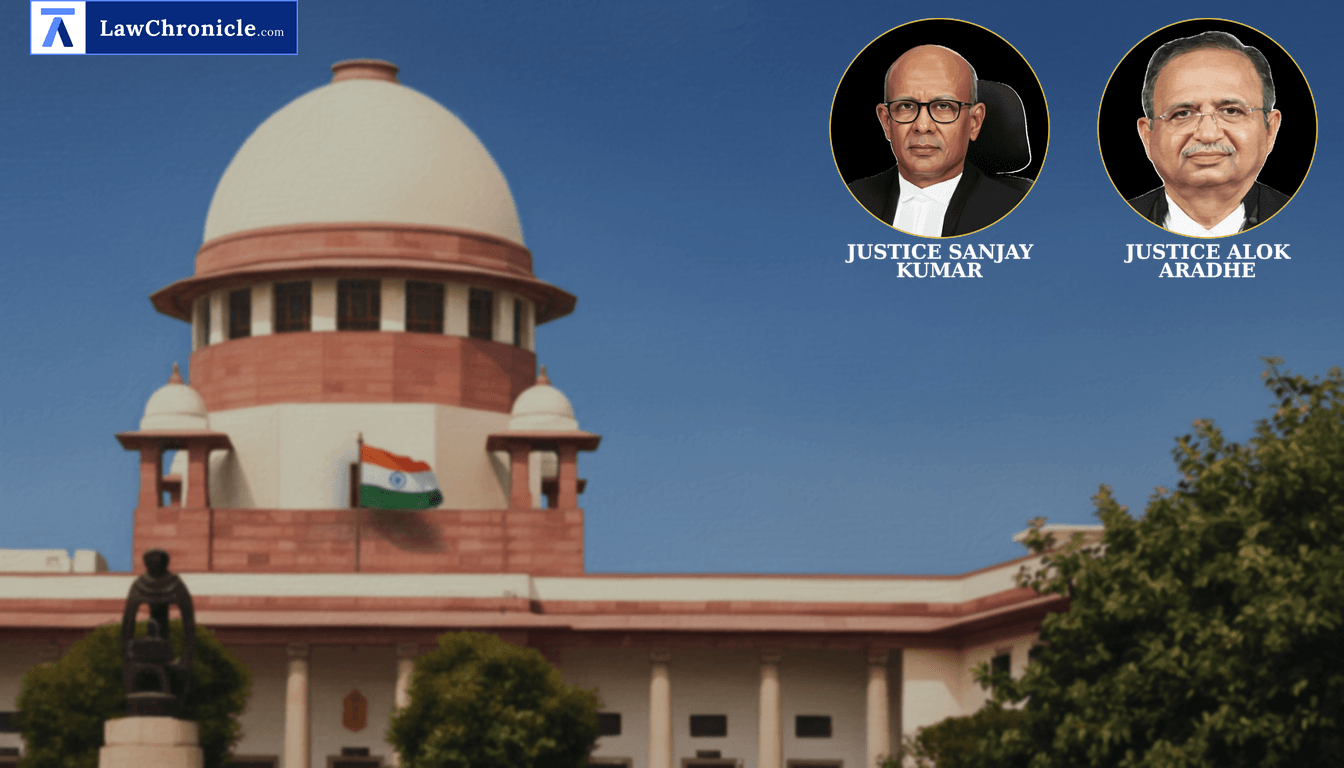
In a significant ruling protecting the integrity of educational admission processes, the Supreme Court held that authorities cannot alter eligibility criteria after the commencement of the selection process. A bench comprising Justice Sanjay Kumar and Justice Alok Aradhe set aside the State of Punjab's decision to expand the 'zone of consideration' for sports quota admissions from Classes XI and XII to include Classes IX and X, noting that the shift was prompted by an undisclosed conflict of interest and violated principles of transparency and fair play.
The Court emphasized that leaving admission norms elastic allows for arbitrariness and nepotism. The bench remarked that the sudden policy change for the 2024 session, which departed from a long-standing practice, failed the test of reasonableness under Article 14 of the Constitution. While the State possesses the power to change policy, such changes must be made fairly and not midstream to benefit specific individuals.
The Doctrine of 'Rules of the Game' and Consistency
The Court relied on the established legal principle that the criteria for selection cannot be altered once the process has begun. Referring to Maharashtra State Road Transport Corporation and others vs. Rajendra Bhimrao Mandve and others ( "(2001) 10 SCC 51": 2001 CaseBase(SC) 1853), the bench noted that this rule applies with equal vigour to educational admissions as it does to recruitment. The Court further observed that the State's actions must be predictable and transparent to maintain public trust, citing the principles of good administration discussed in Sivanandan C.T. and others vs. High Court of Kerala and others ( "(2024) 3 SCC 799": 2023 CaseBase(SC) 177).
In its reasoning, the Court observed: "The practice and procedure followed by the State of Punjab in leaving the norms elastic, without disclosing as to what would be the exact policy with regard to the zone of consideration, and allowing itself sufficient leeway and elbow room to change such policy midstream during the admission process is not in accordance with the principles of fair play in action. Lack of transparency at the outset invariably enables and makes room for arbitrariness and nepotism to walk in through the backdoor, a situation to be eschewed and avoided by an egalitarian State."
Vitiation of Policy Due to Conflict of Interest
A critical factor in the Court's decision was the discovery that the policy change was initiated based on a representation by a coach whose daughter was a direct beneficiary. The Court found that the failure to disclose this private interest vitiated the modification. The bench noted that while the State might have acted bona fide in ignorance of the coach's subterfuge, the foundation of the change was structurally flawed. It was further highlighted that different standards were applied to other medical courses (like BAMS and BHMS) during the same session, where only Classes XI and XII achievements were considered, further underlining the arbitrary nature of the MBBS/BDS specific change.
Court Directions
The Court has the following directions:
"The modification in the policy is, therefore, quashed leaving it open to the State of Punjab to apply its mind independently and uninfluenced by the so-called recommendation made by Ramesh Kumar Kashyap, so as to take a reasoned and well-informed policy decision as to what should be the criteria to be followed in future. The State of Punjab would be well advised to formulate the admission policy in its entirety before initiation of the admission process for each year, if it seeks to modify the same time and again. It is not proper and correct to do so mid-stream during the admission process. However, insofar as session-2024 is concerned, Kudrat Kashyap, who was the direct beneficiary of the subterfuge of her father, Ramesh Kumar Kashyap, cannot be permitted to enjoy the unlawful benefit garnered in her favour through his manipulations and machinations. Though Mansirat Kaur, respondent No. 5, also stood benefited thereby, though through no fault of hers, she is also liable to be divested of the illegal benefit that was conferred upon her owing to the wrongdoings of Ramesh Kumar Kashyap."
"Divjot Sekhon and Shubhkarman Singh shall, therefore, be accommodated in the seats in the government medical college(s) which were allotted to Kudrat Kashyap and Mansirat Kaur, respondent Nos. 4 and 5. In turn, Kudrat Kashyap and Mansirat Kaur shall be given the seats vacated by Divjot Sekhon and Shubhkarman Singh in Gian Sagar Medical College, Banur. The course of study undergone by all of them and the fees already paid by all of them shall remain unaffected and they shall all be permitted to continue with their studies in their new colleges from that stage onwards."
Background:
The dispute arose when the Baba Farid University of Health Sciences issued an email on August 16, 2024, asking sports quota aspirants for MBBS/BDS courses to submit achievements from any class/year, contrary to the initial prospectus which limited credit to Classes XI and XII. The appellants, Divjot Sekhon and Shubhkarman Singh, challenged this after being placed lower in the merit list due to the inclusion of achievements from Classes IX and X by other candidates. They argued that for session-2023, the criteria was expanded only as a one-time exception due to COVID-19, as per a specific corrigendum.
The High Court had initially dismissed the writ petitions, following an earlier precedent. However, the Supreme Court, after examining official files, found that the policy shift was triggered by a representation from the father of the top-ranked candidate. The Court concluded that such midstream changes lack transparency. While allowing the appeals for the 2024 session, the Court granted liberty to the 2025 session aspirants to approach the High Court afresh with proper parties impleaded.
Case Details:
Case No.: Civil Appeal No. of 2026 (@ SLP (C) No. 23112 of 2024)
NeutralCitation: 2026 INSC 26
Case Title: DIVJOT SEKHON v. STATE OF PUNJAB AND OTHERS
Source: 2026 CaseBase(SC) 599
Similar Articles
 Breaking News


