


SC Rejects Blanket Regularisation For Para-Teachers In Jharkhand
 Copy Link
 Share
 Save
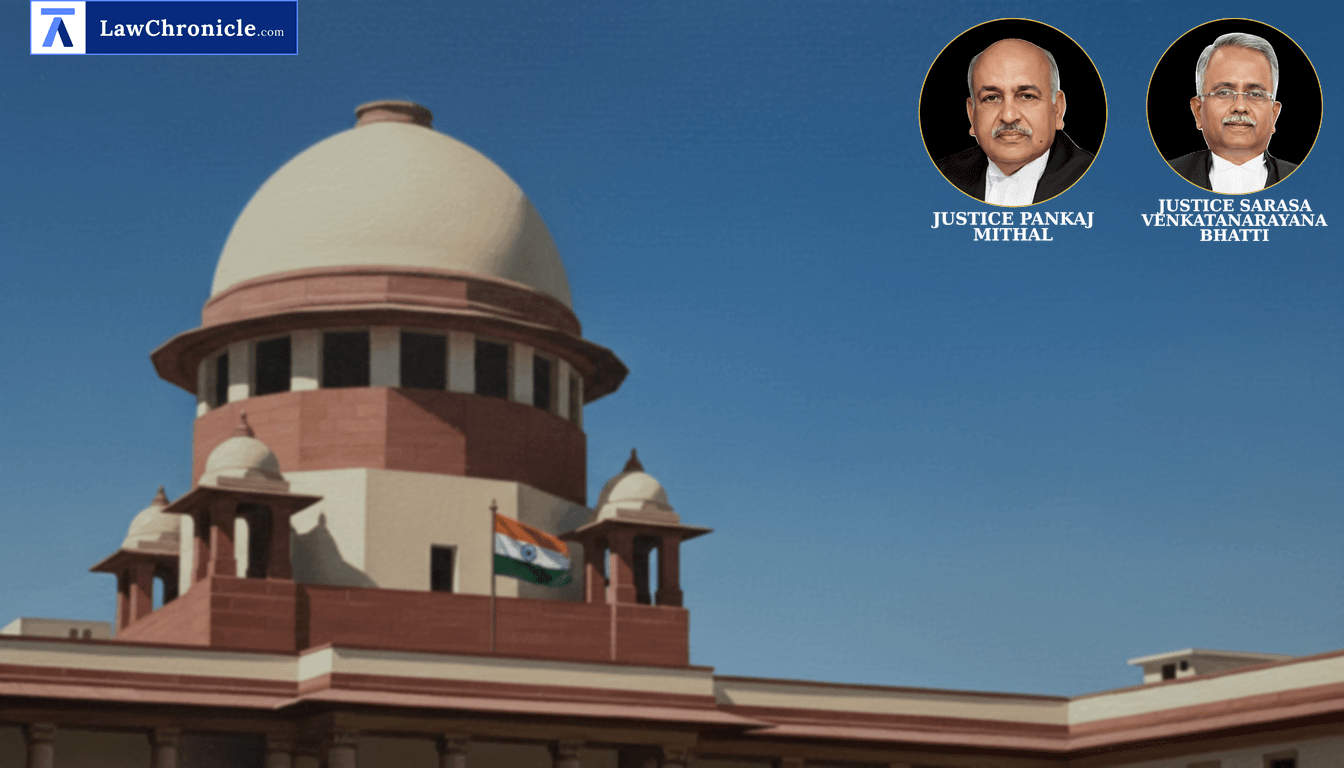
The Supreme Court has ruled that para-teachers engaged under the Sarva Shiksha Abhiyan cannot claim automatic regularisation in the state cadre, reinforcing that such appointments must follow statutory recruitment rules.
A bench comprising Justice Pankaj Mithal and Justice S.V.N. Bhatti delivered the judgment while hearing a batch of appeals challenging the Jharkhand High Court's refusal to grant regularisation to thousands of para-teachers. The Court balanced the teachers' 'legitimate expectation' with the State's prerogative to maintain educational standards through formal recruitment processes under Constitution of India, 1950.
Court Rejects Direct Absorption into State Cadre
The Court observed that while the para-teachers provide essential services, their initial engagement was contractual and scheme-based, funded jointly by the Union and the State. Consequently, they cannot bypass the constitutional mandate for public employment. The Court, in its reasoning, observed: "The prayer for regularisation is a prayer for direct absorption from a scheme post of para-teachers to a State cadre post of Assistant Teacher/Sahayak Acharya. This would change the character of the appointment. A scheme post under the SSA is jointly funded by the Union of India and the State of Jharkhand, is governed by the SSA guidelines, and continues until the scheme ceases to exist. A cadre post under the State of Jharkhand is governed by Article 309 of the Constitution of India, which creates public employment, and the State must follow a constitutionally aligned recruitment process."
While refusing blanket regularisation, the Court noted that the State of Jharkhand had already created a statutory pathway by reserving 50% of vacancies for para-teachers. It held that the State must activate this mechanism regularly to prevent 'ad hocism'.
Background:
The dispute originated from over a hundred writ petitions filed by para-teachers in Jharkhand who sought regularisation as Assistant Teachers, pay parity, and a challenge to the 2012 Recruitment Rules. They argued that they had served for over a decade, possessed necessary qualifications like TET, and performed the same duties as regular teachers. The State of Jharkhand contended that para-teachers were engaged by local committees, not district authorities, and that their service was co-terminus with the SSA scheme.
The High Court had dismissed their pleas, citing the voluntary acceptance of contractual terms. The Supreme Court upheld the High Court’s refusal of blanket regularisation by relying on the landmark STATE OF KARNATAKA V. UMADEVI (III) ( "(2006) 4 SCC 1": 2006 CaseBase(SC) 148), which prohibits 'backdoor' entries into public service. However, the Court also referred to principles in STATE OF PUNJAB & ORS. V. JAGJIT SINGH & ORS. ( "(2017) 1 SCC 148": 2016 CaseBase(SC) 490) regarding pay parity and UP Junior High School Council Instructor Welfare Association v. State Of Up & Ors. regarding the State's duty as a model employer. The Bench ultimately concluded that while no absolute right to regularisation exists, the State is bound to honour the 50% quota it established for para-teachers under its own rules to ensure security of employment.
Case Details:
Case No.: Civil Appeal No(s). _________ of 2026 (@ SLP (Civil) No(s). 4881 of 2023)
NeutralCitation: 2026 INSC 462
Case Title: Sunil Kumar Yadav and Others v. The State of Jharkhand and Others
Appearances:
For the Petitioner(s): Mr. Colin Gonsalves, Senior Advocate; Mr. Gopal Sankaranarayanan, Senior Advocate; Mr. Prashant Bhushan, Advocate; Mr. Narendra Kumar, Advocate
For the Respondent(s): Mr. Arunab Choudhary, Senior Advocate; Mr. Krishna Murari, Advocate
Source: 2026 CaseBase(SC) 391
Similar Articles
 Breaking News


