SC Rejects Post-Collision Vehicle Positions to Fix Contributory Negligence
 Copy Link
 Share
Share Save
Save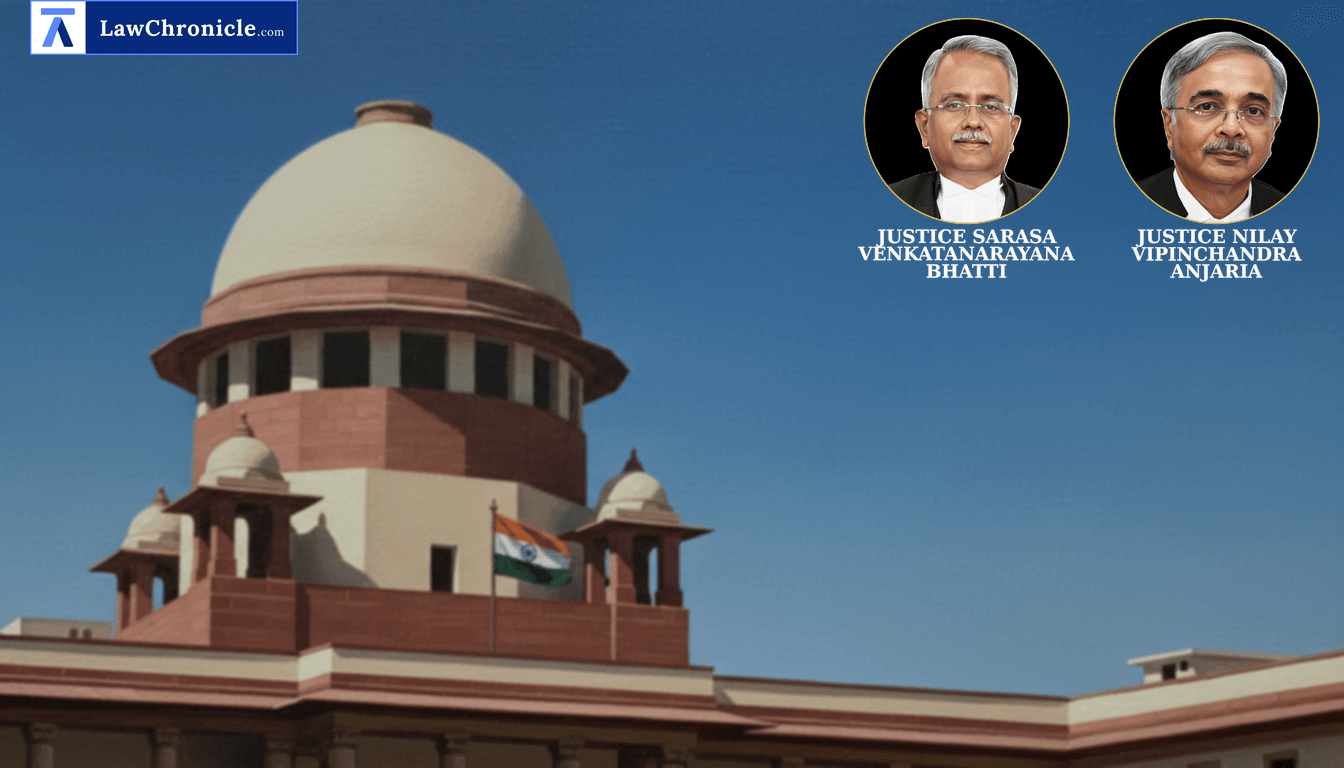
Overturning an erroneous finding of shared liability in a motor accident claim, the Supreme Court has ruled that site maps showing post-impact vehicle positions cannot be used to infer contributory negligence against smaller vehicles. Striking down a 50% liability cut imposed on a crash victim, the Apex Court affirmed that criminal acquittals do not displace prima facie civil liability established through police charge sheets.
In a judgment authored by Justice S.V.N. Bhatti, sitting alongside Justice N.V. Anjaria, the Supreme Court adjudicated a series of civil appeals challenging the High Court of Karnataka's decision to reduce compensation by attributing contributory negligence to a deceased light motor vehicle driver.
Key Takeaways
Charge Sheets Establish Prima Facie Negligence
Police chargesheets constitute valid, reliable prima facie evidence in MACT claims, which cannot be overturned merely by a driver's criminal acquittal.
Site Map Inferences Rejected
The post-impact position of a smaller vehicle on a site map cannot be used to infer its driver was at fault, as heavy vehicles naturally push smaller ones upon collision.
Enhanced Burden of Compensation
Compensation calculations for skilled professionals must realistically reflect software expertise, commercial contracts, and entrepreneurial earnings.
Overturning the High Court's allocation of fault, the Supreme Court held that the crash was entirely caused by the rash and negligent driving of the KSRTC bus driver. The Court has following directions:
"Civil Appeal Nos. 10755 and 10758 of 2026 are allowed. The claimant is awarded the compensation of Rs.50,81,876 (Rupees Fifty Lakhs Eighty One Thousand Eight Hundred and Seventy Six) with interest at the rate of 6 per cent per annum from the date of filing of the claim petition till the date of realisation."
The Court, in its reasoning, observed:
"The spot where a lighter vehicle is found lying on a site map post-accident cannot be assumed to be the spot where the collision occurred, nor that it was being driven on the wrong side, as a collision with a heavy, speeding vehicle naturally pushes or drags the smaller vehicle forward. The Charge Sheet points towards prima facie driver complicity, and site maps alone cannot establish contributory negligence without direct contra-evidence."
Ratio
In motor accident claim proceedings under Section 166 of the Motor Vehicles Act, 1988, criminal court acquittals based on benefit of doubt do not negate the prima facie evidentiary value of a police charge sheet. Furthermore, post-impact topographical site sketches showing the final position of a lighter vehicle cannot serve as the sole foundation to record a finding of contributory negligence against its driver without corroborative ocular evidence.
Background
The dispute stems from a fatal road accident on October 14, 2005, when a Hyundai Santro carrying four occupants collided with a KSRTC heavy passenger bus on NH-48 in Karnataka. The collision resulted in the deaths of the car's driver Nandan Shet, his mother Geetha Shet, and a family friend, leaving the appellant severely injured. The appellant filed claim petitions under the Motor Vehicles Act, 1988 seeking compensation.
Although the police filed a charge sheet against the bus driver under Section 304-A of the Indian Penal Code, 1860, the criminal court acquitted him by extending the benefit of the doubt. The MACT attributed 100% negligence to the bus driver, but awarded minimal compensation under loss of dependency. On appeal, the High Court of Karnataka enhanced the baseline compensation but halved the final payout by attributing 50% contributory negligence to the deceased car driver based on the post-collision site map.
Reversing the High Court's findings, the Supreme Court relied on precedents including ICICI Lombard General Insurance Co. Ltd. v. Rajani Sahoo & Ors. ( "(2025) 2 SCC 599": 2025 CaseBase(SC) 105), Mathew Alexander v. Mohd. Shafi & Anr. ( "(2023) 13 SCC 510": 2023 CaseBase(SC) 570), Sunita & Ors. v. Rajasthan State Road Transport Corporation & Ors. ( "(2020) 13 SCC 486": 2019 CaseBase(SC) 2094), Mangla Ram v. Oriental Insurance Co. Ltd. & Ors. ( "(2018) 5 SCC 656": 2018 CaseBase(SC) 1211), and Geeta Dubey & Ors. v. United India Insurance Co. Ltd. & Ors. ( "2024 SCC OnLine SC 3779": 2024 CaseBase(SC) 956) to hold that civil claims are decided on the touchstone of preponderance of probability. The Court allowed additional evidence under Order XLI Rule 27(1)(b) of the Code of Civil Procedure, 1908, read with Section 161 and Section 162(1) of the Code Of Criminal Procedure, 1973, to properly evaluate the deceased's IT income, enhancing the total compensation to Rs. 50,81,876 payable exclusively by KSRTC.
Case Details:
Case No.: Civil Appeal Nos. 10755-10758 of 2026
Neutral Citation: 2026 INSC 889
Case Title: Reena v. The Managing Director, Karnataka State Road Transport Corporation and Others
Source: 2026 CaseBase(SC) 801
 Breaking News