SC Rejects State Appeal To Restore Murder Conviction Due To Doubts
 Copy Link
 Share
Share Save
Save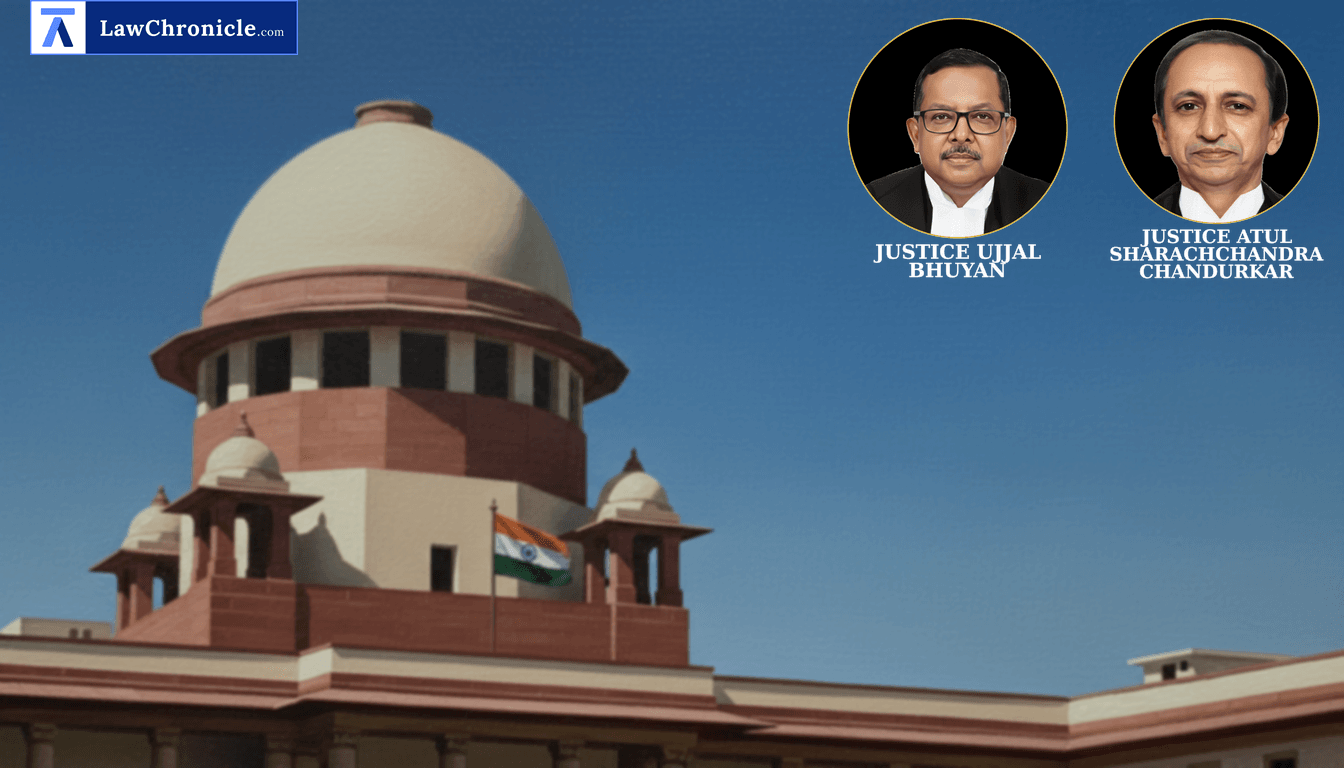
Confronted with glaring prosecution discrepancies and doubts surrounding a dying declaration, the Supreme Court has refused to restore the life imprisonment conviction of four men in a violent assault case. Expressing strong disapproval of judicial reliance on pure conjecture, the apex court nevertheless upheld the modification of the sentence to culpable homicide not amounting to murder due to shaky prosecution evidence.
A bench comprising Justice Ujjal Bhuyan and Justice Atul S. Chandurkar heard the appeal filed by the State of Andhra Pradesh, challenging a High Court verdict that had downgraded the conviction of four accused from Section 302 read with Section 34 of the Indian Penal Code, 1860 to Section 304 Part II of the Indian Penal Code, 1860.
Key Takeaways
Rejection of Judicial Surmises: The Supreme Court admonished lower courts against constructing hypothetical factual scenarios unsupported by record to alter criminal convictions.
Dying Declaration Scrutiny: Detailed 'blow-by-blow' accounts attributed to victims suffering from extensive physical injuries raise grave doubts regarding voluntariness and accuracy.
Fatal Prosecution Inconsistencies: Discrepancies regarding the actual crime scene and missing bloodstain evidence severely undermine murder charges.
Supreme Court Rebukes High Court's Rationale
The apex court explicitly disapproved of the High Court's reasoning, which had presumed that assailants intent on murder would not leave the scene without ensuring the victim was dead. The Court, in its reasoning, observed: "The High Court having itself noted that no witness had deposed on the aforesaid lines, there was no reason at all for it to comment further on the matter. The aforesaid observations are based purely on surmises and conjectures. The order of conviction under Section 302 read with Section 34 of the Penal Code has been modified by the High Court to one under Section 304 Part II of the Penal Code on this basis."
However, upon an independent re-appreciation of the evidence, the Supreme Court noted material inconsistencies in the prosecution case, including overwriting in medical intimation records, unproven presence of eye-witnesses at the scene, and unexplained omissions by the Investigating Officer.
Ratio
In a criminal prosecution, where the medical evidence, eye-witness testimonies, and recorded dying declarations exhibit material inconsistencies and doubts, a higher degree of conviction under Section 302 of the Indian Penal Code, 1860 cannot be restored, especially when the findings of the lower appellate court are anchored on unevidenced surmises but the underlying record lacks sufficient evidence to prove guilt beyond reasonable doubt.
Background
The prosecution alleged that on the night of March 8–9, 2006, the victim was brutally attacked with sickles and iron pipes by four individuals owing to longstanding enmity. The victim died in the hospital hours later. The Sessions Court convicted the accused under Section 302 read with Section 34 of the Indian Penal Code, 1860 and sentenced them to life imprisonment.
On appeal, the High Court of Andhra Pradesh modified the conviction to Section 304 Part II of the Indian Penal Code, 1860 and reduced their sentence to six years of rigorous imprisonment. The State appealed to the Supreme Court seeking restoration of the murder conviction under Section 302. Observing that the accused had already served their six-year sentence imposed by the High Court and did not appeal their modified conviction, the Supreme Court dismissed the State's appeal, bringing quietus to the matter.
Case Details:
Case No.: Criminal Appeal No. 2120 of 2017
Neutral Citation: 2026 INSC 820
Case Title: The State of Andhra Pradesh Home Department v. Ponthati Siva Rami Reddy and Others
Appearances:
For the Petitioner(s): Ms. Prerna Singh, Advocate
For the Respondent(s): Mr. A. Sirajuddin, Senior Advocate
Source: 2026 CaseBase(SC) 759
 Breaking News