


SC Resolves Decades-Old Power Dispute, Issues Cashless Framework for HP
 Copy Link
 Share
 Save
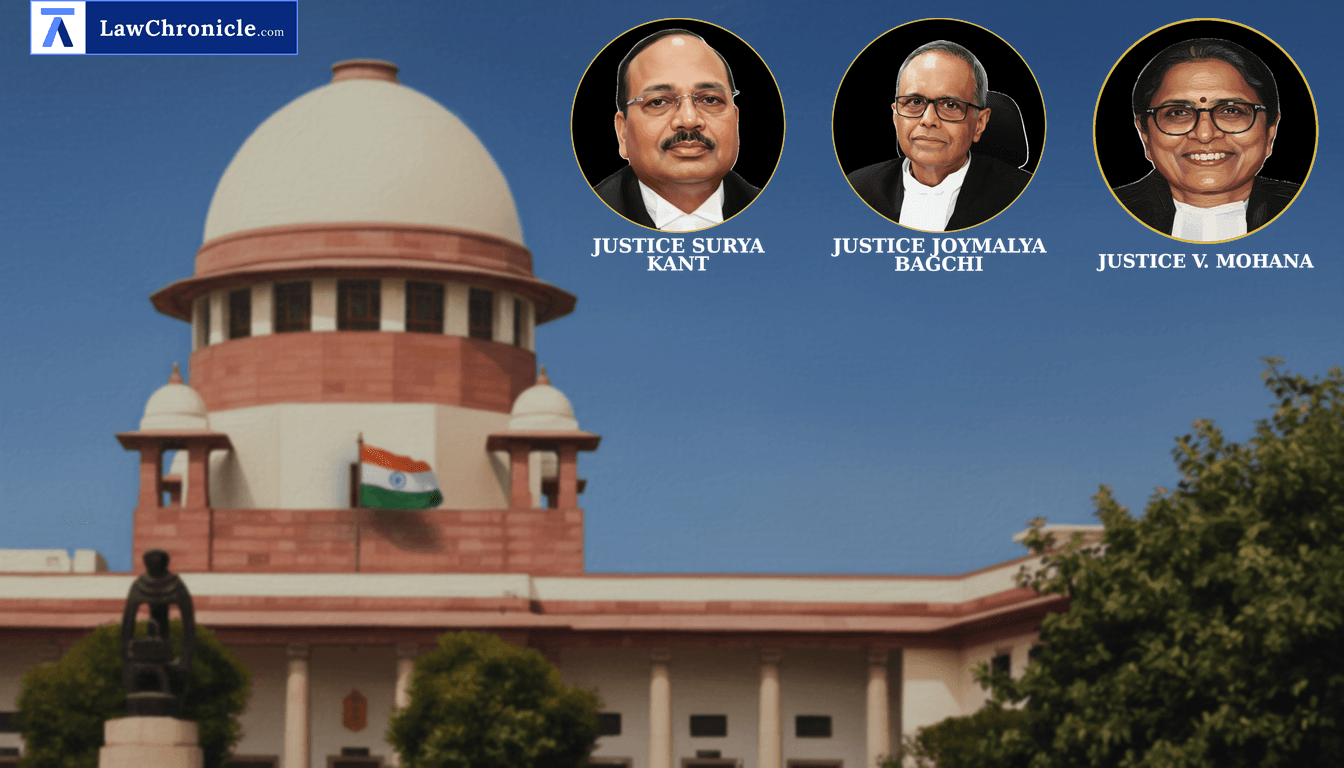
In a decisive execution of a decade-old decree, the Supreme Court has resolved the multi-decade power-sharing dispute over the Bhakra-Nangal and Beas Projects by mandating a 20-year cashless computational framework between Himachal Pradesh, Punjab, and Haryana.
A three-judge bench comprising Chief Justice Surya Kant, Justice Joymalya Bagchi, and Justice V. Mohana brought finality to the execution proceedings arising out of a 2011 decree. The dispute, brought under the original jurisdiction of the Apex Court under Article 131 of the Constitution of India, pertained to Himachal Pradesh's long-pending claims regarding power allocation and financial liabilities against the neighboring successor States.
Key Takeaways
20-Year Cashless Energy Disbursement: Punjab and Haryana must supply 11,973 Million Units of net energy arrears to Himachal Pradesh over 20 lean seasons without direct cash transfers.
Set-off Against Capital Liability: Himachal Pradesh's reconstructed capital cost liability of ₹420.77 crores stands fully adjusted against 1,093 Million Units of energy valued at ₹3.85 per unit.
Finality of Original Jurisdiction Decree: Execution proceedings under Article 131 of the Constitution of India cannot be used by Judgment Debtors to relitigate settled substantive rights or re-evaluate historical allocations.
Court's Rationale and Directions
The Supreme Court observed that the Union of India was entrusted with an onerous task of untying a knot that had tightened over decades. The Bench emphasized that execution proceedings cannot be used to reopen matters conclusively decided in the 2011 decree. It observed that "It is particularly unfortunate that a dispute which has remained pending for several decades continues to be prolonged, requiring further judicial time and attention. It therefore becomes imperative that the issues which still remain to be resolved are brought to a final quietus. We trust that all concerned parties will extend their cooperation and ensure that the directions issued by this Court are implemented in their true letter and spirit."
The Court issued the following directions:
"(a) The energy arrears due to the Plaintiff-State, as computed by the Union of India, shall be taken at 13,066 million units (MU). The same shall be supplied by the States of Punjab and Haryana at the rate of 653 MU per annum over 20 lean seasons, being the period from October to March, in the inter se ratio of 58:42 for the Bhakra-Nangal Project and 60:40 for the Beas Projects;
(b) The Plaintiff-State shall pay the charges determined by the Bhakra Beas Management Board for the year in which each tranche of energy is received;
(c) The Plaintiff-State’s liability towards its 7.19% share of the capital cost of the Bhakra-Nangal and Beas Projects, representing the unreimbursed share of loan servicing undertaken by Punjab and Haryana since 1966–67, shall be assessed at ₹420.77 crores, comprising ₹249.23 crores attributable to Punjab and ₹171.55 crores attributable to Haryana;
(d) The aforesaid capital-cost liability shall be adjusted against a corresponding portion of the energy arrears due to the Plaintiff-State. For this purpose, the energy shall be valued at the rate of ₹3.85 per unit, resulting in an adjustment of approximately 1,093 MU against the capital-cost liability;
(e) Upon giving effect to the aforesaid adjustment, the balance energy arrears payable to the Plaintiff-State shall stand at approximately 11,973 MU. This balance shall be supplied by Punjab and Haryana at the rate of approximately 598 MU per annum over 20 lean seasons, in the inter se ratio of 58:42 for the Bhakra-Nangal Project and 60:40 for the Beas Projects;
(f) The settlement shall accordingly be implemented on a cashless basis, with the capital-cost liability being adjusted against the energy arrears in the manner set out hereinabove, and with the remaining energy being supplied in accordance with the aforesaid schedule."
Ratio
In execution proceedings arising out of an inter-State dispute decree under Article 131 of the Constitution of India, historical entitlements and liabilities determined by the Court cannot be re-agitated, and energy arrears can be legally set off against capital cost liabilities on a structured cashless framework to ensure effective enforcement.
Background
The dispute dates back to the reorganisation of the composite State of Punjab under Section 78 of the Punjab Reorganisation Act, 1966. While Hydel Projects submerged vast land areas in Bilaspur and Kangra (presently in Himachal Pradesh), power benefits were primarily enjoyed by Punjab, Haryana, Rajasthan, and Chandigarh.
Himachal Pradesh attained full statehood under the State of Himachal Pradesh Act, 1970, having previously evolved through the States Merger (Chief Commissioners' Provinces) Order, 1949, the Himachal Pradesh and Bilaspur (New States) Act, 1954, and the Constitution (Seventh Amendment) Act, 1956. The State instituted Original Suit No. 2 of 1996 claiming power allocation and compensation under Section 78 of the Punjab Reorganisation Act, 1966. Rajasthan raised maintainability objections under Section 87-B read with Section 86(1) of the Code of Civil Procedure, 1908, but the Court previously held that the suit was not barred by Article 262(2) or Article 363 of the Constitution of India.
On 27.09.2011, the Supreme Court decreed the suit in part, declaring Himachal Pradesh entitled to 7.19% of power from the Bhakra-Nangal Project, 5.752% from Beas Unit I, and 2.984% from Beas Unit II. Subsequent computational differences over capital costs, operational expenses, and energy valuation rates led to the present proceedings, which the Court has now finally concluded.
Case Details:
Case No.: Original Suit No. 2 of 1996
Neutral Citation: 2026 INSC 1200
Case Title: State of Himachal Pradesh v. Union of India and others
Source: 2026 CaseBase(SC) 9615
Similar Articles
 Breaking News


