


SC Sets Aside NGT Order Against Art Of Living Over Yamuna Floodplains
 Copy Link
 Share
 Save
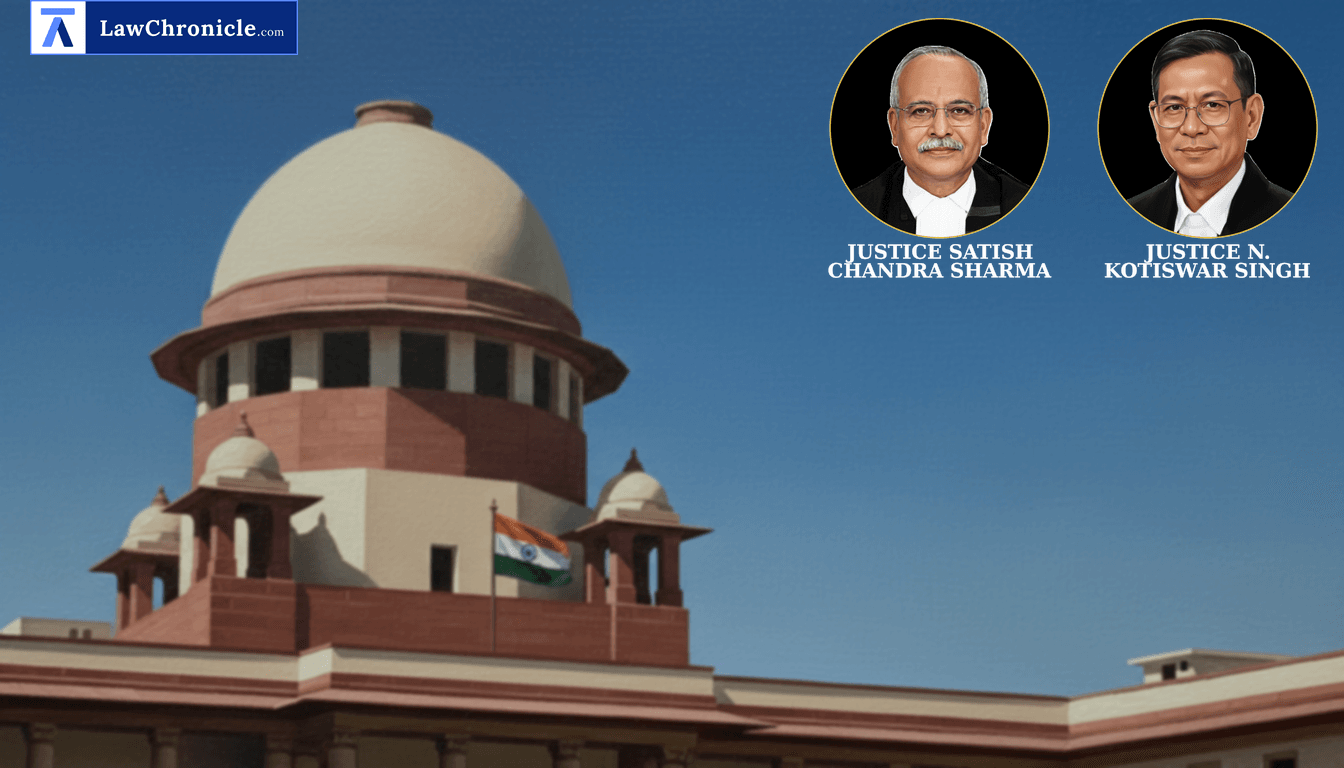
In a massive relief to Vyakti Vikas Kendra India (Art of Living), the Supreme Court has set aside the National Green Tribunal's order holding it liable for environmental compensation over the 2016 World Culture Festival. Dismantling the premise of no-fault liability without proven causal damage, the apex court ordered the Delhi Development Authority to refund the ₹5 crore deposit to the organization.
A bench of Justice Satish Chandra Sharma and Justice Nongmeikapam Kotiswar Singh ruled that the Tribunal erred by conflating environmental 'restoration' with full-scale 'rehabilitation' under Section 15 of the National Green Tribunal Act, 2010. The Court highlighted that liability cannot be fastened on a private entity without establishing a direct causal link to real ecological damage.
Key Takeaways
Restoration Vs Rehabilitation: Section 15 of the NGT Act limits private liability to restoring land to its original status, not funding broader public ecological development.
Causal Link Mandatory: Polluter pays and no-fault liability principles require clear proof of actual damage caused by the proponent rather than pre-existing degradation.
Interim Orders Re-examined: Interim findings passed without prejudice cannot be treated as permanent admissions of guilt without objective analysis of counter-evidence.
Refund Directed: DDA must refund the ₹5 crore environmental compensation deposited by the appellant within four weeks.
Court Observations and Directions
The Apex Court noted that the expert committee reports relied upon by the NGT were contradictory and failed to establish the site's pre-event ecological condition. Clarifying the statutory limits of green compensation, the Court observed that the NGT exceeded its mandate by imposing the burden of developing a biodiversity park on the appellant.
The Court, in its reasoning, observed: "In our view, the Tribunal fell in error in equating the distinct concepts of rehabilitation and restoration. Going by its plain meaning in the context of environmental jurisprudence, rehabilitation refers to complete reparation of the affected area in a manner that it becomes fully functional and provides optimum ecological services. Restoration, however, refers to a process whereby the affected area is simply brought back to its original state, regardless of how optimum the original state was... The task of rehabilitation of public resources falls upon the shoulders of the State... The responsibility of private persons gets triggered when environmental damage or degradation is attributable to them."
Addressing the misapplication of Section 17 of the National Green Tribunal Act, 2010, the bench observed that polluter pays principle requires establishing a clear causal link, stating that "the alleged person must be a 'polluter' before it is held as absolutely liable in law."
The Court has following directions:
"In view of the foregoing discussion and findings, the impugned judgment dated 07.12.2017 is set aside along with all consequential and interim actions taken against the appellant herein. The appellant is entitled to refund of the amount of Rs. 5 crores deposited by it to DDA, in compliance of the Tribunal's order dated 09.03.2016. The same shall be refunded by DDA within four weeks from today. Suffice to note that DDA shall continue to carry out the rehabilitation work at the Yamuna floodplains as per the proposed plan and directions issued by the Tribunal from time to time."
Ratio
Under Section 15 and Section 17 of the National Green Tribunal Act, 2010, the principles of 'polluter pays' and 'no-fault liability' can only be invoked against a project proponent when a direct causal link establishing actual environmental damage caused by the proponent's activity is proved. Furthermore, statutory 'restoration' or 'restitution' cannot be expanded to compel a private party to bear the cost of overall ecological 'rehabilitation' or new public infrastructure development.
Background
The controversy arose when respondent Manoj Misra approached the NGT in February 2016 against the World Culture Festival organized by Art of Living (Vyakti Vikas Kendra India) on the Yamuna floodplains, alleging violation of earlier environmental orders. The NGT appointed an expert committee and passed an interim order on March 9, 2016, allowing the event subject to a payment of ₹5 crore as interim environmental compensation and an undertaking to pay final restoration costs.
Post-event, multiple conflicting committee reports were submitted. While initial reports claimed extensive damage based on satellite imagery, subsequent reports admitted constraints in ascertaining the pre-event ecological state and suggested full-scale 'rehabilitation' instead. A third committee comprising government officials reported no significant difference or compaction at the site. Nevertheless, on December 7, 2017, the NGT held the appellant liable for restoration/rehabilitation under Section 17(3) of the National Green Tribunal Act, 2010.
Setting aside the NGT judgment, the Supreme Court held that the site was already in a damaged condition before allotment, with pre-existing construction debris, and that the NGT erred by treating its unreasoned interim order as final while misapplying the no-fault liability doctrine.
Case Details:
Case No.: Civil Appeal No. 683 of 2018
Neutral Citation: 2026 INSC 910
Case Title: Vyakti Vikas Kendra India v. Manoj Misra (Dead) & Ors.
Source: 2026 CaseBase(SC) 819
Similar Articles


 Breaking News


