SC Validates State Laws Regulating and Banning Real-Money Online Games
 Copy Link
 Share
Share Save
Save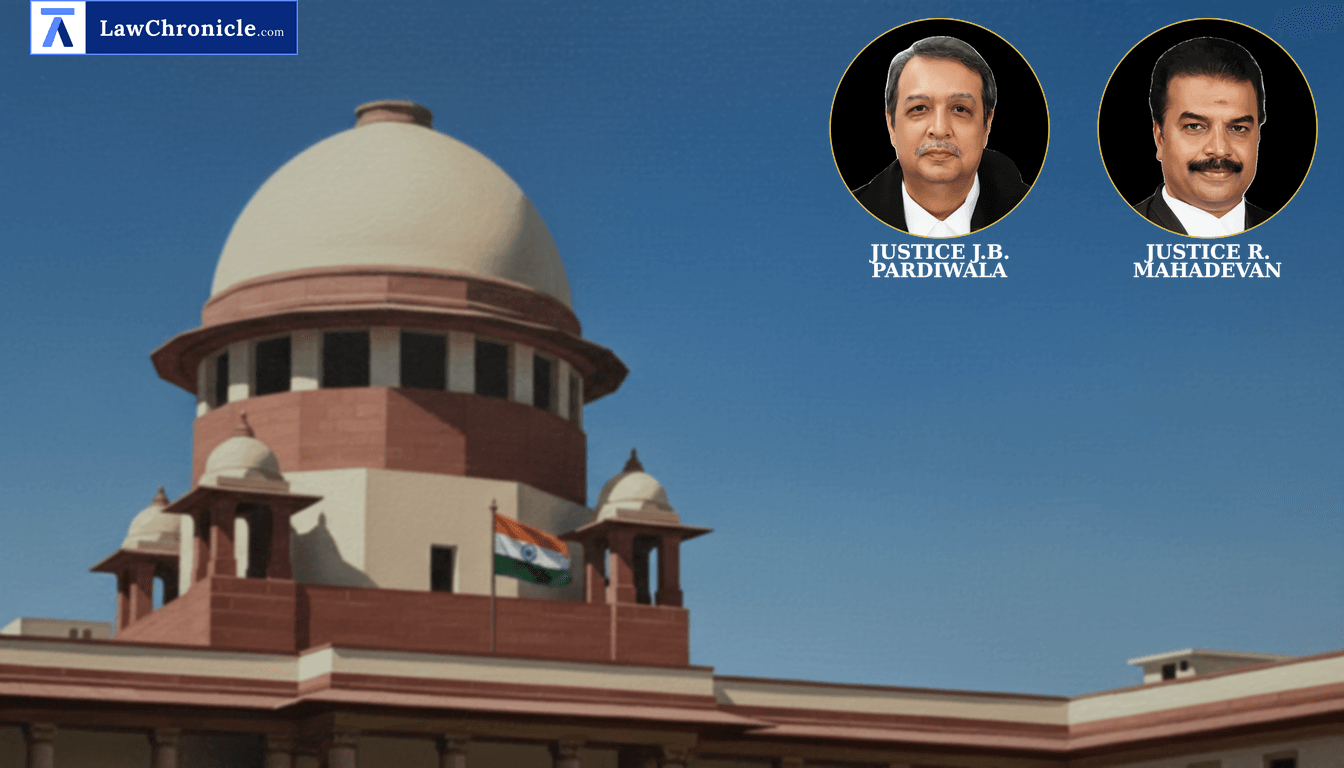
The Supreme Court has upheld the legislative competence of State Governments to prohibit and regulate online games involving monetary stakes, holding that the distinction between games of skill and games of chance vanishes once betting enters the fray.
A bench of Justice J. B. Pardiwala and Justice R. Mahadevan set aside the judgments of the Madras and Karnataka High Courts, which had previously struck down amendments to state police and gaming laws. The Court ruled that even if a game is predominantly one of skill, the act of placing stakes on its uncertain outcome falls within the ambit of "betting and gambling" under Entry 34 List II of the Seventh Schedule of the Constitution of India, 1950.
The Myth of 'Betting on Gambling' and Constitutional Interpretations
The Court rejected the narrow interpretation that Entry 34 List II of the Seventh Schedule only allows States to regulate "betting on gambling" (i.e., betting only on games of chance). It termed this interpretation a "Constitutional aberration" that effectively rewrote the text of the Constitution of India, 1950. The Court clarified that "betting and gambling" is a composite expression where both terms involve staking money on an uncertainty.
The Court, in its reasoning, observed: "The expression 'betting and gambling' cannot be split to mean that the staking angle alone would amount to betting whereas the risk angle or the chance element would amount to gamble. Both betting and gambling involve the aspect of staking money on an uncertainty. Merely because the risk element is commonly perceived as 'taking a chance', it cannot mean an expression would cover only games of chances."
Distinguishing Precedents: RMDC and K.R. Lakshmanan
While the respondents relied heavily on State of Bombay v. R.M.D. Chamarbaugwala ( "AIR 1957 SC 699": 1957 CaseBase(SC) 51), R.M.D. Chamarbaugwala v. Union of India, and Dr. K.R. Lakshmanan v. State of Tamil Nadu & Anr. ( "(1996) 2 SCC 226": 1996 CaseBase(SC) 298), the Supreme Court noted that those cases were decided in specific factual contexts. For instance, in Dr. K.R. Lakshmanan v. State of Tamil Nadu & Anr. ( "(1996) 2 SCC 226": 1996 CaseBase(SC) 298), the protection for horse-racing was tied to specific statutory exceptions that the State has now chosen to remove. The Court noted: "The decision in Dr. K.R. Lakshmanan v. State of Tamil Nadu & Anr. ( "(1996) 2 SCC 226": 1996 CaseBase(SC) 298) has no application to cases like the one at hand where the State Legislature, in its wisdom, has deemed it appropriate to regulate games where monetary stakes are involved, without affording any special protection to games of mere skill."
Public Order and the Digital Epidemic of Gaming Addiction
Beyond Entry 34 List II of the Seventh Schedule, the Court held that the States of Tamil Nadu and Karnataka derived legislative competence from Entry 1 List II (Public Order) (Public Order) and Entry 6 List II (Public Health) (Public Health). The Court took judicial notice of the "gaming disorder" recognized by the WHO and the empirical data provided by the States regarding suicides and financial ruin linked to online betting.
The Court has the following directions:
"The appeals preferred by the State of Tamil Nadu and the appeals preferred by the State of Karnataka stand allowed. The impugned judgments passed by the High Court of Madras and the High Court of Karnataka, respectively, are set aside. As a corollary, Part II of the Tamil Nadu Gaming and Police Laws (Amendment) Act, 2021, Sections 2(i), 2(l)(iv) and Schedule to the Tamil Nadu Prohibition of Online Gambling and Regulation of Online Gaming Act, 2022/2023, Sections 2, 3, 6, 8 & 9 of the Karnataka Police (Amendment) Act, 2021, respectively, are declared intra-vires the Constitution."
Background:
The dispute began when Tamil Nadu and Karnataka amended their respective police and gaming acts in 2021 to curb the "menace" of online gambling. These amendments effectively banned online games like Rummy and Poker when played for stakes, even in cyberspace. The High Courts of Madras and Karnataka struck down these provisions, primarily relying on the "preponderance of skill" test established in State of Bombay v. R.M.D. Chamarbaugwala ( "AIR 1957 SC 699": 1957 CaseBase(SC) 51) and State of Andhra Pradesh v. Satyanarayana.
The High Courts held that games of skill are protected under Article 19(1)(g) of the Constitution of India, 1950 and that the States lacked the power to ban them. However, the Supreme Court has now overruled this, stating that once money is risked on an uncertain event, the activity becomes res extra commercium (outside the scope of commerce), meaning no fundamental right can be claimed to carry out such a business. The Court emphasized that the "even tempo" of community life was being disturbed by widespread financial losses and addiction caused by these platforms.
Case Details:
Case No.: CIVIL APPEAL NOS. 6124-6131 OF 2023
NeutralCitation: 2026 INSC 594
Case Title: STATE OF TAMIL NADU & ORS. v. JUNGLEE GAMES INDIA PVT. LTD. & ORS.
Appearances:
For the Petitioner(s): Mr. Kapil Sibal, Senior Counsel; Mr. Prateek K. Chadha, AAG Karnataka.
For the Respondent(s): Dr. Abhishek Manu Singhvi, Senior Counsel; Mr. Arvind P. Datar, Senior Counsel; Mr. Mukul Rohatgi, Senior Counsel; Mr. Aryama Sundaram, Senior Counsel; Mr. Neeraj Kishan Kaul, Senior Counsel; Mr. Sajan Poovayya, Senior Counsel.
Source: 2026 CaseBase(SC) 590
 Breaking News