SC: Welfare of Minor Overcomes Absolute Parental Rights in Property Disposition
 Copy Link
 Share
Share Save
Save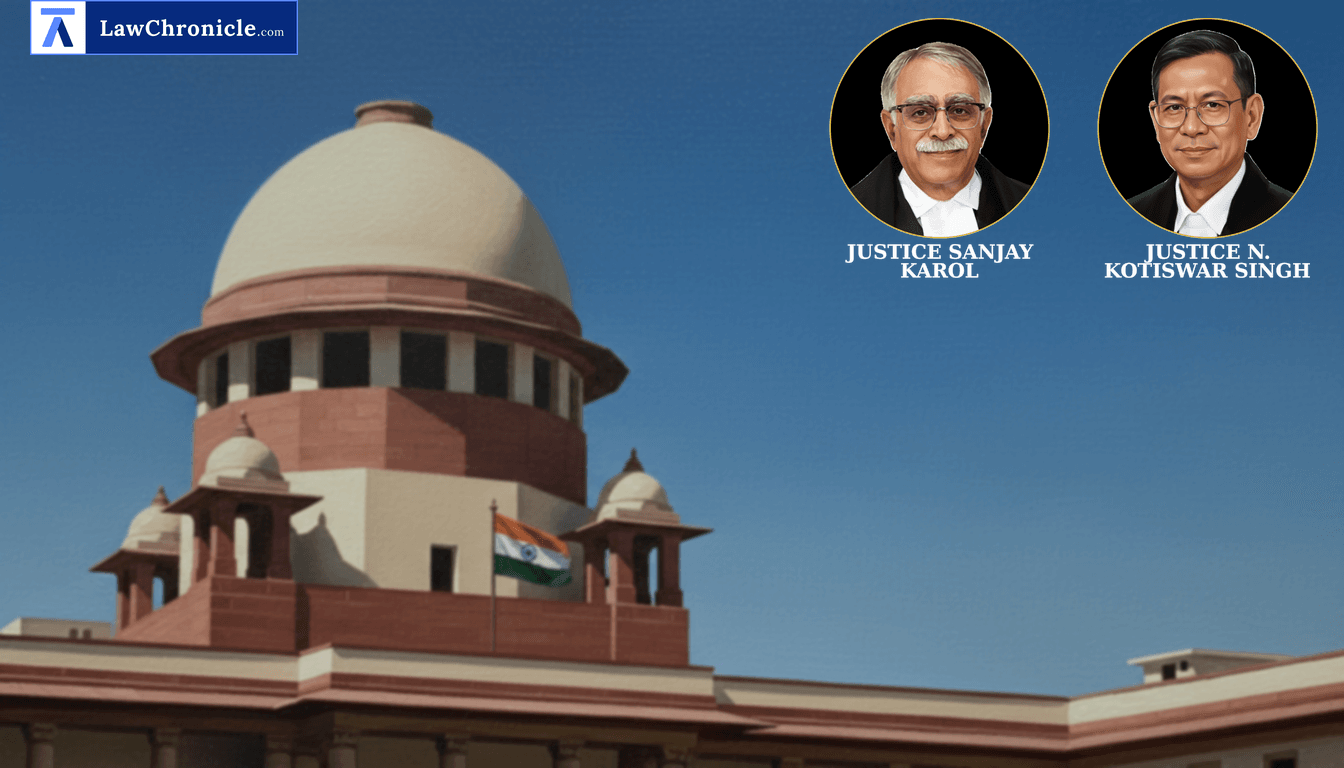
The Supreme Court set aside the orders of the High Court and the District Court that had denied a mother permission to enter into a development agreement involving her minor son's inherited property, emphasizing that judicial oversight under the doctrine of parens patriae must prioritize the 'best interest of the child' over rigid procedural considerations.
A bench of Justice Sanjay Karol and Justice Nongmeikapam Kotiswar Singh heard the appeal filed by a mother seeking to dispose of her minor son’s share in inherited land in exchange for monetary consideration and a constructed flat. The Court explored the depths of fiduciary responsibility and the balance between the rights of adult co-owners and the security of a minor’s estate.
The Doctrine of Parens Patriae and Judicial Responsibility
The Court analyzed the distinction between ex ante and ex post judicial scrutiny, noting that Section 8 of the Hindu Minority and Guardianship Act, 1956 is a preventive mechanism requiring prior court approval. Referring to Maneka Gandhi v. Union of India ( "(1978) 1 SCC 248": 1978 CaseBase(SC) 307) and Gurbaksh Singh Sibbia v. State of Punjab ( "(1980) 2 SCC 565": 1980 CaseBase(SC) 263), the Court noted that even preventive procedures must satisfy tests of fairness and reasonableness. The bench underscored that the doctrine of parens patriae implies the State bears a moral and legal responsibility for those incapable of safeguarding their own interests.
The Court, in its reasoning, observed: "Authority, held privately of whatever nature is never absolute. ‘Welfare’ supersedes all else as the governing standard. Courts and statutory bodies do not merely adjudicate disputes; they assume responsibility. Philosophy, constitutional values, common law tradition, and statutory provisions show that parens patriae is not a doctrine of narrow application, but an important tool to protect interests wherever vulnerability displaces agency."
Evaluating ‘Best Interest’ in Property Development
Justice Karol observed that a minor's undivided share in undeveloped land often remains a "notional interest with little immediate utility." In contrast, receiving a constructed unit and cash provides liquidity for education and health. The Court relied on Hunooman Persaud Panday v. Mussumat Babooee Munraj Koonweree to highlight that the power of a manager for an infant heir is limited and must be exercised only in cases of need or benefit to the estate.
Integrating several precedents, the Court noted that while Section 8 of the Hindu Minority and Guardianship Act, 1956 imposes restraints as seen in Vishwambhar & Ors. v. Laxminarayan ( "(2001) 6 SCC 163": 2001 CaseBase(SC) 1720), unauthorized alienations are voidable rather than void (Vishwambhar & Ors. v. Laxminarayan ( "(2001) 6 SCC 163": 2001 CaseBase(SC) 1720), Sri Narayan Bal & Ors. v. Sridhar Sutar & Ors ( "(1996) 8 SCC 54": 1996 CaseBase(SC) 554)). The Bench further noted that the welfare-centric approach established in Annie Besant v. G. Narayaniah and McKee v. McKee requires the Court to act as a surrogate guardian rather than a mere adjudicator.
Directions Issued to the Lower Court
The Court has the following directions:
"(i) The amount received as part of the development contract shall be kept with a nationalized bank with auto renewal, till the minor attains majority. However, liberty is granted to the guardian to seek modification of such terms from the concerned Court, to be considered on its own merits, depending upon the prevailing circumstances.
(ii) Change, if any, to the Development Agreement, shall not be made without the approval of the concerned Court.
(iii) The co-owners of the flat so received, if desirous of selling their share at a time prior to the minor’s attaining majority, shall inform the Court and seek its permission.
(iv) The District Judge, Darjeeling (the concerned Court) may impose other conditions, as it may see fit, and pass a reasoned order therefor."
Background:
The appellant, as the natural guardian of her minor son, sought permission under Section 8 of the Hindu Minority and Guardianship Act, 1956 to enter into a development agreement with a developer. The family intended to exchange 0.13 acres of land for 10 lakh rupees and flats, where the minor and mother would receive a specific share. The District Judge, Darjeeling, rejected the application, calling the claim of "necessity" a bald statement and questioning the lack of details regarding other assets. The High Court at Jalpaiguri affirmed this dismissal.
The Supreme Court found that the lower courts failed to appreciate that a structured arrangement yielding specific returns in residences and cash replaced a passive, vulnerable asset with one of assured utility. The Court clarified that while Sri Narayan Bal & Ors. v. Sridhar Sutar & Ors ( "(1996) 8 SCC 54": 1996 CaseBase(SC) 554) excludes joint family property from Section 8, the present case involved inherited shares that required the protection of the Hindu Minority and Guardianship Act, 1956. Consequently, the appeal was allowed.
Case Details:
Case No.: Civil Appeal No. of 2026 (@ SLP (C) No. 25053 of 2025)
NeutralCitation: 2026 INSC 621
Case Title: Shephali Chakraborty v. The State of West Bengal
Source: 2026 CaseBase(SC) 525
 Breaking News