Section 34 Limitation Period Starts from Disposal of Section 33 Application: SC
 Copy Link
 Share
Share Save
Save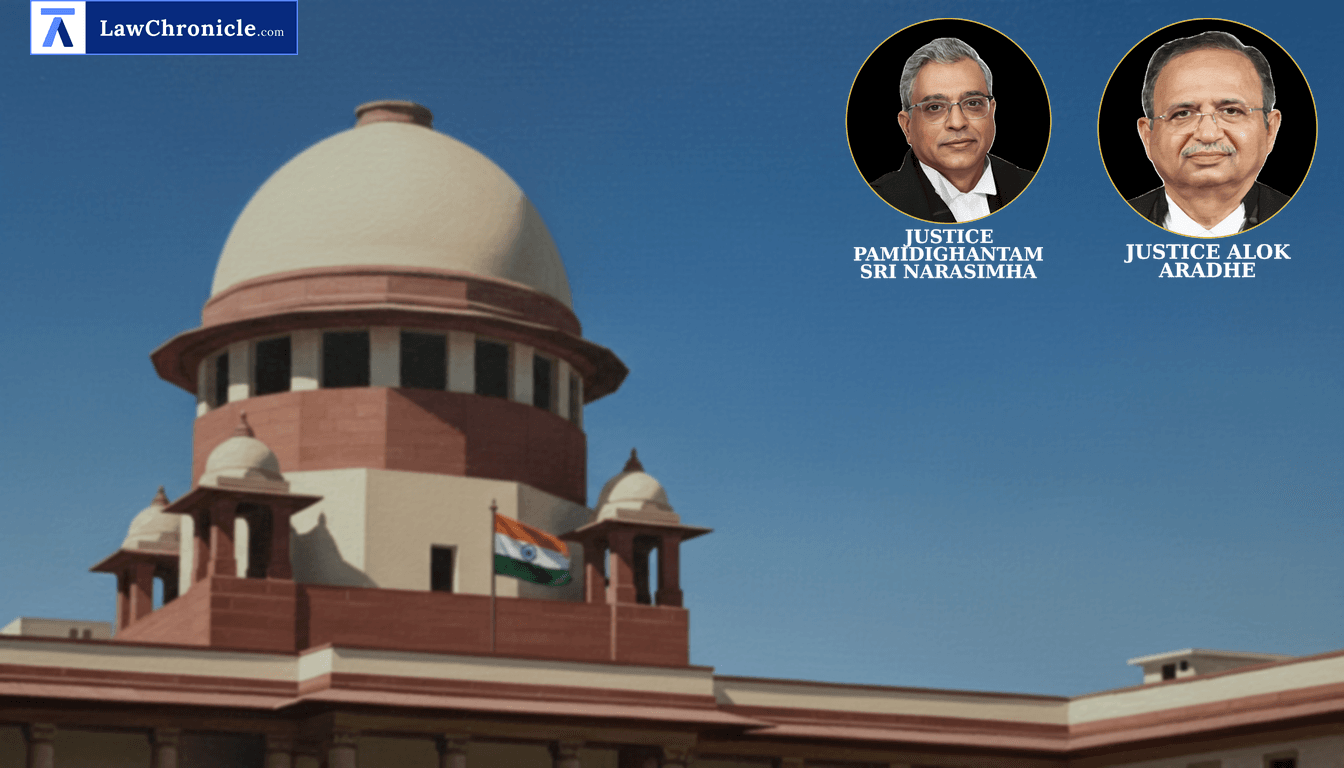
The Supreme Court has clarified that once the jurisdiction of an Arbitral Tribunal is formally invoked under Section 33 of the Arbitration and Conciliation Act, 1996, the period of limitation for filing a challenge under Section 34 commences only from the date that request is disposed of. This rule applies regardless of whether the Section 33 application is ultimately allowed or dismissed, as the law does not distinguish between maintainable or unmaintainable applications for the purpose of computing limitation.
In a significant ruling, a Bench of Justice Pamidighantam Sri Narasimha and Justice Alok Aradhe set aside a Karnataka High Court order that had refused to exclude the time spent during the pendency of a Section 33 application. The apex court emphasized that as long as such proceedings are pending, parties cannot be compelled to initiate proceedings under Section 34 as a matter of 'abundant caution,' as the award remains subject to the tribunal's limited jurisdiction for correction or interpretation.
Court's Interpretation of Section 34(3) and Section 33
The Court, in its reasoning, observed: "From careful scrutiny of Section 34(3) of the Act, it is evident that where a request under Section 33 of the Act has been made, the limitation for filing an application under Section 34 of the Act shall be reckoned from the date on which such request is disposed of by the Arbitral Tribunal. The said provision does not distinguish between the applications which are ultimately allowed or dismissed. The said provision also does not indicate that only an application which is maintainable under Section 33 of the Act would defer the commencement of litigation under Section 34(3) of the Act."
The Bench further noted that if the legislature intended to restrict the benefit only to applications that were ultimately allowed or held maintainable, it would have explicitly stated so. The Court clarified that while legitimate remedies must be protected, courts remain justified in imposing punitive costs if Section 33 applications are found to be sham, frivolous, or filed solely to defeat limitation periods.
Precedents and Directions
The Bench relied on the recent decision in Geojit Financial Services Ltd. v. Sandeep Gurav and cited Ved Prakash Mithal and Sons v. Union of India and USS Alliance v. State of U.P. to reinforce that the starting point of limitation for Section 34 is the date of disposal of the Section 33 application. It distinguished the case of State of Arunachal Pradesh v. Damani Construction Co., noting that the latter involved a mere letter seeking review rather than a formal application.
The Court has the following directions:
"The impugned judgment and order dated 22.01.2024 passed by the High Court is set aside. The orders dated 05.08.2023 passed by the Principal District and Sessions Judge, Ballari, condoning the delay in filing the applications under Section 34 of the Act, are restored. The applications under Section 34 of the Act, shall now be decided on their own merits, in accordance with the law."
Background:
The dispute originated from land acquisition proceedings in Bellary District under the National Highways Act, 1956. Following a preliminary notification in 2009, an award was passed under Section 3G(1). After a de novo consideration by an Arbitrator, a fresh award was passed on February 3, 2022, granting benefits under the Land Acquisition Act, 1894. Both the National Highway Authority of India (NHAI) and the respondent filed applications under Section 33 of the Arbitration and Conciliation Act, 1996 for correction and additional awards, respectively.
The Arbitrator dismissed these applications via a common order on July 4, 2022, which the NHAI received on September 15, 2022. NHAI subsequently filed Section 34 applications on October 29, 2022. While the District Judge condoned the delay, the High Court reversed this, holding that the NHAI's Section 33 application was not maintainable as it sought substantive modification rather than mere clerical correction, thus refusing to extend the limitation period. The Supreme Court has now corrected this position, holding that the formal invocation of Section 33 is the only requirement to trigger the deferred limitation period under Section 34(3).
Case Details:
Case No.: Civil Appeal No. of 2026 (@ SLP (C) No. 7570 of 2024)
NeutralCitation: 2026 INSC 616
Case Title: National Highway Authority of India v. T. Younis & Anr.
Appearances:
For the Petitioner(s): Ms. Pinky Anand, Senior Counsel
For the Respondent(s): Mr. Sushil Kumar Jain, Senior Counsel
Source: 2026 CaseBase(SC) 523
 Breaking News