


Section 7 IBC Default Requires Summary Proof, Not Exact Ledger Accounting: SC
 Copy Link
 Share
Share Save
Save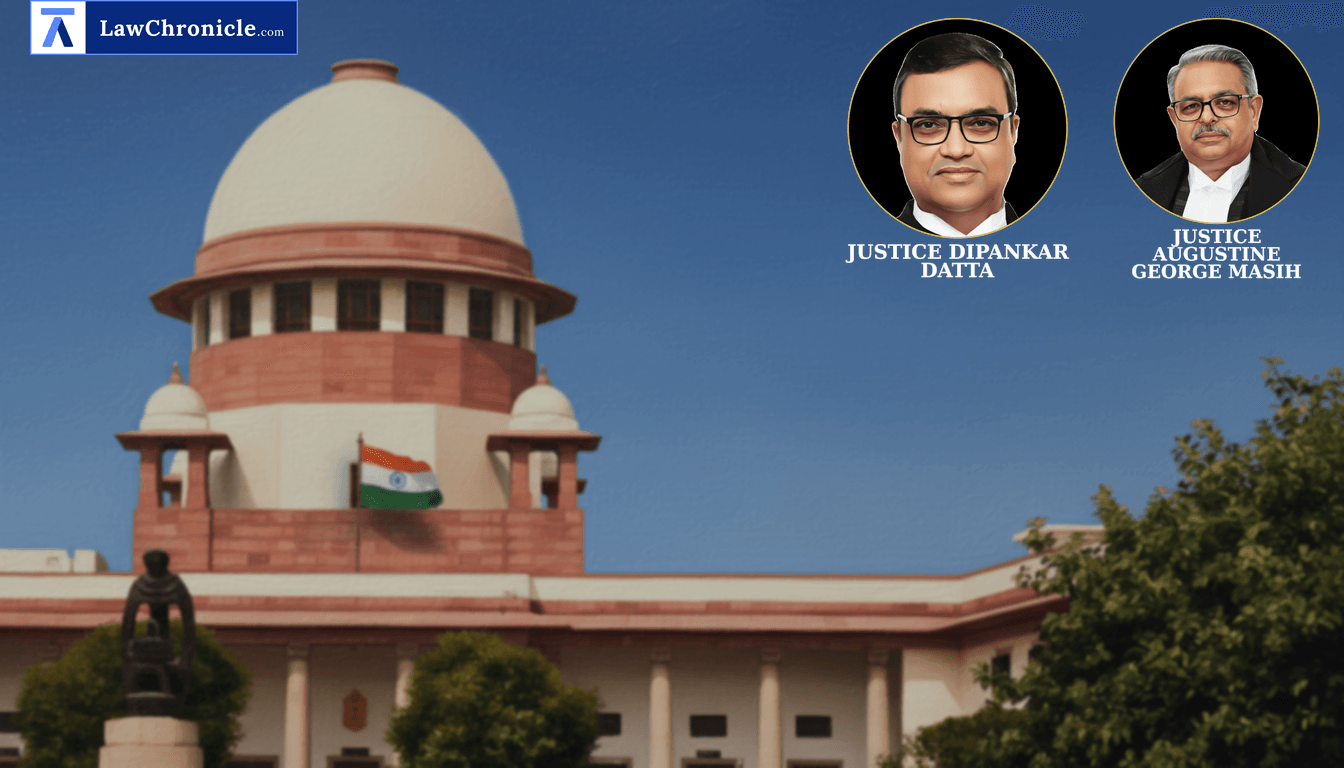
Setting a strict evidentiary standard for corporate insolvency triggers, the Supreme Court has ruled that establishing a debt default under the Insolvency and Bankruptcy Code, 2016 requires only a summary, prima facie proof of a static historical non-payment rather than a full forensic reconciliation of accounts. A bench comprising Justice Dipankar Datta and Justice Augustine George Masih dismissed statutory appeals challenging the initiation of the Corporate Insolvency Resolution Process (CIRP) against GSTAAD Hotels Pvt. Ltd. and Neo Capricorn Plaza Pvt. Ltd., affirming that a disputed computation of interest or quantum does not negate the core occurrence of default.
Key Takeaways
- Evidentiary Standard Clarified: Adjudicating Authorities under Section 7 of Insolvency and Bankruptcy Code, 2016 need only be satisfied on a preponderance of probabilities regarding debt and default, leaving precise quantum reconciliation for the resolution professional during CIRP.
- Hierarchy of Proof Defined: A Record of Default issued by an Information Utility holds high evidentiary value creating a strong presumption of default, which cannot be rebutted by mere denials or bookkeeping disagreements.
- Profitability Is No Shield: Operating profits or a positive EBITDA do not insulate a company from CIRP if its cash flows fail to service debt obligations as and when they fall due.
- Issue Estoppel Applied: Borrowers cannot collaterally challenge debt assignment agreements in Section 7 proceedings once the validity of such assignments has been conclusively settled by constitutional courts.
Adjudicating Authority Scope and Evidentiary Hierarchy
The Supreme Court analyzed the evidentiary framework governing Section 7 applications, declaring that the fourteen-day window for ascertaining default was designed for summary determination rather than protracted trial-like accounting reconciliations. Framing the core rules on default proof, the Supreme Court established a clear evidentiary hierarchy for tribunals evaluating insolvency petitions. The Apex Court observed that "The standard applicable at the admission stage is one of preponderance of probabilities upon the documentary material placed on record. The threshold is deliberately modest which is a summary, prima facie finding of financial debt and default, grounded in documentary evidence, rather than a full trial upon disputed facts... Where the records of an Information Utility by themselves, or the loan documents, account statements, balance confirmations, acknowledgements of liability, one-time settlement proposals and contemporaneous correspondence taken collectively, demonstrate that a sum exceeding the statutory threshold had become due and remained unpaid, the Adjudicating Authority is not expected to defer admission merely because the parties dispute the computation of interest, penal charges or other accounting entries."
Explaining the legal position of authenticated information utility records, the Supreme Court held that an authenticated Record of Default creates a strong presumption displaceable only by clear, cogent, and compelling evidence. The Bench further observed that recent statutory amendments to Section 7(5) of the Insolvency and Bankruptcy Code, 2016 reinforced that an Information Utility record is legally sufficient for ascertainment. Addressing the argument that profit-making hotel enterprises should not be pushed into insolvency, the Court rejected the premise that EBITDA reflects debt-servicing capability. The Apex Court noted that internal accruals must align with debt coverage ratios, emphasizing that the trigger under the Insolvency and Bankruptcy Code, 2016 is default rather than balance-sheet insolvency.
Ratio
The evidentiary threshold to satisfy the Adjudicating Authority of a default under Section 7 of the Insolvency and Bankruptcy Code, 2016 is a summary, prima facie standard based on a preponderance of probabilities. The occurrence of default is a static historical event, distinct from the dynamic quantification of debt. A Record of Default from an Information Utility forms the first tier of evidence carrying a high presumption of default, while other documentary materials under Part V of Form 1 form the second tier to collectively establish default. Disputes as to quantification or claims of operational profitability do not arrest the admission of a Section 7 application once a default exceeding the statutory threshold is established.
Background
The dispute originated from term loans totaling Rs 600 crores extended in December 2017 by Piramal Finance Ltd. (later PCHFL) to GSTAAD Hotels Pvt. Ltd. and Neo Capricorn Plaza Pvt. Ltd., alongside subsequent facilities under the Emergency Credit Line Guarantee Scheme. In December 2022, the lenders assigned the debt facilities to Omkara Assets Reconstruction Pvt. Ltd. after defaults occurred. Omkara subsequently issued recall notices and filed Section 7 applications against both corporate debtors before the NCLT Mumbai Bench after registering defaults with NeSL.
Although the corporate debtors challenged the assignment before the High Court of Karnataka, the assignment was upheld, and a Special Leave Petition against that decision was dismissed by the Supreme Court. In parallel Section 7 proceedings, the NCLT admitted the petitions, which was upheld by the NCLAT. The appellants then appealed to the Supreme Court under Section 62 of the Insolvency and Bankruptcy Code, 2016.
In its evaluation, the Apex Court relied upon precedents including Innoventive Industries Ltd. v. ICICI Bank ( "(2018) 1 SCC 407": 2017 CaseBase(SC) 147), Maitreya Doshi v. Anand Rathi Global Finance Ltd. ( "(2023) 17 SCC 606": 2022 CaseBase(SC) 993), Devas Multimedia (P) Ltd. v Antrix Corpn. Ltd., Kalyani Transco v. Bhushan Power & Steel Ltd, E.S. Krishnamurthy v. Bharath Hi-Tech Builders (P) Ltd., and M. Suresh Kumar Reddy v. Canara Bank ( "(2023) 8 SCC 387": 2023 CaseBase(SC) 953) to affirm that concurrent findings of fact regarding debt and default should not be disturbed unless perverse. The Court also discussed Vidarbha Industries Power Ltd. v. Axis Bank Ltd. ( "(2022) 8 SCC 352": 2022 CaseBase(SC) 786) to clarify the scope of judicial discretion under Section 7.
Finding that the financial debt and default comfortably crossed the statutory threshold under Section 4 of the Insolvency and Bankruptcy Code, 2016, the Supreme Court dismissed both statutory appeals and ordered the CIRP to proceed in accordance with law.
Before concluding, the Supreme Court noted an incident where an AI-generated compilation containing non-existent judgments was submitted on behalf of the appellants. While exemplary costs were initially contemplated, the Bench refrained from imposing costs due to the subsequent passing of the first appellant.
Case Details:
Case No.: Civil Appeal No. 12195 of 2025 with Civil Appeal No. of 2026 (Arising out of Diary No. 58001 of 2025)
Neutral Citation: 2026 INSC 1134
Case Title: Deepak Raheja and Another v. Omkara Assets Reconstruction Private Ltd. and Another
Source: 2026 CaseBase(SC) 8280
 Breaking News