Section 8 Heirs Inherit as Tenants-in-Common, Not Joint Tenants: Supreme Court
 Copy Link
 Share
Share Save
Save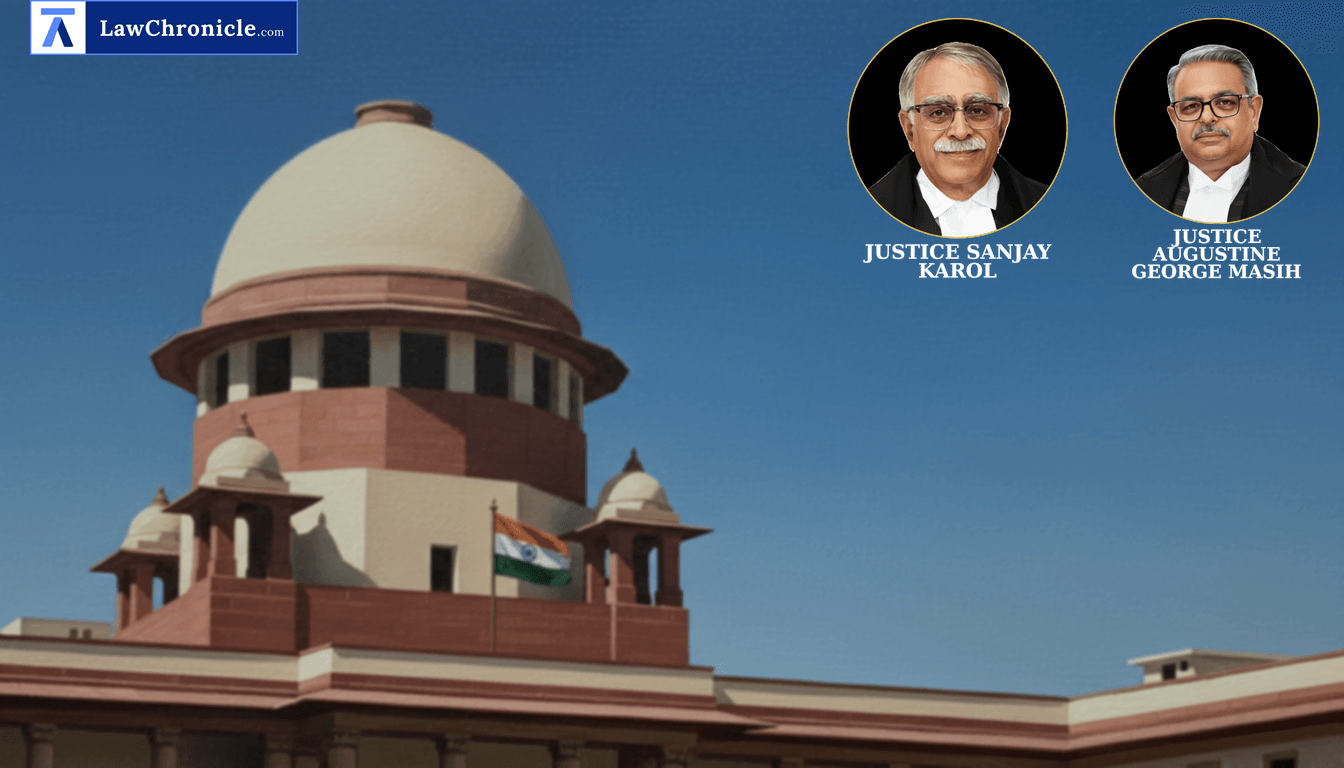
The Supreme Court has clarified that heirs inheriting property under Section 8 of the Hindu Succession Act, 1956, take their shares as tenants-in-common and not as joint tenants, thereby excluding the application of the concepts of 'karta' and 'legal necessity' to such individual shares.
A bench of Justice Sanjay Karol and Justice Augustine George Masih was hearing an appeal arising from a decades-old partition dispute between a step-mother and her four step-daughters. The Court was tasked with determining whether a widow, acting as a 'karta', could validly alienate property inherited alongside other Class I heirs based on the principle of 'legal necessity'.
Legal Necessity and Karta-ship Irrelevant to Section 8 Succession
The Court observed that once property devolves upon heirs under Section 8 of the Hindu Succession Act, 1956, each heir acquires a distinct and identifiable share. The bench noted that the Mitakshara concept of a 'karta' managing a joint family estate does not apply to property inherited in an individual capacity through statutory succession.
The Court, in its reasoning, observed: "In the context of Section 8, the question of karta-ship ordinarily does not arise merely because the property has come from a paternal ancestor. The heirs succeed as tenants-in-common with definite and separate shares, and the property devolves by succession rather than by survivorship. ...there arises no question of the defendant acting as karta to sell off a part of the property on account of legal necessity, be it for whatever reason, for she only had the right to do whatever she wished with the 1/5th share of the property that vested with her."
Distinction Between Joint Tenancy and Tenancy-in-Common
Elaborating on the nature of co-ownership, the Court clarified that joint tenancy is governed by the rule of survivorship, which is largely unknown to Hindu law except in coparcenary. Conversely, in a tenancy-in-common which is the mandate of Section 19 of the Hindu Succession Act, 1956 each owner has a notionally separate share that devolves upon their own heirs.
The Court has the following directions:
"Consequently, the appeal fails and is dismissed. We only hope that with the finality that accompanies the above conclusion, the long-standing dispute between the parties can, in true effect, be put behind them, by the parties and they can truly move on to a better, more peaceful tomorrow for all those involved. In the circumstances, there shall be no order as to costs."
Background:
The dispute originated from a suit for partition filed in 1972 involving the property of late Dajiba. The plaintiffs (four daughters) claimed 4/5th of the property, while the defendant (widow) claimed she had the right to sell portions of the land as 'karta' for the legal necessity of a daughter's marriage. The Civil Court initially decreed the suit in favor of the daughters, but the First Appellate Court reversed this, accepting the 'legal necessity' argument. The High Court of Bombay (Aurangabad Bench) later restored the Civil Court's decree.
In affirming the High Court's view, the Supreme Court relied on CWT v. Chander Sen and Yudhishter v. Ashok Kumar ( "(1987) 1 SCC 204": 1986 CaseBase(SC) 602), which established that property inherited under Section 8 is held in an individual capacity. The bench also referenced M. Arumugam v. Ammaniammal ( "(2020) 11 SCC 103": 2020 CaseBase(SC) 1764) to reiterate that such property does not automatically become coparcenary property. The Court concluded that the widow and four daughters each held a 1/5th share as tenants-in-common, rendering the sale by the widow beyond her own share invalid.
Case Details:
Case No.: Civil Appeal No. __________________ OF 2026 (@ SLP(C) No. 13232 of 2022)
NeutralCitation: 2026 INSC 613
Case Title: DARUBAI & ANR. v. KAMALABAI & ORS.
Source: 2026 CaseBase(SC) 521
 Breaking News