


Shah Bano Case Revisited Through Sonia Gandhi's Memoir
 Copy Link
 Share
 Save
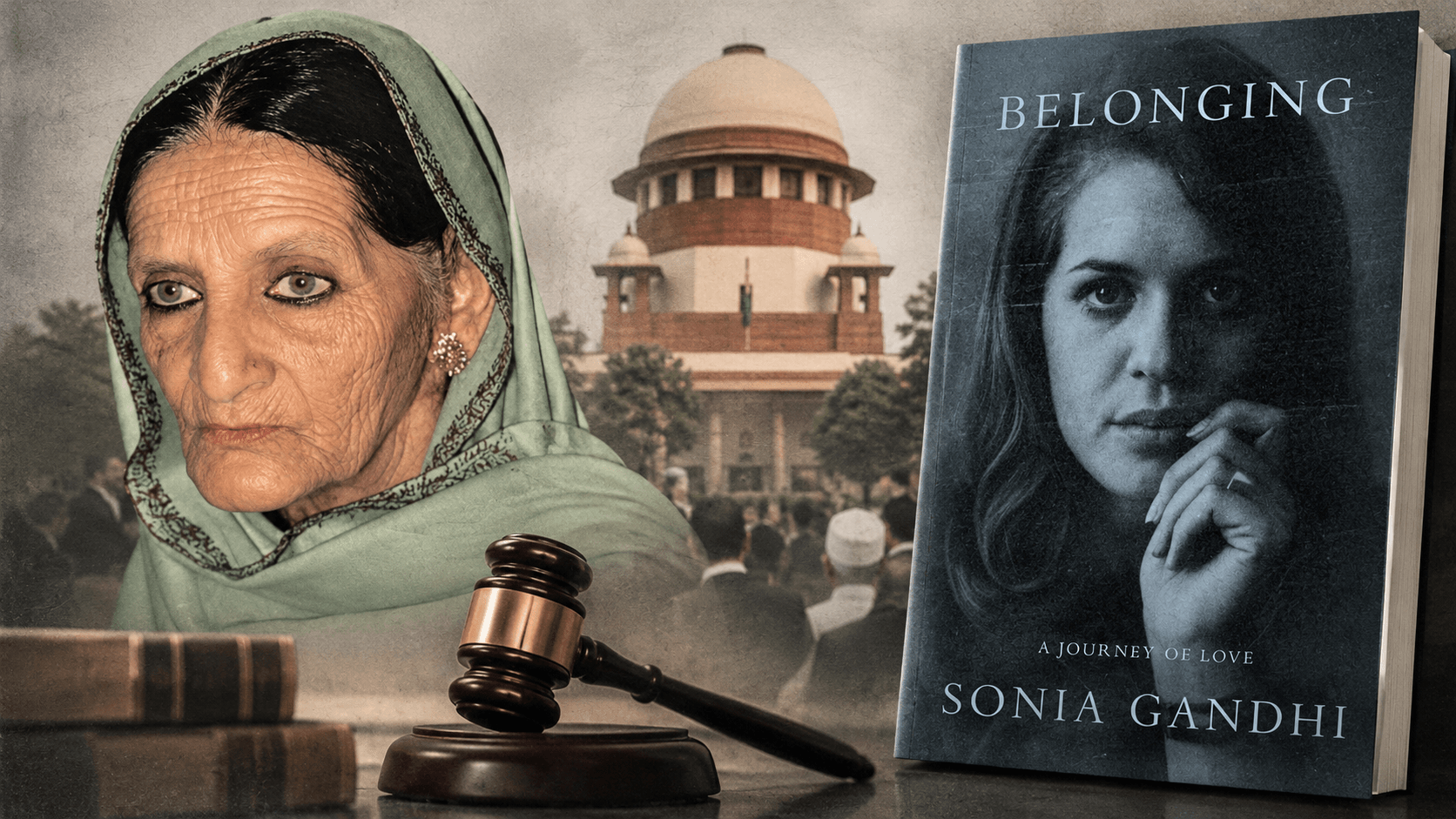
Few judgments in Indian constitutional history have travelled as far beyond the courtroom as Mohd. Ahmed Khan v. Shah Bano Begum (1985 CaseBase(SC) 214). Decided by a five-judge Constitution Bench headed by Chief Justice Y.V. Chandrachud on 23 April 1985, it began as a maintenance dispute between a divorced woman and her husband. It became a defining argument about religion, gender, and the limits of legislative power. Actress Yami Gautam Starrer 2025 Film Haq once again reignited the powerlessness experienced by Muslim women after their husbands divorce them on the spot.
Four decades on, Sonia Gandhi's memoir offers a rare insider's account of how Prime Minister Rajiv Gandhi approached the controversy. This article revisits the case through that account and tests the memoir's version against the law.
Tracing the Law on Maintenance to Divorced Muslim Women
Maintenance under Section 125 CrPC
The foundation of the dispute is Section 125 of the Code of Criminal Procedure, a provision meant to prevent destitution. It requires a person with sufficient means to maintain a wife who cannot maintain herself. The provision is religion-neutral and includes divorced wives until they remarry. Before Shah Bano, the Supreme Court had already allowed Muslim divorcees to invoke it, so the 1985 ruling did not arise from nowhere.
Maintenance under Muslim Personal Law
The husband's answer rested on Muslim Personal Law, as applied through the Muslim Personal Law (Shariat) Application Act, 1937. His case was that his obligation ended with payment of mehr and maintenance for the iddat period, the waiting period of about three months after divorce. The question before the Court was whether personal law displaced Section 125, or whether the two could operate side by side.
Shah Bano Verdict
Shah Bano was a woman from Indore who had been married since 1932, was divorced by her husband, an advocate, in 1978 after decades of marriage. The Supreme Court ruled that Section 125 applies to all citizens irrespective of religion. It held that the provision's secular purpose, protecting a woman against destitution, was not displaced by personal law. The Apex Court also remarked that Article 44, the Directive Principle on a Uniform Civil Code, remained an unrealised promise. That observation, though not the core of the ruling, fed the then controversy that followed.
Shah Bano and Rajiv Gandhi
The Prime Minister's dilemma, in his wife's telling
Sonia Gandhi's memoir frames the case as a collision between two constitutional values: One being the idea of laws applying equally to every citizen, and the other being the freedom of religion, which carried an early assurance to minorities that their personal laws would be respected.
Sonia Gandhi writes that she was herself troubled by newspaper commentary, including voices of well-known women activists and Muslim women, who backed Shah Bano's right to maintenance. As conveyed by her, she confronted her husband directly. His reply, as she records it, was a plea for trust in his intentions: "Wouldn't I defend women's rights; don't you know me?"
The Compromise
According to the memoir, Rajiv Gandhi was portrayed as protecting women like Shah Bano without endangering the whole structure of Muslim Personal Law. The result was the Muslim Women (Protection of Rights on Divorce) Act, 1986. It shifted the primary obligation to the husband for the iddat period, along with a reasonable and fair provision (mata'a) and mehr, and placed the burden on relatives or the Wakf Board where a woman could not support herself afterwards. The memoir argues that this gave Muslim women a fairer share than the monthly award of Rs 179.20 in Shah Bano's case.
The Political Fallout
The memoir acknowledges that the amendment was a political step that was widely criticised from two directions. The BJP accused the government of "vote-bank politics". Progressive and liberal opinion saw capitulation to conservative elements within the community. Critics at the time pointed out that the 1986 Act appeared to confine a husband's liability to the iddat period and in effect set aside the Court's reasoning.
The Limited Vindication in 2001 vindication
The memoir says the Supreme Court upheld Rajiv Gandhi's stand in 2001. The reality is more textured. In Danial Latifi v. Union of India (2001 CaseBase(SC) 2710), a Constitution Bench upheld the 1986 Act but read it down. It held that a divorced Muslim woman is entitled to a reasonable and fair provision for her future, to be made within the iddat period. In practical terms, the Court preserved the substance of Shah Bano's protection while saving the statute from being struck down under Articles 14, 15 and 21. An interesting aspect to note here is that Danial Latifi, who had argued for Shah Bano in 1985, was the petitioner who challenged the Act.
What If the Rajiv Gandhi Govt Had Not Intervened in Shah bano Verdict?
This section is necessarily speculative, but the legal consequences can be reasoned through.
- Shah Bano would have stood as the binding law, with Section 125 applicable to Muslim divorcees on the same footing as other women. The Danial Latifi litigation, which took until 2001 to settle, would probably never have been needed.
- A secular, court-enforced right would have given divorced Muslim women a clearer and more predictable remedy for the intervening years, instead of years of uncertainty over what the 1986 Act meant.
- The government feared that leaving the ruling untouched would be read as interference in religious law and would alienate a significant section of the community. Commentators continue to debate whether the Act's eventual political cost, particularly in strengthening the argument of "appeasement" and the polarisation that followed, outweighed what the government hoped to avoid. There is no way to settle that counterfactual.
- Without the 1986 Act, the debate on personal law reform and a Uniform Civil Code might have taken a different shape, with the Court rather than Parliament holding the initiative on gender justice within personal law.
The Shayara Bano contrast
The memoir's critics often invoke the 2017 triple talaq case as the counter-example. In Shayara Bano v. Union of India (2017 CaseBase(SC) 287), the Supreme Court, by a 3:2 majority, declared instant triple talaq unconstitutional. This time, the government of the day did not legislate against the Court. It legislated in support of it, enacting the Muslim Women (Protection of Rights on Marriage) Act, 2019, which made instant triple talaq void and an offence punishable with up to three years' imprisonment.
The contrast is real but incomplete. Supporters of the 2019 law see it as a model of Parliament backing a judgment on gender justice. Critics, including some who agree that instant talaq is wrong, argue that making it a criminal offence is disproportionate and treats a civil matter as a crime within one community only.
The two episodes also differ in subject: Shah Bano concerned financial support after divorce, while Shayara Bano concerned the validity of a mode of divorce itself. What links them is a constitutional question that remains open to each generation: how much weight personal law carries when it meets equality and dignity.
Crux
Sonia Gandhi's memoir presents the aftermaths of Shah Bano case as a good-faith attempt to balance religious sensitivities and gender justice, and as a decision later vindicated by the Supreme Court in a manner that preserved the essence of Shah Bano's right. The episode shows that Parliament can respond to a judgment, but that its response will in turn be judged against the Constitution. For students of law and politics alike, it remains a reminder that the law can change based on circumstances, and public reactions, depending upon how those in power strike a balance between pressure from the people and rights of the stakeholders.
 Breaking News


