Shayara Bano vs. Union of India Case Summary
 Copy Link
 Share
Share Save
Save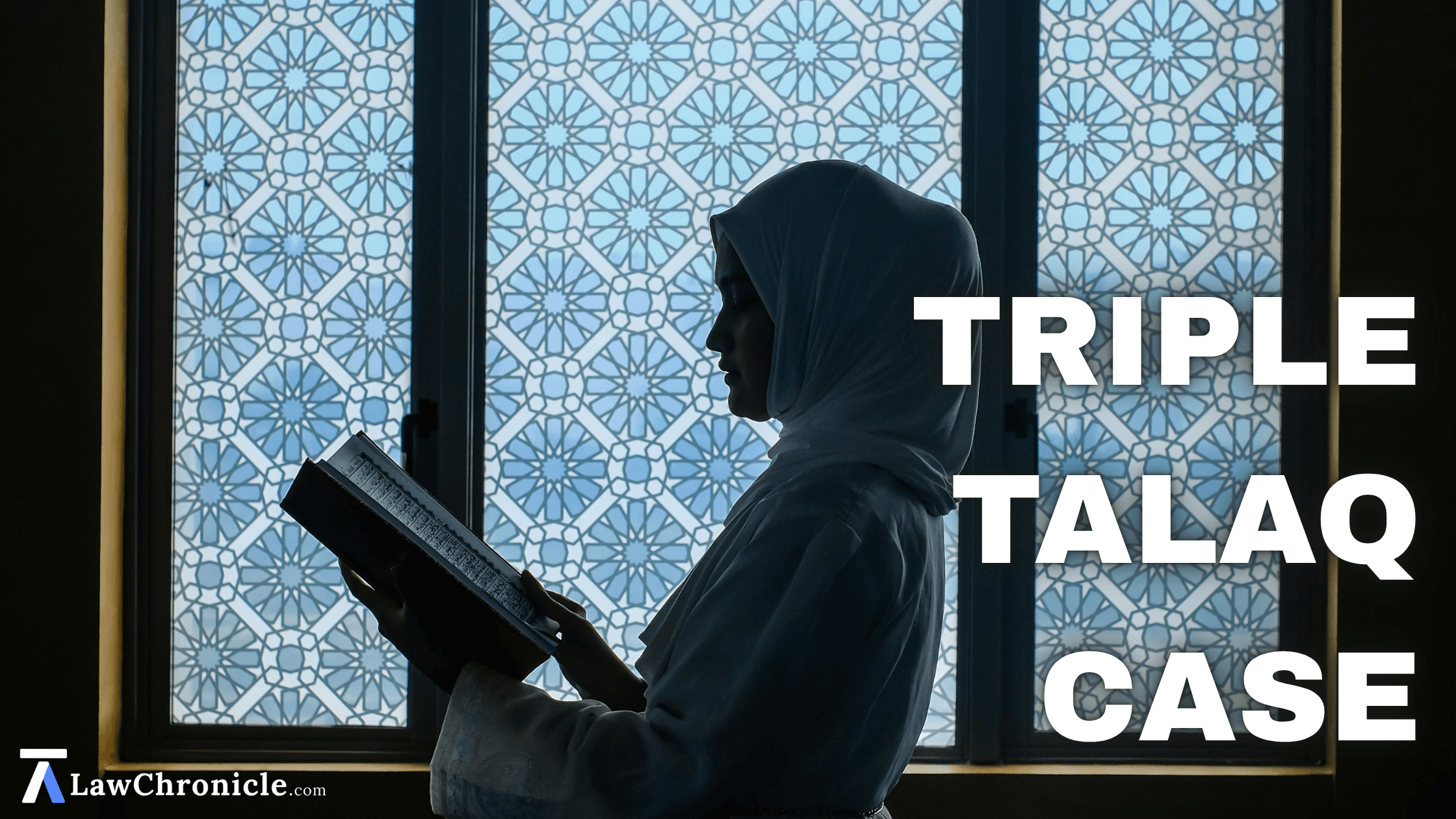
The ShayaraBano vs. Union of India case, commonly referred to as the Triple Talaq Judgment or the Shayara Bano Triple Talaq Case, stands as one of the most consequential constitutional pronouncements in post-independence India on the intersection of personal law, gender equality, and fundamental rights. Decided by a five-judge Constitution Bench of the Supreme Court of India on 22ndAugust 2017, the judgment declared the practice of Talaq-e-Biddat (instantaneous triple talaq),as unconstitutional.
The verdict came after decades of legal ambiguity and social concern regarding a practice that enabled Muslim men to dissolve their marriages irrevocably and instantaneously by pronouncing the word 'talaq' three times in one go, without any requirement of reconciliation, waiting period, or judicial oversight. The Shayara Bano vs. Union of India judgment fundamentally altered the landscape of Muslim personal law in India and paved the way for the subsequent enactment of the Muslim Women (Protection of Rights on Marriage)Act, 2019.
Triple Talaq Case at a Glance
- Full Case Name: Shayara Bano vs. Union of India & Others
- Citation: 2017CaseBase(SC) 287
- Court: Supreme Court of India (Constitution Bench)
- Date of Judgment: 22ndAugust,2017
- Bench: Chief Justice J.S. Khehar, Justice Kurian Joseph, Justice R.F. Nariman, Justice U.U. Lalit, Justice S. Abdul Nazeer
- Outcome: Triple Talaq (Talaq-e-Biddat) declared unconstitutional by a 3:2 majority
Background of the Case
Personal Background of Shayara Bano
Shayara Bano got married in 2001. Over the course of fifteen-years of marriage, she alleged repeated subjection to domestic violence and cruelty. In October 2015, her husband unilaterally dissolved their marriage by pronouncing triple talaq, stating 'talaq, talaq, talaq' in a written letter (talaqnama) sent to her. With that single document, her marriage of fifteen years stood ended without her consent, without a judicial process, and without any opportunity for reconciliation.
Filing of the Writ Petition
In February 2016, Shayara Bano filed a Writ Petition under Article 32 of the Constitution of India directly before the Supreme Court. Her petition challenged the constitutional validity of three practices prevalent in Muslim personal law: Talaq-e-Biddat (instantaneous triple talaq), Nikah Halala (the requirement that a woman who has been divorced by triple talaq must marry another man, consummate that marriage, get divorced, and only then can remarry her former husband), and Polygamy (the practice of a Muslim man marrying up to four wives simultaneously).
The Supreme Court, in itstriple talaq case, confined the hearing to the constitutional validity of Talaq-e-Biddat, while the challenges to Nikah Halala and Polygamy were left for separate consideration.
Intervention by Other Parties
The Shayara Bano Triple Talaq case attracted significant interventions from multiple stakeholders. The Union of India supported the petitioner, contending that the practice was manifestly arbitrary and violated constitutional guarantees of equality and dignity. The All India Muslim Personal Law Board (AIMPLB) defended the practice, arguing it was an essential religious practice protected under Article 25 of the Constitution, and that the judiciary had no jurisdictionto interfere with Muslim personal law. Several women's rights organizations also intervened in support of the petition.
Legal Issues Before the Supreme Court
- Whether the practice of Talaq-e-Biddat (instantaneous triple talaq) is constitutionally valid.
- Whether Talaq-e-Biddat qualifies as an 'essential religious practice' under Islam, thereby entitled to protection under Article 25 of the Constitution.
- Whether Muslim personal law, as applied through the Muslim Personal Law (Shariat) Application Act,1937, is amenable to fundamental rights review under Part III of the Constitution.
- Whether the practice violates Articles 14 (Right to Equality), 15 (Prohibition of Discrimination), and 21 (Right to Life and Personal Liberty) of the Constitution.
Supreme Court Analysis on Triple Talaq Law
The Muslim Personal Law (Shariat) Application Act,1937
The Court examined the Muslim Personal Law (Shariat) Application Act, 1937, which directs that in matters relating to marriage, dissolution of marriage, maintenance, dower, and other personal matters, the rule of decision for Muslims shall be Muslim personal law (Shariat). A critical question before the Court was whether this statute, by giving statutory recognition to Muslim personal law, had transformed talaq into a 'law' under Article 13(1) of the Constitution, thereby making it subject to fundamental rights scrutiny.
Justice RF Nariman (writing for himself and Justice UU Lalit) held that the 1937Act had codified Muslim personal law and that Talaq-e-Biddat, being part of the law applied through the statute, was subject to the constitutional mandate of Part III. The majority ultimately struck down triple talaq as manifestly arbitrary under Article 14 read with Article 13.
Right to Equalityunder Article 14
Article 14 of the Constitution guarantees that the State shall not deny to any person equality before the law or equal protection of the laws within the territory of India. The Supreme Court, in the Triple Talaq Judgment, applied the doctrine of manifest arbitrariness to strike down triple talaq. Justice Nariman, applying the principle laid down in Shayara Bano's case and tracing the evolution through Rajbala vs. State of Haryana (2015 CaseBase(SC) 367) and Subramanian Swamy vs. CBI (2014CaseBase(SC) 284), held that a law that is manifestly arbitrary, one that is exercised without adequate determining principle and unreasonably, violates Article 14.
Talaq-e-Biddat was found to be manifestly arbitrary because it allowed a Muslim husband to dissolve a marriage capriciously and whimsically, without any requirement of reconciliation, without the wife's consent, and without any justification, all at the pleasure of the husband. Such unilateral, irreversible power without procedural safeguard was held to be the very antithesis of the equality guarantee under Article 14.
Prohibition of Discrimination under Article 15
Article 15 prohibits the State from discriminating against any citizen on grounds only of religion, race, caste, sex, or place of birth. The petitioner argued that Talaq-e-Biddat discriminated against Muslim women on the ground of sex and religion, as the power of instantaneous unilateral divorce was available exclusively to the husband and denied the wife any corresponding right or procedural protection. The Court in Shayara Bano vs Union of India noted this asymmetry as being inconsistent with the constitutional commitment to non-discrimination.
Article 21:Right to Life and Personal Liberty
Article 21 of the Constitution guarantees that no person shall be deprived of his life or personal liberty except according to procedure established by law. The practice of triple talaq was argued to strike at the very core of a Muslim woman's right to live with dignity. The Court acknowledged that the right to life includes the right to live with dignity, and that a practice enabling the instantaneous and irrevocable dissolution of marriage, leaving the woman without recourse, violated the dignity component of Article 21.
Freedom of Religion under Article 25
Article 25 of the Constitution guarantees freedom of conscience and the right to freely profess, practise, and propagate religion, subject to public order, morality, health, and other provisions of Part III. The AIMPLB argued that Talaq-e-Biddat was an essential practice of Islam and therefore constitutionally protected under Article 25.
The Court applied the 'essential religious practices' doctrine,a test developed in cases like The Commissioner, Hindu Religious Endowments, Madras vs. Sri Lakshmindra Thirtha Swamiar of Sri Shirur Mutt (1954CaseBase(SC) 168) and Dargah Committee, Ajmer vs. Syed Hussain Ali (1961CaseBase(SC) 151), to determine whether a practice is essential to a religion. Justice Nariman and Justice Lalit held that Talaq-e-Biddat, being a form of talaq that is considered 'sinful' even by Islamic theologians while remaining legally valid, cannot be considered an essential religious practice. If even Hanafi jurisprudence, the school that recognises it, treats it as sinful, it cannot be elevated to the status of an essential religious tenet entitled to constitutional protection.
The Dissolution of Muslim MarriagesAct,1939
The Dissolution of Muslim Marriages Act, 1939 was also referred to during the proceedings. This Act codified the grounds on which a Muslim woman could seek dissolution of her marriage through a court of law, including grounds of cruelty, desertion, failure to maintain, imprisonment, and other causes. The Court noted the contrast: while a Muslim woman could dissolve a marriage only through a judicial process under this Act, a Muslim man could, under Talaq-e-Biddat, dissolve the marriage instantaneously and unilaterally without any judicial process whatsoever, an asymmetry underscoring the discriminatory character of the practice.
The Special Marriage Act, 1954
The Special Marriage Act, 1954 was referenced in Shayara Bano Triple Talaq judgment to illustrate that secular matrimonial legislation in India mandates procedural safeguards, notice, and judicial oversight for dissolution of marriage. The existence of such safeguards under secular law was contrasted with the complete absence of any procedural protection in Talaq-e-Biddat, further supporting the argument that the practice was manifestly arbitrary.
Shayara Bano Triple Talaq Judgment
Justice R.F. Nariman and Justice U.U. Lalit (Majority: Striking Down Triple Talaq)
Justices Nariman and Lalit held that the Muslim Personal Law (Shariat) Application Act,1937, had given statutory recognition to triple talaq, thereby making it 'law' under Article 13. Applying the doctrine of manifest arbitrariness developed under Article14 jurisprudence, they held Talaq-e-Biddat unconstitutional. They issued an injunction restraining Muslim men from pronouncing triple talaq and called upon Parliament to enact legislation within six months to govern the issue.
Justice Kurian Joseph (Concurring: Striking Down on Different Grounds)
Justice Kurian Joseph concurred in the result but arrived at his conclusion through a different route. He held that what is bad in theology cannot be good in law. Relying on the finding in Shamim Ara vs. State of U.P. (2002CaseBase(SC) 865) that triple talaq was not good in law and had never been recognised as a valid form of divorce even within certain schools of Islamic jurisprudence, Justice Joseph held that the practice was not constitutionally protected and must be struck down. He did not rest his reasoning on the Shariat Act or on manifest arbitrariness under Article 14.
Chief Justice J.S. Khehar and Justice S. Abdul Nazeer (Dissent: Upholding Triple Talaq)
The dissenting opinion authored by Chief Justice Khehar (for himself and Justice Nazeer) held that Talaq-e-Biddat was an integral part of Muslim personal law since before the constitutional era and was not a 'law' under Article 13 that could be struck down on fundamental rights grounds. The dissenters held that personal law practices in existence prior to the Constitution were not 'State action' and thus immune from Part III challenge. They further held that Talaq-e-Biddat was protected as an essential religious practice under Article 25. However, even the dissenting judges called upon Parliament to enact legislation on the subject, and imposed a six-month stay on the practice pending such legislation.
Significance and Aftermath of the Triple Talaq Judgment
Immediate Legal Effect
The Shayara Bano Triple Talaq Case effectively ended the enforceability of Talaq-e-Biddat in India. By a majority of 3:2, the Supreme Court declared the practice unconstitutional. Although the three majority judges adopted different reasoning, the combined effect of their opinions was to render triple talaq void and inoperative.
Muslim Women (Protection of Rights on Marriage) Act, 2019
Following the Shayara Bano vs Union of India Judgment, the Union Government introduced legislative measures that culminated in the enactment of the Muslim Women (Protection of Rights on Marriage) Act, 2019. This legislation went a step further than the Supreme Court's verdict by criminalizing the pronouncement of triple talaq, making it a cognizable and non-bailable offence punishable with imprisonment of up to three years. The Act also provides for the payment of subsistence allowance and custody of minor children to the aggrieved Muslim woman.
 Breaking News