


Signed Order Prevails Over Open Court Dictation: SC Dismisses Review In Garb of Clarification
 Copy Link
 Share
Share Save
Save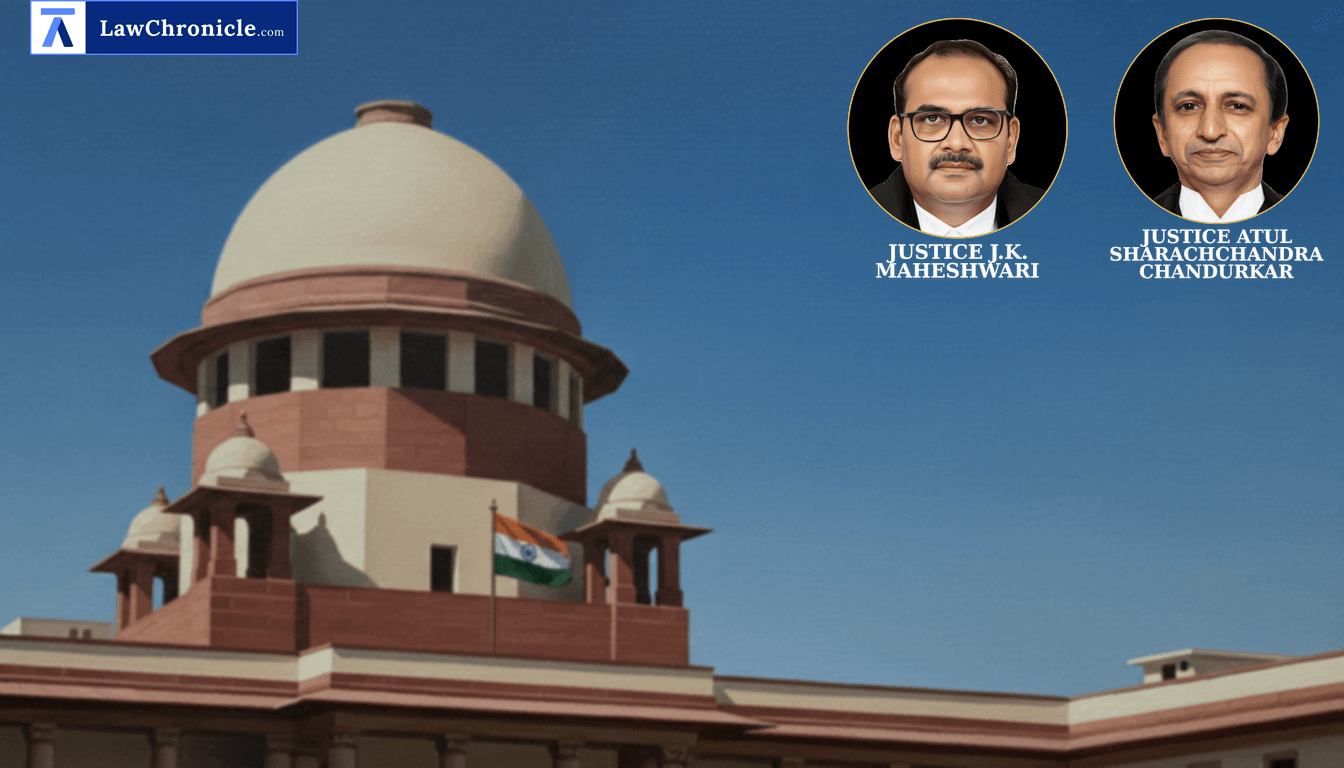
In a significant clarification on judicial procedure, the Supreme Court has ruled that a digitally signed and uploaded order remains the final operative pronouncement of the Court, even if it varies from the draft dictated in open Court, provided no material changes necessitating a re-hearing are made. The Court emphasized that open-court dictation is often a skeletal framework subject to refinement in chambers to ensure legal precision.
A bench comprising Justice J.K. Maheshwari and Justice Atul S. Chandurkar delivered this ruling while dismissing a miscellaneous application that sought to declare an open-court dictation as binding over the subsequently signed and uploaded order. The Court viewed the application as a misconceived attempt to undermine judicial authority, noting that the practice of enhancing skeletal draft orders in chambers is a necessary administrative reality in India's overburdened legal system.
The Primacy of Signed Judgments and Judicial Responsibility
The Court, in its reasoning, observed: "The signed order is what embodies the final unalterable opinion of the Court, it is the only version of the Court’s order which is reached after multiple rounds of correction after dictation in Court. This practice, born out of necessity, is not only in line with Order XII of the Supreme Court Rules, but also acknowledged in the judgment of U.P. Housing & Development Board & Ors. v. M/s Fast Builders, Lucknow and Anr. where this Court had observed that an order dictated in open Court can be altered and changed so long as no material changes are being made in the order, at which stage re-hearing would be required."
The Court further clarified the distinction between a draft and a final judgment, noting that judges have the right to change their mind up until the moment of signature, a principle rooted in public policy to ensure that judicial decisions are not left to chance or conjecture. The bench reiterated that while material changes require re-hearing, refinements such as the disposal of a pending writ petition or the omission of an ancillary status quo order do not always constitute such material alterations.
Guidelines on Miscellaneous Applications and Registry Compliance
Addressing the maintainability of the application, the Court referenced Jaipur Vidyut Vitran Nigam Ltd. & Ors. v. Adani Power Rajasthan Ltd. and Anr. ( "2024 SCC OnLine SC 313": 2024 CaseBase(SC) 480) and Ajay Kumar Jain v. State of Uttar Pradesh & Anr. to underscore that post-disposal applications for modification are only permissible for clerical errors or when an order becomes impossible to execute.
Background:
The dispute originated from an interim order passed by the High Court of Gujarat, which directed the resumption of land based on a State resolution. This resolution was passed without hearing the respondent, Adani Ports and Special Economic Zones Ltd. The Supreme Court initially stayed the High Court's order and subsequently disposed of the civil appeal on January 27, 2026, setting aside the resolution and granting liberty to the State to pass a fresh order after a proper hearing.
The applicants (Respondent Nos. 7-10 and 12-17) filed a miscellaneous application alleging variance between the Court's oral dictation on January 27 and the signed order uploaded on February 12, 2026. They relied on media reports and YouTube transcripts to argue that the Court had orally directed 'status quo' and allowed the High Court to continue hearing the writ petition, whereas the signed order omitted the status quo and disposed of the writ petition.
Citing Vinod Kumar Singh v. Banaras Hindu University ( "(1988) 1 SCC 80": 1987 CaseBase(SC) 343), the applicants argued that once pronounced, a judgment becomes operative regardless of signature. However, the Supreme Court distinguished these precedents, noting that in the present case, there were no conflicting orders and the signed order merely refined the skeletal dictation. The Court found the application to be a "gross abuse of process" and imposed exemplary costs.
Case Details:
Case No.: MISCELLANEOUS APPLICATION NO. 1276 OF 2026 IN CIVIL APPEAL NO. 536 OF 2026
NeutralCitation: 2026 INSC 483
Case Title: FAKIR MAMAD SULEMAN SAMEJA AND ORS. v. ADANI PORTS AND SPECIAL ECONOMIC ZONES LTD. AND ORS.
Appearances:
For the Petitioner(s): Ms. Kamini Jaiswal, Learned Counsel
For the Respondent(s): Mr. Mukul Rohatgi, Learned Senior Counsel
Source: 2026 CaseBase(SC) 416
 Breaking News