


Sikkim HC Nullifies Composite Land Awards to Protect Union's Review Rights
 Copy Link
 Share
 Save
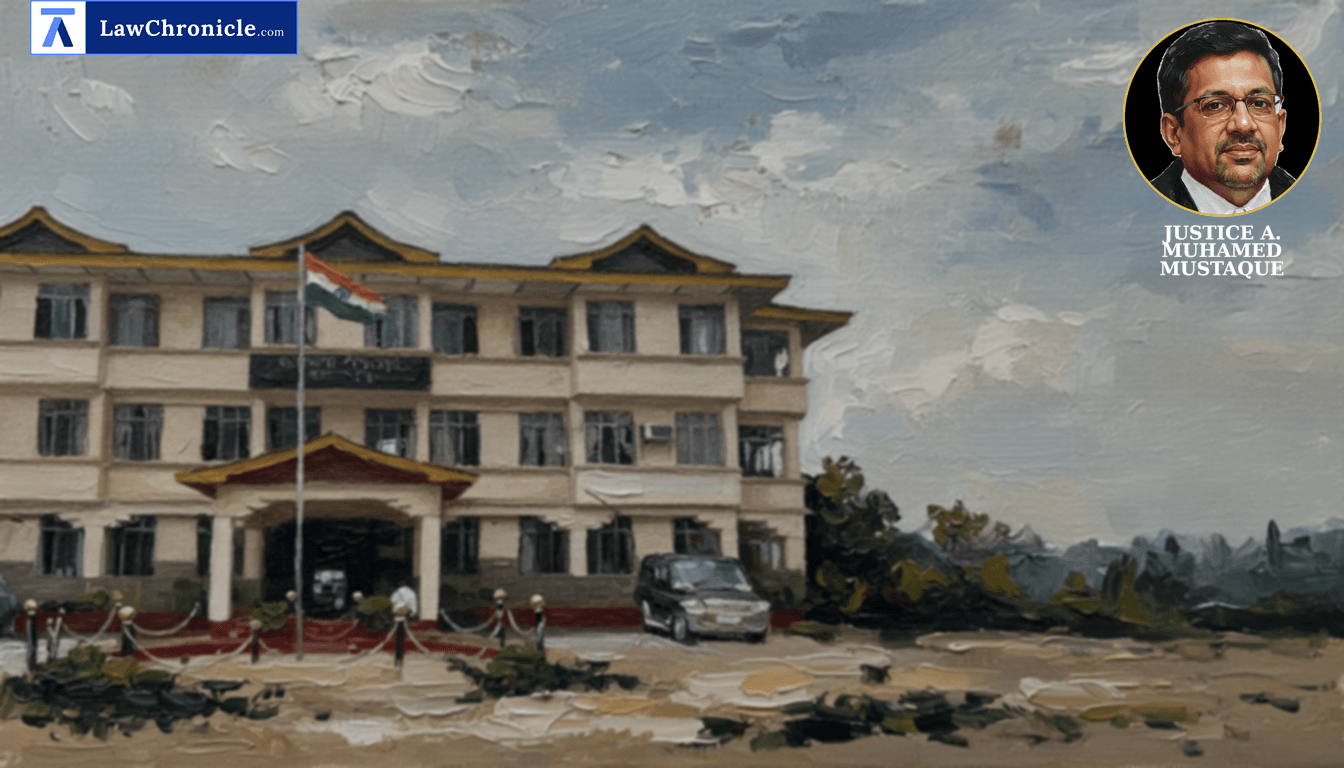
The Sikkim High Court has curtailed the power of District Collectors to issue composite land acquisition awards, ruling that the simultaneous determination of market value and solatium fatally forecloses the Union Government’s statutory right to seek a revisional inquiry into compensation rates.
A Single Bench of Justice A. Muhamed Mustaque, Chief Justice, adjudicated a writ petition filed by the Union of India challenging an award passed by the District Collector of Mangan District under Section 23 of the Right to Fair Compensation and Transparency in Land Acquisition, Rehabilitation and Resettlement Act, 2013. The dispute centered on the acquisition of over 102 hectares of land in high-altitude Himalayan revenue blocks, Lachen, Lachung, and Chungthang, for the construction of Key Location Places for the Indian Army near the international border.
Key Takeaways
Prohibition of Composite Awards
Statutory authorities cannot combine Section 23 market value determination with Section 30 final award proceedings, as it renders the Government's revisional powers under Section 36 redundant.
Revisional Remedy Accessibility
Even if the State Government exercises administrative power to fix land rates, it remains duty-bound to conduct a quasi-judicial inquiry under Section 36 if the Requiring Body challenges the legality of the Collector’s findings.
Collector as Government Agent
Since the Collector acts as an agent of the Appropriate Government, the Government cannot challenge the award via certiorari but may seek a declaratory writ to render it unenforceable due to procedural violations.
Invalidity of the Composite Award Structure
The Sikkim High Court scrutinized the procedural transition from the Land Acquisition Act, 1894 to the Right to Fair Compensation and Transparency in Land Acquisition, Rehabilitation and Resettlement Act, 2013, noting a significant shift in how awards are finalized. The Bench observed that while the 1894 Act treated the award as a singular final determination, the 2013 Act contemplates two distinct stages: valuation under Section 23 and the final award under Section 30. The Bench explained that "The award passed by the Collector, insofar as it combines the determination of compensation under section 23 with the award of solatium under section 30, is in opinion of this Court, legally unsustainable and unenforceable, inasmuch as that would foreclose the right of the Union Government to question the determination of the value by the Collector under Section 23. The Government is therefore bound to examine the matter as to the legality and propriety of the determination of compensation by the Collector."
The Mandate for Revisional Oversight
The Bench highlighted that Section 36 of Right to Fair Compensation and Transparency in Land Acquisition, Rehabilitation and Resettlement Act, 2013 serves as a crucial check on the Collector’s administrative inquiry. By passing a composite award, the Collector inadvertently foreclosed the Ministry of Defence’s ability to invoke the Government's revisional jurisdiction to satisfy itself as to the "legality or propriety" of the land rates.
The Sikkim High Court issued the following directions :
"(i) The award passed by the Collector shall, for the present purposes, be treated only as a determination under Section 23 of the Right to Fair Compensation and Transparency in Land Acquisition, Rehabilitation and Resettlement Act, 2013 and not as a final award.
(ii) The Government shall consider the objections raised by the Union Government and the Defence Estate Office concerning the legality and propriety of the rate fixed for determining the compensation under Section 23.
(iii) The aforesaid exercise shall be completed within a period of six weeks. It is reiterated that all concerned persons, including the landholders, shall be afforded an opportunity of hearing, before the Government takes a decision in this matter.
(iv) Thereafter, the Collector shall proceed to pass the final award in accordance with the decision taken by the appropriate Government under Section 36, and the applicable provisions of the Right to Fair Compensation and Transparency in Land Acquisition, Rehabilitation and Resettlement Act, 2013 including Sections 23 and 30."
Ratio
Under the Right to Fair Compensation and Transparency in Land Acquisition, Rehabilitation and Resettlement Act, 2013, the determination of market value under Section 23 and the issuance of a final award under Section 30 are distinct statutory phases. A Collector is prohibited from passing a composite award that merges these stages, as doing so bypasses the revisional window provided under Section 36, thereby violating the procedural rights of the Requiring Body to challenge the legality and propriety of the valuation before the Appropriate Government.
Background
The Indian Army proposed acquiring land in Mangan District for strategic defense purposes. Initially, the Collector estimated the land value at approximately ₹65 per sq. ft., totaling ₹230 crore. However, following representations from landowners to the State Government and citing a different notification from the Energy and Power Department, the rate was dramatically increased to ₹150 per sq. ft., escalating the total compensation to over ₹564 crore.
The Ministry of Defence raised persistent objections, asserting that the revision lacked a justifiable basis under Section 26 of Right to Fair Compensation and Transparency in Land Acquisition, Rehabilitation and Resettlement Act, 2013. Despite these objections, the Collector issued an award on January 18, 2023, incorporating the higher rate and solatium. The Union Government approached the Sikkim High Court under Article 226 of the Constitution of India. Citing precedents like Surendra Kumar Bhatia vs. Kanhaiya Lal and Others ( "(2009) 12 SCC 184": 2009 CaseBase(SC) 113) and Pune Municipal Corpn. vs. State of Maharashtra and Others, the Court held that while the inquiry is administrative, it must adhere to statutory discipline. Relying on Agra Development Authority vs. Special Land Acquisition Officer and Others ( "(2001) 2 SCC 646": 2001 CaseBase(SC) 1312), the Bench affirmed that a writ petition is maintainable for the limited purpose of declaring an award unenforceable if it defeats the statutory scheme. The Sikkim High Court ultimately disposed of the petition, directing a fresh revisional inquiry into the rates.
Case Details:
Case No.: WP(C) No.28 of 2023
Case Title: Union of India And Others vs. State of Sikkim And Others
Appearances:
For the Petitioner(s): Mr. S. D. Sanjay, Senior Advocate; Ms. Sangita Pradhan, Deputy Solicitor General of India; Ms. Sittal Balmiki and Mr. Amit Kumar Sharma, Advocates
For the Respondent(s): Mr. Zangpo Sherpa, Additional Advocate General; Mr. S. K. Chettri, Government Advocate; Mr. Sujan Sunwar, Assistant Government Advocate; Mr. Mohan Sharma, Advocate; Mr. Sudesh Joshi, Senior Advocate; Mr. Sourav Singh and Mr. Adarsh Gurung, Advocate
Source: 2026 CaseBase(SIK) 98
Similar Articles

 Breaking News


