Single Composite Appeal Valid Against Common Judgment Deciding Multiple Suits: SC
 Copy Link
 Share
Share Save
Save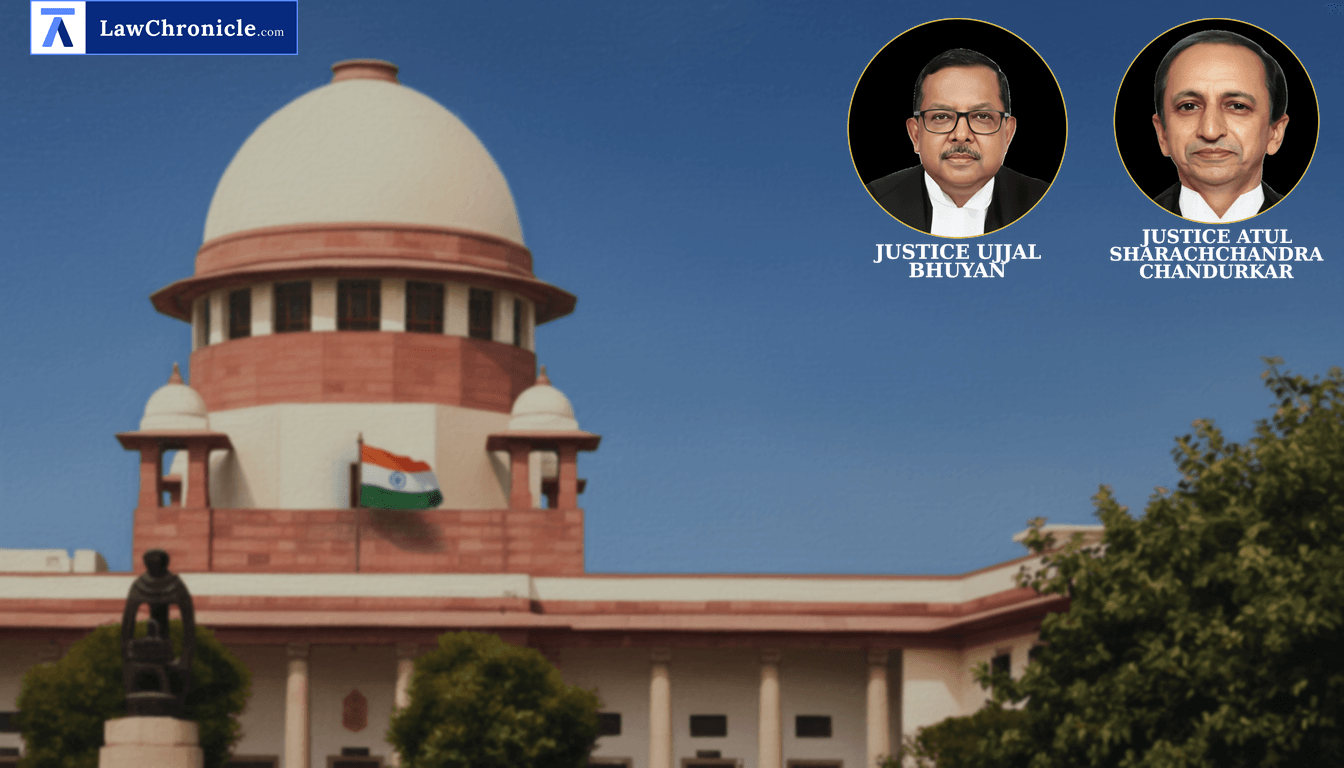
Procedural formalisms cannot extinguish substantive statutory rights of appeal when a litigant substantially satisfies all legal requisites. The Supreme Court has ruled that a single composite appeal filed under Section 96 of the Code of Civil Procedure, 1908 challenging a common judgment that disposes of multiple clubbed suits is fully maintainable.
A Division Bench comprising Justice Ujjal Bhuyan and Justice Atul S. Chandurkar restored second appeals before the Karnataka High Court, holding that non-filing of separate appeal memoranda is a curable defect of form rather than substance.
Key Takeaways
- Substantive Right Over Form: Right of appeal is a substantive right that cannot be defeated by purely technical or procedural omissions.
- Maintainability of Composite Appeal: A single appeal challenging a common judgment in consolidated suits is maintainable if full court fees for both decrees and certified copies are duly filed.
- Curable Procedural Defect: The lack of separate memoranda of appeal is a procedural defect, and appellate courts must afford litigants an opportunity to cure it.
- Bar of Res Judicata Inapplicable: Res judicata attaches to judgments rather than decrees; challenging a common judgment in one composite appeal prevents any estoppel.
Court's Rationale on Section 96 and Order XLI Rule 1
Evaluating the procedural requirements under the Code of Civil Procedure, 1908, the bench observed that when suits are consolidated under Section 151 of the Code of Civil Procedure, 1908 for convenience, they share common evidence and reasoning. The Court noted that Order XLI Rule 1 of the Code of Civil Procedure, 1908 explicitly allows dispensing with multiple copies of a judgment when suits are tried together.
The Court, in its reasoning, observed: "The deficiency, if any, was the absence of a separate memorandum of appeal for each appeal. In other words, what could be challenged by filing two separate appeals was done by filing a composite appeal. The deficiency was more of ‘form’ and not of ‘substance’. This deficiency was curable and did not render the composite appeal not maintainable."
Addressing the necessity of providing an opportunity to rectify procedural errors, the Court relied on Charan Singh Vs. Ram Saroop, reiterating that courts ought to alert litigants to file separate memoranda rather than summarily dismissing their substantive claims.
Reaffirming the principle established in Manohar Vinayak and others Vs. Laxman Anandrao Deshmukh and others ( "AIR 1947 Nagpur 248": 1947 CaseBase(BOM) 55) and Narhari and others Vs. Shankar and others ( "1950 INSC 24": 1950 CaseBase(SC) 39), the Court held that res judicata does not operate within consolidated proceedings arising from a single judgment. It further noted that the Himachal Pradesh High Court's full bench decision in Ramesh Chand Vs. Om Raj and others ( "R.S.A. No.57 of 2017 decided on 17.05.2022": 2022 CaseBase(HP) 577) correctly affirmed the maintainability of a single appeal against a common judgment in consolidated suits.
The Court issued the following directions:
"Accordingly, the judgment of the High Court dated 02.09.2022 passed in RSA Nos.3214 of 2007 and 3215 of 2007 is set aside. Both the second appeals preferred by the respondents herein stand restored before the High Court for being adjudicated afresh on merits."
Ratio
A composite appeal filed under Section 96 of the Code of Civil Procedure, 1908 against a common judgment disposing of consolidated suits between the same parties is legally maintainable, provided requisite court fees and certified copies of all decrees are submitted. The absence of separate memoranda of appeal constitutes a curable procedural defect of form which does not attract the bar of res judicata or justify non-suiting a litigant without adjudication on merits.
Background
The dispute originated when the plaintiff filed two separate civil suits one for declaring a sale deed null and void, and another seeking a perpetual injunction regarding suit land. Upon an application under Section 151 of the Code of Civil Procedure, 1908 by the defendants, the trial court clubbed both suits, recorded common evidence, and dismissed both suits via a common judgment.
Aggrieved, the plaintiff filed a single composite appeal under Section 96 read with Order XLI Rule 1 of the Code of Civil Procedure, 1908, annexing certified copies of both decrees and paying full court fees under the Court Fees Act, 1958. The first appellate court allowed the appeal and decreed both suits. However, in second appeal, the Karnataka High Court set aside the appellate decree, relying on Mallanna alias Appaiah Vs. Smt. Muninanjamma alias Nanjamma ( "R.S.A. No.90 of 1996 decided on 12.02.2001": 2001 CaseBase(KAR) 78) and Karnataka State Agro Corn Products Ltd. Vs. M/s Kerala Agro Seeds to hold that a single composite appeal was unmaintainable.
Distinguishing cases involving counter-claims or cross-suits such as M/s S.A.L. Steel Limited Vs. M/s Sreenidhi Trading Company and others ( "R.F.A. No.100242 of 2017 decided on 20.05.2024": 2024 CaseBase(KAR) 7913) and Sri Dinesh Poojary Vs. Sri Venkappa Gowda, as well as consolidation practices discussed in M/s Chitivalasa Jute Mills Vs. M/s Jaypee Rewa Cement ( "T.P.(C) No.16 of 2002 decided on 04.02.2004": 2004 CaseBase(SC) 992) and procedural dispensation in P.A. Oommen Vs. Moran Mar Baselius Marthoma ( "1992 INSC 175": 1992 CaseBase(SC) 505), the Apex Court held that the High Court erred in exalting procedural form over substantive justice, thereby leaving the plaintiff remediless.
Case Details:
Case No.: Civil Appeal Nos. 9923-9924 of 2026
Neutral Citation: 2026 INSC 838
Case Title: Bassanna Since Deceased by LRs. and Others v. Bhimanna and Others
Appearances:
For the Petitioner(s): Mr. Basava Prabhu S. Patil, Senior Advocate
For the Respondent(s): Mr. Sharanagouda Patil, Advocate
Source: 2026 CaseBase(SC) 767
 Breaking News