Sir Hari Singh Gour and Sir Maurice Gwyer: Two Lawyers who built Delhi University
 Copy Link
 Share
Share Save
Save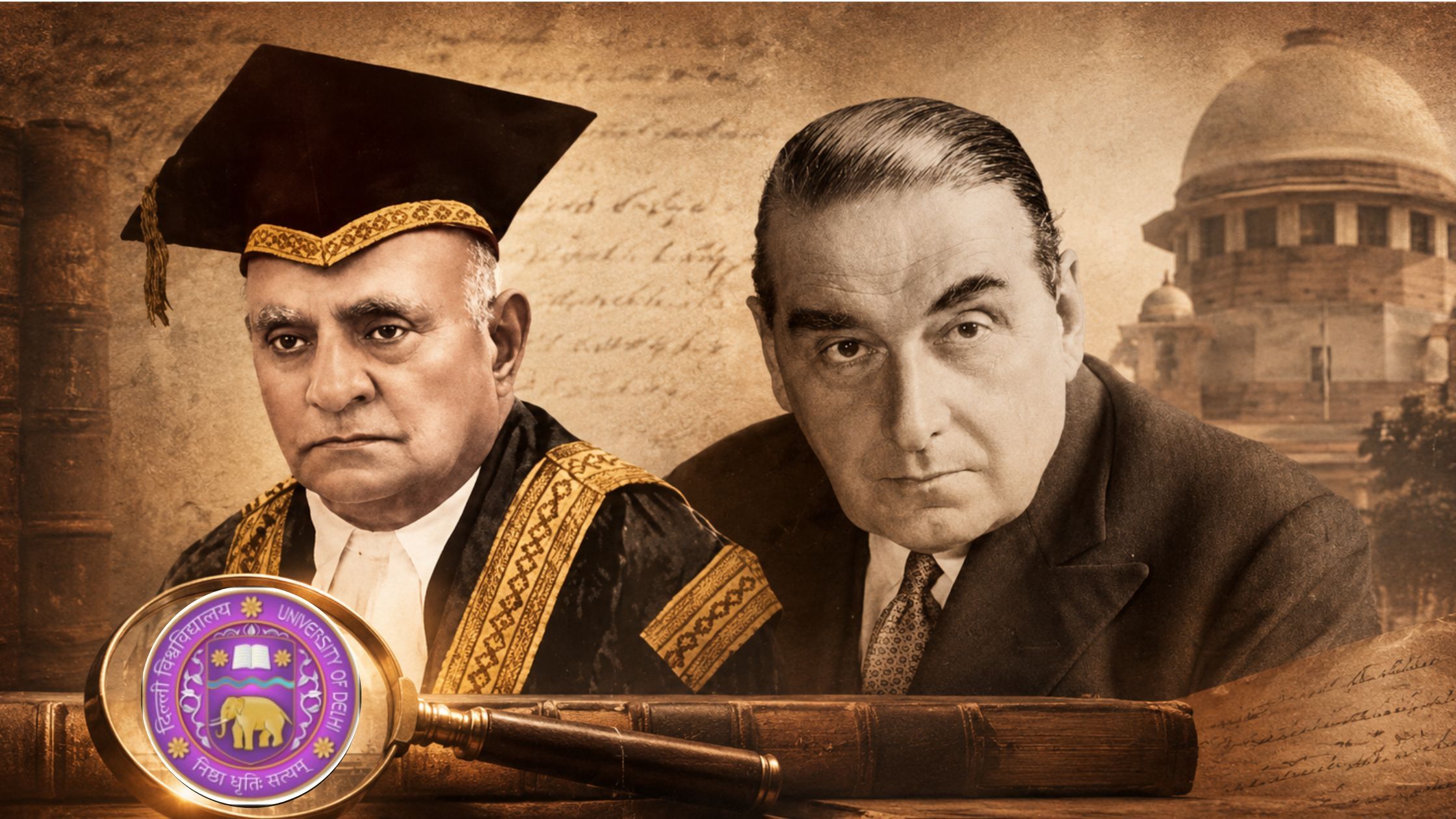
Delhi University is one of the most respected universities in India, and not many know the two lawyers who were there during the foundational years of its making. Delhi University's first Vice-Chancellor was a self-made lawyer from a poor Bundeli family in central India. Its most transformative Vice-Chancellor was a British judge who once held the highest judicial office in the country. Together, Sir Hari Singh Gour and Sir Maurice Gwyer gave Delhi University both its founding identity and its institutional ambition, and their names still mark the campus today.
Every time Delhi University appoints or extends the tenure of a Vice-Chancellor, two names resurface in institutional memory. Sir Hari Singh Gour laid the foundation in 1922. Sir Maurice Gwyer, arriving sixteen years later, built the university that most of Delhi recognizes today: its hostels, its academic structure, and its "education city" character. Both men reached the university by way of the law, and both left it in a permanently different state.
Delhi University's First Vice-Chancellor
Sir Hari Singh Gour was born on 26th November 1870 to a modest Bundeli Rajput family near Sagar in present-day Madhya Pradesh. His father worked as a carpenter and farmer, and the family depended on an allowance from Gour's elder brother to get by. At the age of ten, Sir Hari Singh Gour won a scholarship worth two rupees a month, which paid for night school in Sagar, the first rung of an academic climb that would eventually take him to Cambridge.
Sir Hari Singh Gour studied at Hislop College in Nagpur before proceeding to Downing College, Cambridge, at the age of eighteen. His years in England were not easy: Gour faced considerable racial discrimination as a student, including being denied a mathematics scholarship he had rightfully won because the rules of the time excluded Indian candidates. Rather than let the experience embitter him, Sir Hari Singh Gour turned to poetry, publishing Stepping Westward and Other Poems and earning election as a Fellow of the Royal Society of Literature: a rare honour for an Indian student of that era. He went on to collect degrees in rapid succession: a BA in 1892, an MA in 1896, an LL.M. in 1902 and an LL.D. in 1908, followed by further study at Trinity College, Dublin.
Returning to India, Sir Hari Singh Gour built a formidable legal practice across the High Courts of the Central Provinces, Calcutta and Allahabad, and authored two texts that became standard references for a generation of Indian lawyers: The Law of Transfer in British India and The Penal Law of India. His later work, the Hindu Code, drew on more than 500 books and 7,000 cases and cemented his reputation as one of India's foremost jurists.
A Reformer in the Legislature
Sir Hari Singh Gour's legal scholarship was inseparable from his politics. As Deputy President of the Central Legislative Assembly and Leader of the Opposition from 1921 to 1934, he pushed through some of the earliest social reform legislation in modern India. Sir Hari Singh Gour steered the bill enabling women to be enrolled as lawyers, introduced independent India's first bill for the abolition of untouchability in 1921, and moved the Civil Marriage Bill of 1923 well ahead of its time. In 1924, he successfully raised the age of consent for girls within marriage from 12 to 13: a campaign he had waged in the legislature for years, grounded partly in his reading of early clinical psychology on the harms of child marriage. He also served as an Indian delegate to the Joint Parliamentary Committee on the Government of India Bill and sat on the Indian Central Committee associated with the Simon Commission.
Founding Delhi University
When the University of Delhi was established in 1922, Sir Hari Singh Gour was appointed its first Vice-Chancellor, a post he held until 1926. In just a few years, he laid the institutional groundwork, setting up departments, establishing academic standards, and accepting the role without salary. He was knighted in 1925. Delhi University later honoured him with an honorary D.Litt.
Sir Hari Singh Gour went on to serve two terms as Vice-Chancellor of Nagpur University, and in 1946 he used a substantial part of his personal fortune to found the University of Sagar, now renamed Dr. Hari Singh Gour University in his memory: the oldest university in Madhya Pradesh. He remained its Vice-Chancellor until his death on 25 December 1949, having bequeathed much of his life's savings to the institution he built. He was also a member of India's Constituent Assembly, contributing to the drafting of the Constitution.
Despite laying Delhi University's foundations, Sir Hari Singh Gour's presence on campus today is comparatively understated with no statue, hall, library or garden bears his name, even as his early administrative work continues to underpin the institution.
The Judge Who Reshaped Delhi University
If Gour built the university's foundations, it was Sir Maurice Linford Gwyer who gave Delhi University its enduring shape. Born on 25th April 1878 in London, Sir Maurice Gwyer was educated at Highgate School, Westminster School, and Christ Church, Oxford, and was elected a Fellow of All Souls College, Oxford, in 1902.
His career before India was spent almost entirely in British legal administration. He served as Solicitor and Legal Adviser to the Ministry of Health from 1919 to 1926, as HM Procurator General and Treasury Solicitor from 1926 to 1933, and as First Parliamentary Counsel from 1933 to 1937, the official responsible for drafting UK government legislation. He was appointed CB in 1921, KCB in 1928, KCSI in 1935, and eventually GCIE in 1948, marking a steady rise through the ranks of British imperial administration.
Chief Justice of the Federal Court of India
In 1937, Sir Maurice Gwyer was appointed the first Chief Justice of the Federal Court of India, the institutional predecessor of the Supreme Court of India, a position he held until 1943. It was this legal eminence that Delhi University drew on when it appointed him Vice-Chancellor in 1938, a post he would hold concurrently with his judicial office and continue in until 1950, well beyond his tenure on the bench.
3-Year Honours Degree and an "Education City"
Sir Maurice Gwyer's tenure coincided with, and substantially drove, a period of major institutional growth. He is credited with introducing the three-year Honours degree in 1943, replacing the earlier two-year Intermediate programme: a structural reform that reshaped undergraduate education across the subcontinent and whose basic framework still underlies Indian higher education today.
Sir Maurice Gwyer's ambition went beyond academics. Having also served a term as President of the New Delhi YMCA, he set about building the Delhi University campus as a self-contained "education city," consciously modelled on the university towns of Oxford and Cambridge. Under his leadership, the university introduced English and BSc Honours courses, expanded postgraduate teaching, set up new laboratories, and recruited outstanding professors from across India, drawing figures such as E.M. Forster to lecture at Delhi for nearly four decades.
Sir Maurice Gwyer founded Gwyer Hall, the Delhi University's oldest men's hostel, in 1937-38 to house students arriving from outside Delhi, initially with only 26 residents. He is remembered on Delhi University campus for a close personal interest in the hostel's construction and for the affection of resident cats, several of which he is said to have kept himself. In 1948, Sir Maurice Gwyer went on to found Miranda House, naming it after the free-spirited and wondrous character from Shakespeare's The Tempest, in honour of his own daughter Miranda, his favourite actress Carmen Miranda, and the character itself. Hansraj College also became part of the university in 1952, four years into Miranda House's existence.
A Name That Still Marks the Campus
Sir Maurice Gwyer's imprint on Delhi University remains visible in ways Sir Hari Singh Gour's does not. The area historically known as Raipur Quarters was renamed Maurice Nagar in his honour when he demitted office in 1950, in recognition of his contribution "as it stood entirely his creation." Gwyer Hall, the residence he founded, and the architectural character of the campus, with contributions from architect Walter Sykes George, who also designed St Stephen's College, Miranda House and the Regal Cinema building at Connaught Place, remain part of Delhi University's everyday landscape.
Sir Maurice Gwyer died on 12th October 1952 at his home in Eastbourne, England, and was buried at St Marylebone Cemetery, East Finchley.
The Two Lawyers who built DU
Sir Hari Singh Gour and Sir Maurice Gwyer arrived at Delhi University from very different starting points: one a self-made Indian jurist who overcame poverty and colonial prejudice to become a legislator and legal scholar, the other a career British administrator who rose to lead India's highest court. Yet both men treated the Vice-Chancellorship not as a ceremonial appointment but as an opportunity for institution-building, at a time when Delhi University was still finding its academic identity.
Their combined legacy: Sir Hari Singh Gour's founding administration and legislative reforms, Sir Maurice Gwyer's academic restructuring and campus expansion, explains why, nearly a century later, discussions about Delhi University's Vice-Chancellors still return to their names.
 Breaking News