State a Sovereign Custodian, Cannot Receive Gift of Temple Land: Supreme Court
 Copy Link
 Share
 Save
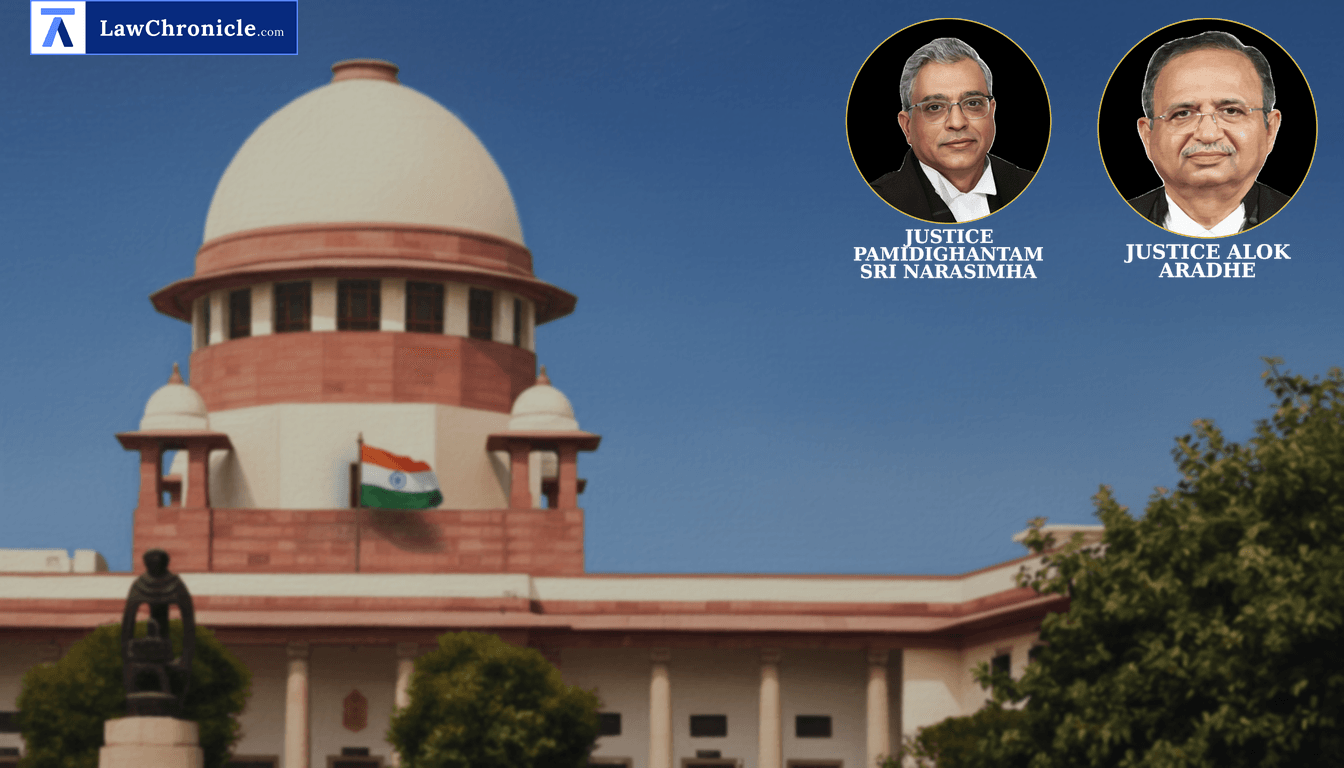
In a stern rebuke to state overreach, the Supreme Court has clarified that the Government cannot receive or retain gifts of temple lands, declaring that a statutory custodian holds property strictly in trust and cannot transform into a beneficiary of gratuitous transfers.
A Division Bench comprising Justice Pamidighantam Sri Narasimha and Justice Alok Aradhe set aside a High Court order that had upheld a gift deed transferring 1 acre and 10 cents of temple land to the State of Tamil Nadu for constructing a Taluk Office.
Key Takeaways
Absolute Prohibition on Inam Gifts: Gifts of inam lands dedicated to religious deities are void ab initio and cannot be validated by any authority.
State as Custodian, Not Owner: The executive cannot leverage its regulatory power to absorb trust properties for administrative convenience.
Strict Compliance Mandated: Statutory guidelines under state religious endowment laws must be strictly followed before any alienation or leasing of temple land.
Mandatory Fair Rent Valuation: Land occupied by the State must yield fair market rent determined by statutory committees rather than nominal sums.
Court's Rationale on Temple Property and State Custodianship
The Supreme Court underscored that property dedicated to a religious institution vests in the deity in perpetuity. A trustee holds such property only in trust and has no unfettered authority to gift it away. Denouncing the State’s initial defense of the transfer, the Bench stressed that the government’s supervisory authority under Tamil Nadu Hindu Religious and Charitable Endowments Act, 1959 does not grant it ownership rights. The Bench explained that "The administration of property belonging to a religious/charitable institution carries with it a duty of preservation, not a power of unfettered disposition. The question which arises for consideration in these appeals, stated at its simplest, is whether the State Government, which the law requires to act as a custodian of the properties belonging to religious/charitable institutions, can itself become the recipient of a gift of such property from a temporary trustee of a temple."
Addressing the distinct nature of religious endowments, the Supreme Court noted "That wealth, once given, ceases to belong to the donor, to the priest, to the trustee, or to the State; it vests in the deity, and every hand through which it subsequently passes holds it only in trust for the deity and, through the deity, for the community of worshippers it was meant to serve. Every custodian holds it only in trust for the deity and the worshippers it serves."
Highlighting precedents such as Commissioner, Hindu Religious Endowments, Madras v. Sri Lakshmindra Thirtha Swamiar of Sri Shirur Mutt ( "(1954) 1 SCC 412": 1954 CaseBase(SC) 168) and A.S. Narayana Deekshitulu v. State of Andhra Pradesh ( "(1996) 9 SCC 548": 1996 CaseBase(SC) 1965), the Bench reaffirmed that while secular management of religious endowments can be regulated by law, such regulation is meant to protect trust assets from dissipation.
The Apex Court issued the following directions:
"(i) the authorities of the State Government and the Hindu Religious and Charitable Endowments Department shall strictly comply with the procedure prescribed under Sections 34, 34-A and 41 of the 1959 Act, and the Rules framed thereunder, before effecting or sanctioning any exchange, sale, mortgage or lease of property belonging to, or given or endowed for the purpose of, any religious institution.
(ii) Every decision touching the properties of a religious/charitable institution must be guided solely by the best interest and benefit of the trust, and never by the administrative convenience of the Government.
(iii) The State, as custodian, cannot unilaterally usurp, nor permit any of its officers to usurp, the property of the religious/charitable institutions it is charged to protect; a transaction that offends this principle, whatever its label or ostensible public purpose, is liable to be struck down."
Ratio
A gift of inam land dedicated to a deity executed by a trustee is void ab initio under Section 41(1) of the Tamil Nadu Hindu Religious and Charitable Endowments Act, 1959 and cannot be cured by registration under Section 22-A of the Registration Act, 1908. The State, as a statutory custodian of religious endowments, cannot accept a gratuitous transfer of trust property for its own administrative convenience.
Background
The dispute concerned 1 acre and 10 cents of land belonging to the Nagapalayam Mariamman-Ponnachiamman Temple in Erode District, Tamil Nadu. On August 30, 2017, a temporary trustee executed a gift deed transferring the land to the Government of Tamil Nadu for constructing a Taluk Office. The deed was registered without obtaining prior statutory sanctions.
Devotees and the hereditary trustee challenged the alienation before the High Court of Judicature at Madras, contending that it violated Section 34 of the Tamil Nadu Hindu Religious and Charitable Endowments Act, 1959. The High Court dismissed the writ petition on March 19, 2019, holding that gifts were not explicitly barred under Section 34 and relegated the parties to a civil suit. Devotees subsequently appealed to the Supreme Court.
During the pendency of the appeal, the State Government filed an affidavit admitting that the property was an inam land governed by Section 41 of the Tamil Nadu Hindu Religious and Charitable Endowments Act, 1959, making any gift null and void. The State agreed to cancel the gift deed and treat its occupation as a lease. While the Court permitted the State to retain the land on lease since a public office had already been constructed, it enhanced the fair lease rent from Rs. 13,235/- to Rs. 31,000/- per month with effect from March 8, 2019, and imposed costs of Rs. 1,00,000/- on the State for its initial defense of the illegal transaction.
Case Details:
Case No.: Civil Appeal Nos. of 2026 (@ Special Leave Petition (C) Nos. 20051-20052 of 2019)
Neutral Citation: 2026 INSC 1144
Case Title: K. Ramalingam and Others v. Government of Tamil Nadu Rep. by its Secretary and Others
Source: 2026 CaseBase(SC) 8283
 Breaking News