


States Must Implement Mother Tongue-Based Education as Constitutional Right: SC
 Copy Link
 Share
Share Save
Save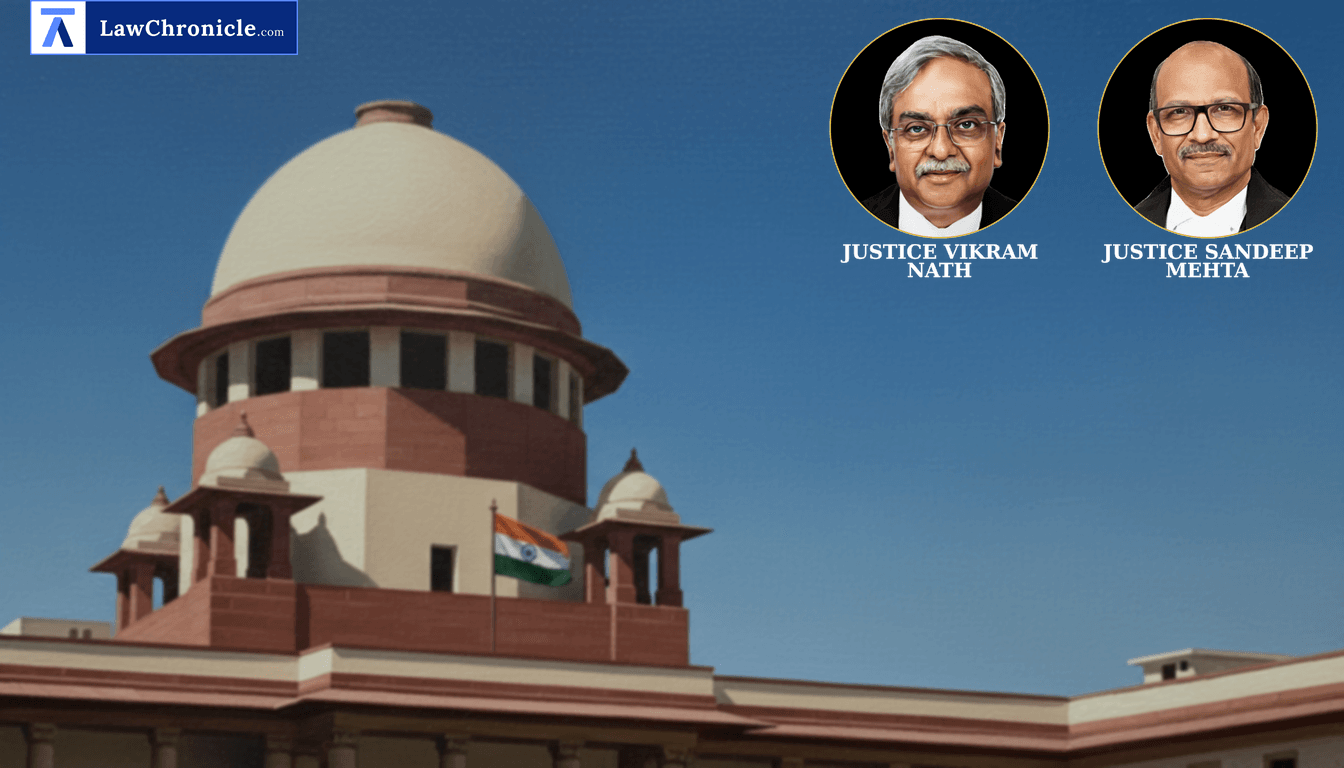
The Supreme Court of India has reaffirmed that the right to receive education in one's mother tongue is not a matter of administrative convenience but a fundamental existential right rooted in the Constitution of India, 1950. In a landmark ruling, the Court emphasized that comprehension must precede meaningful participation in society, and language serves as the very essence of individual identity.
A bench comprising Justice Vikram Nath and Justice Sandeep Mehta delivered this significant judgment while hearing an appeal against a Rajasthan High Court order that had dismissed a Public Interest Litigation (PIL). The appellants had sought the inclusion of the Rajasthani language in the recruitment syllabus for teachers and the imparting of education to children in their local language.
While the Court noted that the specific relief regarding the 2023 teacher recruitment examination had become infructuous due to the passage of time, it chose to address the broader constitutional issues. The Court observed that education is a transformative force intended to empower individuals, and such empowerment is impossible if the medium of instruction remains unintelligible to the learner.
The Constitutional and Statutory Mandate for Mother Tongue Instruction
The Court, in its reasoning, observed: "The constitutional framework also recognises that the quality of education is inextricably linked to the medium through which it is imparted, reflecting the principle that education must be intelligible and accessible to the learner. Instruction that cannot be adequately grasped by the students due to language barriers or unfamiliar mediums of instruction cannot, in any meaningful sense, be regarded as quality education, for the very purpose of education is to equip the learner with knowledge, understanding, and skills."
The judgment drew heavily from the Right of Children to Free and Compulsory Education Act, 2009, specifically Section 29(2)(f), which mandates that the medium of instruction shall, as far as practicable, be in the child's mother tongue. The Bench also highlighted that the right to receive information in a comprehensible form is an intrinsic facet of the freedom of speech and expression under Article 19(1)(a) of the Constitution of India, 1950.
Judicial Precedents on Linguistic Rights
The Court relied on several landmark precedents to fortify its stance. It cited State of U.P. & Anr. v. Anand Kumar Yadav & Ors. ( "(2018) 13 SCC 560": 2017 CaseBase(SC) 1052) to emphasize that the right to education is essentially a right to "quality" education. Furthermore, the Court referred to Devesh Sharma v. Union of India & Ors. ( "(2023) 18 SCC 339": 2023 CaseBase(SC) 833), which highlighted the transformative purpose of the Right of Children to Free and Compulsory Education Act, 2009 in dismantling barriers to access.
Regarding the linguistic choice of the learner, the Court invoked English Medium Students Parents Assn. v. State of Karnataka & Ors., where it was held that the mother tongue is a vital instrument for cognitive growth and cultural continuity. The Bench also reiterated the principle from State of Karnataka & Anr. v. Associated Management of English Medium Primary & Secondary Schools & Ors, confirming that the freedom of a child to be educated in a language of their choice at the primary stage is protected under the constitutional guarantee of free speech.
Directions Issued to the State of Rajasthan
The Court expressed concern over the "lackadaisical response" of the State government, which had argued that only languages listed in the Eighth Schedule of the Constitution of India, 1950 could be taught. The Court dismissed this as a pedantic approach, noting that Rajasthani is already taught at the university level.
The Court has the following directions:
"The State of Rajasthan shall formulate an appropriate and comprehensive policy for the effective implementation of the constitutional mandate relating to mother tongue-based education, particularly in the backdrop of the National Education Policy, 2020. The State shall take necessary measures to recognise and accord due status to the Rajasthani language as a local/regional language for educational purposes and to progressively facilitate its adoption as a medium of instruction, initially at the foundational and preparatory stages of schooling and progressively at higher levels, in a manner consistent with constitutional principles and pedagogical requirements. ...the State to take affirmative and time-bound steps towards introducing and providing Rajasthani as a subject in all schools, government and private, in a phased and progressive manner."
Background:
The dispute originated when the appellants filed a PIL in the Rajasthan High Court seeking the inclusion of the Rajasthani language in the Rajasthan Eligibility Examination for Teachers (REET). The High Court had dismissed the petition on the grounds that the appellants failed to establish an enforceable legal right or a statutory duty on the part of the State.
However, the Supreme Court set aside the High Court's order, ruling that the State cannot remain indifferent to the non-realization of rights clearly envisaged under the Constitution of India, 1950. The Court has directed the State of Rajasthan to file a compliance affidavit by September 25, 2026.
Case Details:
Case No.: Civil Appeal No. of 2026 (Arising out of SLP (C) No. 1425 of 2025)
NeutralCitation: 2026 INSC 476
Case Title: Padam Mehta and Another v. State of Rajasthan and Others
Source: 2026 CaseBase(SC) 408
 Breaking News