


Supreme Court Allows Appeals, Sets Aside Convictions for Lack of Prosecution Evidence
 Copy Link
 Share
 Save
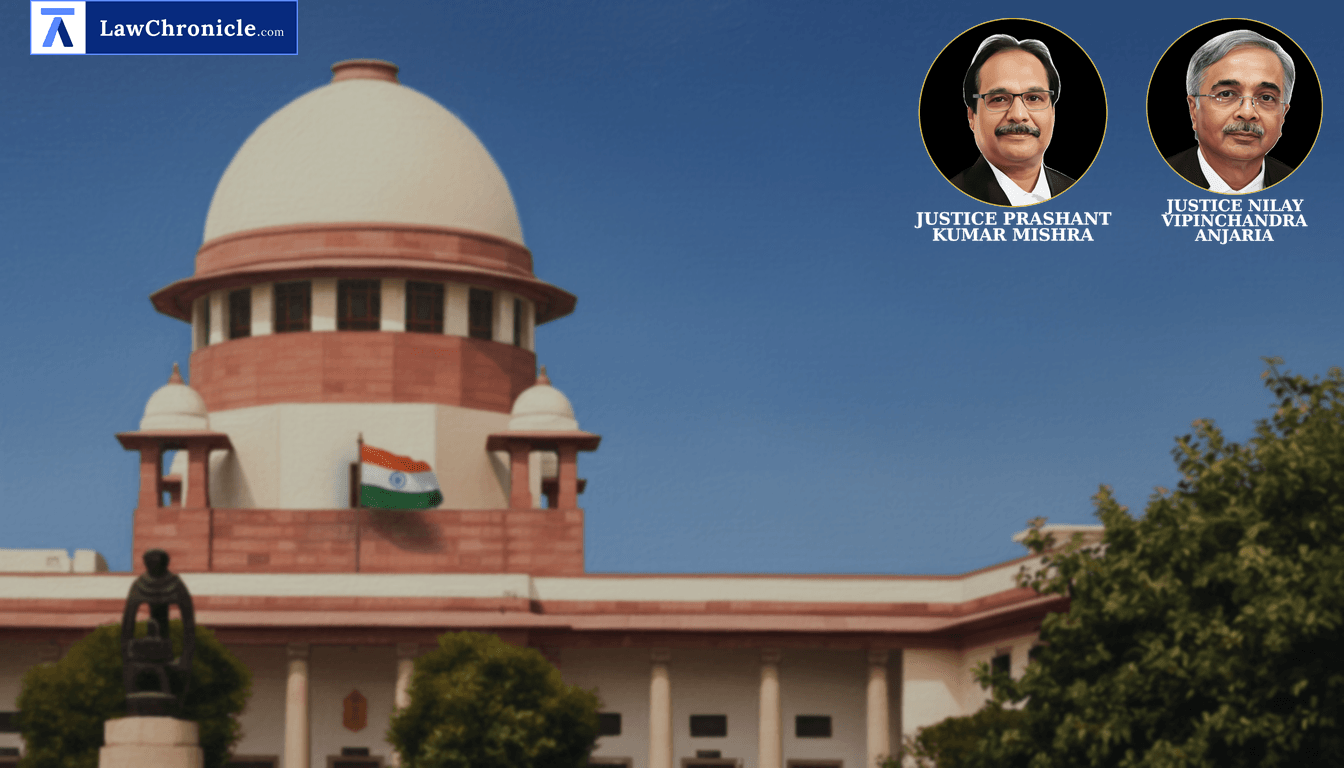
A bench of Justices Prashant Kumar Mishra and Vipul M. Pancholi heard appeals by several accused persons challenging the Chhattisgarh High Court’s affirmation of convictions in a homicide trial. The appeals arose from separate Criminal Appeals Nos. 904 of 2012 and 931 of 2012, which the High Court had dismissed on 17 February 2021, thereby upholding trial court convictions under Section 302 read with Section 149 and Section 148 IPC.
The Court allowed the appeals and set aside the conviction and sentence imposed by the Trial Court and affirmed by the High Court, holding that the prosecution had failed to prove the case beyond reasonable doubt. The bench observed that the principal eyewitness was an interested witness whose testimony contained material contradictions and that crucial corroborative evidence was either inconsistent or absent. The Court noted that independent witnesses had turned hostile and the medical evidence did not conclusively link the seized articles to the injuries. As the Court, in its reasoning, observed: “In view of the aforesaid discussion, we were of the view that the prosecution had failed to prove the case against the appellants-accused persons beyond reasonable doubt, despite which the Trial Court had recorded the judgment and order of conviction and sentence, which had been confirmed by the High Court.” The Court further emphasised that “merely because the witness was an interested or related witness, his/her deposition could not be discarded. Further, deposition of such witnesses was required to be scrutinized closely.” The judgment also recorded the doctor’s admission that “he had not mentioned in the post-mortem report that the lacerated and incised wounds were caused by which weapon.”
Background
The dispute stemmed from an incident on 14 July 2010 in which the informant, Parasbai (PW-4), reported that her son, Goreylal, had been assaulted near a pond and later died. The informant stated that her granddaughter, Indu Bai, informed her that members of the Teli caste were assaulting her father; when the informant reached the scene she alleged that several accused were assaulting her son with lathis and stones and that his hands were tied. FIR was lodged the same day at 12:40 hours and the police charged the accused under Section 302 read with Sections 148 and 149 IPC; an additional charge under Section 506B IPC was framed against one accused.
The prosecution examined ten witnesses, produced documentary evidence and relied on physical articles said to be produced by the accused before the Investigating Officer. The Trial Court convicted the accused persons and sentenced them to life imprisonment under Section 302 read with Section 149 IPC (with fines) and to two years’ rigorous imprisonment under Section 148 IPC. The High Court dismissed the appeals; the accused then approached this Court.
Before the Supreme Court, defence counsel contended that PW-4 was an interested witness and a chance witness whose testimony contained contradictions, that Indu Bai (the person who allegedly gave the first information) was not examined, and that independent witnesses had turned hostile. The State, through the Advocate General, relied on PW-4’s detailed version, medical evidence from the post-mortem doctor (PW-7) and the Investigating Officer’s (PW-8) account that sticks and a stone had been produced by the accused.
On examination of the record the Court found significant infirmities: PW-4’s account differed on material points and she conceded she could not identify which accused’s stick or stone had caused injuries; Indu Bai was not examined; independent witnesses did not support the prosecution; and the post-mortem report and doctor’s testimony did not specify which wounds were caused by which weapon. The Court concluded that reliance solely on PW-4’s deposition was unsafe and that production of sticks and a stone by way of memorandum statements could not supply the missing proof. Consequently, the appeals were allowed, the impugned convictions were set aside, and the bail bonds of the appellants—discharged by this Court’s earlier order dated 30 July 2025—were formally discharged. Pending applications stood disposed of.
Case Details: Case No.: 2025 INSC 1454; Criminal Appeal Nos. 3647 of 2025 and 3648 of 2025 Case Title: Punimati & Anr. v. The State of Chhattisgarh & Ors.; Dayalu & Ors. v. State of Chhattisgarh Appearances: For the Petitioner(s): Counsel names not indicated in the judgment For the Respondent(s): Advocate General for the State (name not indicated in the judgment)
Similar Articles
 Breaking News


