


Supreme Court Cancels Bail Where High Court Overlooked Unlawful Assembly Liability and Grave Injuries
 Copy Link
 Share
 Save
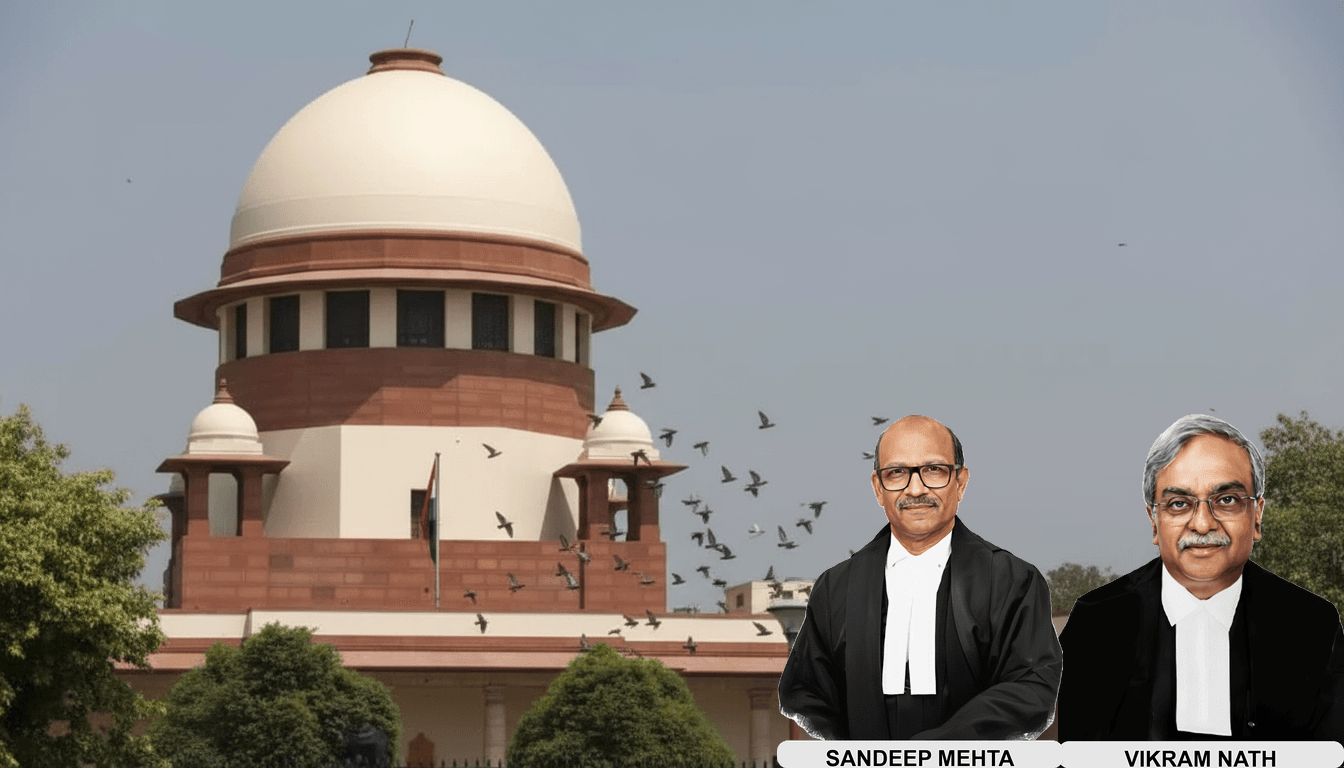
A bench of Justices Vikram Nath and Sandeep Mehta heard an appeal by the original complainant against an order of the Bombay High Court, Aurangabad Bench, which had granted bail to two accused in a criminal case arising from a violent incident on a public road. The appeal challenged the High Court’s grant of bail in an FIR that charged multiple persons with offences including murder (Section 302 IPC) and offences under the Scheduled Castes and Scheduled Tribes (Prevention of Atrocities) Act, 1989.
The Court allowed the appeal, set aside the High Court order and cancelled the bail granted to the two respondents. The Supreme Court held that the High Court had erroneously treated the prosecution’s inability at the bail stage to fix the precise weapon-to-injury attribution as a ground for bail and had relied on extraneous considerations such as the existence of pending civil litigation. The Court emphasised the distinction between cancellation of bail and interference with a grant of bail, and it stressed that in cases of rioting and unlawful assembly “each member of the assembly is equally responsible for the acts committed in furtherance of the unlawful object.” The Court, in its reasoning, observed: “We make it clear that there is a clear distinction between cancellation of bail on the considerations provided under Section 439(2) CrPC (corresponding Section 483(3) BNSS) and reversal of an order of bail by the superior Court. While cancellation should only be resorted to in cases where the accused misuses the liberty of bail granted to him or tempers with the evidence. On the other hand, the order granting bail can be interfered with by the superior Court considering the nature and gravity of the offences; if the order granting bail ignores the relevant material available on record or that the same is based on extraneous considerations. The present is a case in the second category.” The Court also recalled that “A superficial application of bail parameters not only undermines the gravity of the offence itself but also risks weakening public faith in the judiciary's resolve…” and found that “there was absolutely no justifiable reason to grant bail to the accused respondents.”
Background
The dispute arose from a long‑running civil dispute over a right of way adjacent to agricultural land. On 19 August 2022 the complainant alleged that six persons, including the two respondents, attacked her husband near a shop on the Shirdi‑Lasalgaon Road; her husband was assaulted with iron rods and sticks, the complainant and her relatives sustained injuries, and caste‑based abusive acts were alleged. FIR No. 322 of 2022 was registered for offences including Sections 143, 147, 148, 149, 326, 323, 504, 506, 509 and under Sections 3(1)(r), 3(1)(s), 3(2)(5), 3(2)(v‑a), 3(1)(w) and 3(1)(g) of the SC/ST Act. The deceased succumbed on 24 August 2022 and Section 302 IPC was added.
The High Court granted bail to the two accused after noting the pending civil litigation between the parties, the absence of a specific attribution in witness statements as to which accused caused which injury, the discovery issues around weapons, and the temporal gap between assault and death. The State and the complainant challenged this on the ground that the High Court had effectively performed a trial‑level appraisal and overlooked that the offence was committed by an unlawful assembly whose members were jointly liable.
The Supreme Court applied settled precedents including Shabeen Ahmad v. State of Uttar Pradesh and Victim ‘X’ v. State of Bihar to hold that a superior court could set aside an unreasoned or perverse order granting bail where relevant material and the gravity of the offence were ignored. The Court recorded the post‑mortem injuries, noted the collective nature of the attack and the head injury causing cerebral damage, and concluded that the High Court’s reasons for bail were insufficient. The appeal was allowed, the impugned order was set aside and bail cancelled. The respondents were directed to surrender before the trial court within four weeks; the trial court was directed to conclude the trial within one year. The Court granted liberty to the accused to renew bail applications after recording eye‑witness and medical jurist evidence and clarified that its observations would not influence the trial’s outcome.
Case Details:
Case No.: 2026 INSC 181
Case Title: Shobha Namdev Sonavane v. Samadhan Bajirao Sonvane and Others
Appearances:
For the Petitioner(s): Advocates not specified in the judgment
For the Respondent(s): Advocates not specified in the judgment
Source: 2026 CaseBase(SC) 147
Similar Articles


 Breaking News


