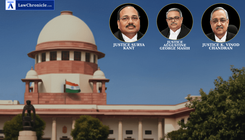
Supreme Court directs restoration of 25% LDCE quota for Higher Judiciary, lowers LDCE eligibility and restores three‑year Bar practice for Civil Judge exams
 Copy Link
 Share
Share Save
Save
A bench of Chief Justice B.R. Gavai and Justices Augustine George Masih and K. Vinod Chandran heard a batch of interlocutory applications arising from Writ Petition (C) No. 1022 of 1989 concerning qualification, promotion and selection rules for entry into Judicial Services and promotions within the subordinate judiciary. The applications challenged the reduced quota for Limited Departmental Competitive Examination (LDCE), the minimum qualifying experience for LDCE and the eligibility criteria for entry as Civil Judge (Junior Division).
The Court allowed a wide‑ranging set of modifications to recruitment and promotion norms. It directed that the LDCE quota for promotion to the Higher Judicial Service (District Judge cadre) be restored to 25% of cadre strength; the minimum qualifying service for LDCE for Higher Judiciary be reduced so that a candidate with three years’ service as Civil Judge (Senior Division) and a cumulative seven years’ service (including Junior Division) would be eligible; 10% of posts in the Cadre of Civil Judge (Senior Division) were to be reserved for accelerated promotion from Civil Judge (Junior Division) through LDCE with a minimum of three years’ service as Civil Judge (Junior Division); the LDCE quota was to be calculated on cadre strength; High Courts were directed to frame or revise suitability rules for promotion under the 65% merit‑cum‑seniority quota; and the Court restored a three‑year practice requirement for candidates for Civil Judge (Junior Division) examinations, to be computed from provisional enrolment/registration. The Court reiterated the need for judicial officers to “keep abreast of knowledge of law and the latest pronouncements” and to have an “objective method of testing the suitability” of candidates.
The Court, in its reasoning, observed: “While we agree with the Shetty Commission that the recruitment to the Higher Judicial Service i.e. the District Judge cadre from amongst the advocates should be 25 per cent and the process of recruitment is to be by a competitive examination, both written and viva voce, we are of the opinion that there should be an objective method of testing the suitability of the subordinate judicial officers for promotion to the Higher Judicial Service. ... In order to achieve this, while the ratio of 75 per cent appointment by promotion and 25 per cent by direct recruitment to the Higher Judicial Service is maintained, we are, however, of the opinion that there should be two methods as far as appointment by promotion is concerned : 50 per cent of the total posts in the Higher Judicial Service must be filled by promotion on the basis of principle of merit‑cum‑seniority … (b) 25 per cent by promotion strictly on the basis of merit through limited competitive examination of Civil Judges (Senior Division) having not less than five years' qualifying service; and (c) 25 per cent of the posts shall be filled by direct recruitment from amongst the eligible advocates …”
Background The batch of I.As. arose from long‑running proceedings that began with the All India Judges’ Association matters and subsequent recommendations of the Shetty Commission. In 2002 the Court had endorsed a 75:25 promotion‑to‑direct recruitment ratio and directed that promotion be split into merit‑cum‑seniority and LDCE channels. In 2010 the Court reduced the LDCE share from 25% to 10% because many High Courts had been unable to fill LDCE seats; that ratio was reflected in amended service rules. Stakeholders including several High Courts and State Governments filed I.As. seeking restoration of the LDCE quota to 25%, reduction of the five‑year senior‑division requirement, introduction of LDCE incentives at junior levels, clarification whether LDCE quotas should be based on cadre strength or annual vacancies, introduction of objective suitability tests for merit‑cum‑seniority promotions, and restoration of a minimum period of Bar practice for Civil Judge (Junior Division) entrants.
After hearing amicus curiae Shri Sidharth Bhatnagar and multiple State and High Court counsels, and reviewing responses and statistical charts, the Court found that restoring incentives would not impair judicial administration if unfilled LDCE seats reverted to regular promotion in the same year. It concluded that the five‑year senior‑division requirement frustrated LDCE’s incentive purpose in many States and reduced it to three years (with seven years’ cumulative service) for LDCE to Higher Judiciary, while reinstating a three‑year Bar practice requirement for entry at the Junior Division counted from provisional Bar enrolment. The Court mandated High Courts to frame/modify suitability rules (factors listed included quality of judgments, ACRs, disposal rates and viva performance), required one year’s training for new Civil Judges, and directed High Courts and State Governments to amend rules within three and six months respectively. It granted liberty for existing selection processes to continue under current rules where already initiated.
Case Details: Case No.: I.A. No. 93974 of 2019 with I.A. Nos. 72900, 73015, 40695 of 2021 and I.A. Nos. 50269, 201893 of 2022 in Writ Petition (C) No. 1022 of 1989 Case Title: All India Judges Association and Others v. Union of India and Others Appearances: For the Petitioner(s): Shri Sidharth Bhatnagar (Amicus Curiae) For the Respondent(s): Shri B.H. Marlapalle (Senior Counsel), Ms. Radhika Gautam (for Bar Council of India)
 Breaking News