Supreme Court Discharges Forest Officer Citing Lack of Specific Role and Principle of Parity
 Copy Link
 Share
Share Save
Save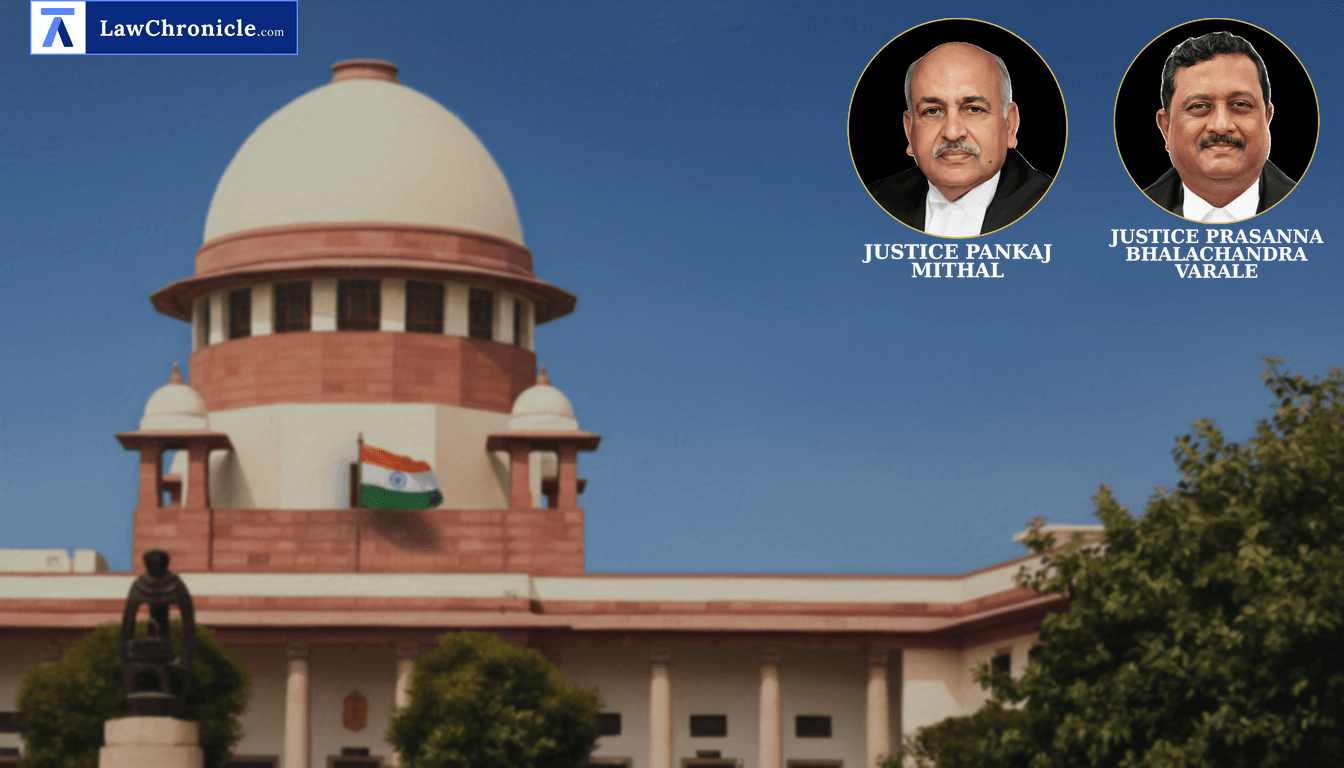
The Supreme Court quashed criminal proceedings against a Forest Range Officer, emphasizing that vague and general allegations without specific imputations cannot sustain a trial, especially when similarly situated co-accused have been discharged.
In a significant ruling, a bench comprising Justice Pankaj Mithal and Justice Prasanna B. Varale set aside the Orissa High Court's order that had refused to discharge the appellant. The Court highlighted the necessity of identifying the specific role of each accused in a joint accusation to prevent the criminal process from becoming an instrument of oppression.
Judicial Rationale on Individual Culpability and Parity
The Court observed that the accusations against the appellant were broad and failed to satisfy the legal requirement for implicating an individual in criminal proceedings. It noted that the High Court had failed to independently assess the materials against the appellant and had erroneously singled him out despite his claim for parity with other discharged officials.
The Court, in its reasoning, observed: "In any criminal case, there must be clear and specific material that shows the accused might have committed the crime. A case cannot be allowed to continue based only on guesses or vague statements. In this case, the material does not show any direct involvement of the Appellant in the crime. The accusations are made against a group of people together and do not explain what exactly the Appellant is supposed to have done. Such broad and general claims, without mentioning the Appellant’s individual role, are not enough to continue with the trial."
Application of the Principle of Parity
The bench further pointed out that two Indian Forest Service officers, who held higher administrative positions in the same chain of events, had already been discharged. The Court held: "The principle of parity, which is a fundamental tenet of criminal jurisprudence, requires that similarly situated accused persons be treated alike. When the allegations and evidence against the Appellant are not even qualitatively stronger than those against the discharged co-accused, the continuation of proceedings against the Appellant alone would be arbitrary and violative of Constitution of India, 1950."
The Court's Directions
Determining that the material did not even cross the threshold of "grave suspicion," the Court has the following directions:
"In light of the aforesaid consideration, we are of the opinion that the appeal deserves to be allowed and Appellant is entitled for his discharge from the offences alleged against him. Accordingly, the appeal is allowed and disposed of."
Background:
The case originated from an FIR lodged in 2001 alleging large-scale illicit felling of live green trees in the Jeypore Forest Division under the guise of salvage operations. It was alleged that Forest Department and OFDC officials conspired with a private firm, M/s Keshari Traders, to allow illegal transportation of timber to Andhra Pradesh, causing a loss of approximately Rs. 34.80 lakhs to the state exchequer. The appellant, then a Forest Range Officer, was charged under Section 13(2) read with Section 13(1)(d) of the Prevention of Corruption Act, 1988, Sections 471, 477-A, and 120-B of the Indian Penal Code, 1860, and Section 27 of the Odisha Forest Act.
The appellant moved for discharge under Section 227 of the Code of Criminal Procedure, which was rejected by the Special Judge (Vigilance) and subsequently by the High Court. The appellant argued that he had no role in the appointment of the private firm and that verification reports suggested the timber was old and dry, not freshly felled green trees. Relying on precedents like Neelu Chopra and another Vs. Bharti, State of Haryana v. Bhajan Lal ( "1992 Supp (1) SCC 335; AIR 1992 SC 604": 1990 CaseBase(SC) 91), and Yogesh v. State of Maharashtra ( "(2008) 10 SCC 394": 2008 CaseBase(SC) 522), the Supreme Court concluded that continuing the prosecution without specific allegations would amount to an abuse of the process of law.
Case Details:
Case No.: CRIMINAL APPEAL NO. OF 2026 (@ SPECIAL LEAVE PETITION (CRL) No. 9445 of 2023)
NeutralCitation: 2026 INSC 510
Case Title: SUSANTA KUMAR DALEI @SUSANTA KUMAR DALAI VERSUS STATE OF ODISHA (VIGILANCE)
Appearances:
For the Petitioner(s): Mr. P. Vamshi Rao, Advocate
For the Respondent(s): Mr. Suvendu Suvasis Dash, Advocate
Source: 2026 CaseBase(SC) 589
 Breaking News